A law is respected, and a court order obeyed, when the public can see a purpose behind it, whether it is for the greater good, to protect individual rights, to settle disputes or to hold power to account. By and large, people follow laws they can recognise as legitimate. Without that legitimacy, the order does not stop being an order, but it stops being followed.
This week, two journalists were sentenced to jail in the Maldives for the act of journalism. Shahuzaan received fifteen days for asking the President a question at a press conference. Leevan received ten days for reporting that a court order existed. Both were sentenced in closed hearings. These are the first such sentences handed down to journalists since the adoption of the 2008 constitution.
Also unprecedented in our democratic era is the gag order on which these sentences rest. It is the broadest in recent Maldivian legal memory. No previous order has tried to silence the entire population. The Maldives Journalists Association has called it unconstitutional and unprecedented. It is both.
It is also utterly impractical; the order is unenforceable. Tell me, who is going to follow it? Or the government would have to get seriously Orwellian about it, with spies at every coffee table, bugs in every home, microphones in every office, and a telescreen at every holhuashi.
President Nasheed has publicly stated that he has no intention to follow this, or any order that infringes on freedom of the press. Given his history, we believe him. On social media, the documentary has travelled the length of the internet, beyond any jurisdiction the court can reach. Every taxi driver and every shopkeeper has an opinion. Everyone and their grandmother is coming up with innovative ways to use the word “sofa.” Many are posting every song they know with “Aisha” in it, with one well-known version the clear favourite (my personal preference is the Shalabee cover).
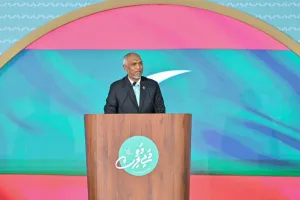
This is the trap President Muizzu has walked into. The order does not protect him. It exposes him.
The presidency draws its authority from visible composure, and from the surety that should come with the office. A head of state who is seen deploying every instrument of state power to suppress a single news story does not look strong. He looks defensive. He looks rattled. He looks smaller than the office he holds.
A confident administration would have let the story run its course. The news cycle in the Maldives is short, and public attention moves. Instead, every new escalation has handed the story another news cycle. Without the gag order, without the jailing of the journalists, without the jailing of those protesting the jailing of the journalists, there would be no politicians across the political spectrum making an utter mockery of the order, there would be no political parties mobilising their bases, there would be no Al Jazeera reporting from Malé.
As I write, the three former presidents, Nasheed, Yameen, and Solih, are preparing for a joint press conference. Three political adversaries who have spent the better part of fourteen years inflicting real political damage on one another, in one room, sharing a mic.Granted, any savvy political commentator in the country could have seen this meeting coming from miles away. This day would have come. But surely, Muizzu’s antics over the last week have brought it forward.
Maldivian presidents tend to acquire an epithet over time. Gayoom was given the name of the small sea snail that fastens to a rock and will not be prised off. Nasheed accumulated several, with “Flat Dhonbe” the most sanitary. Waheed was, and will always remain, “Baghee Waheed.” Yameen was crowned king of the small frigate tuna. I cannot help wondering if the eighth president of our republic will be remembered by a sofa that is shaped like an L.