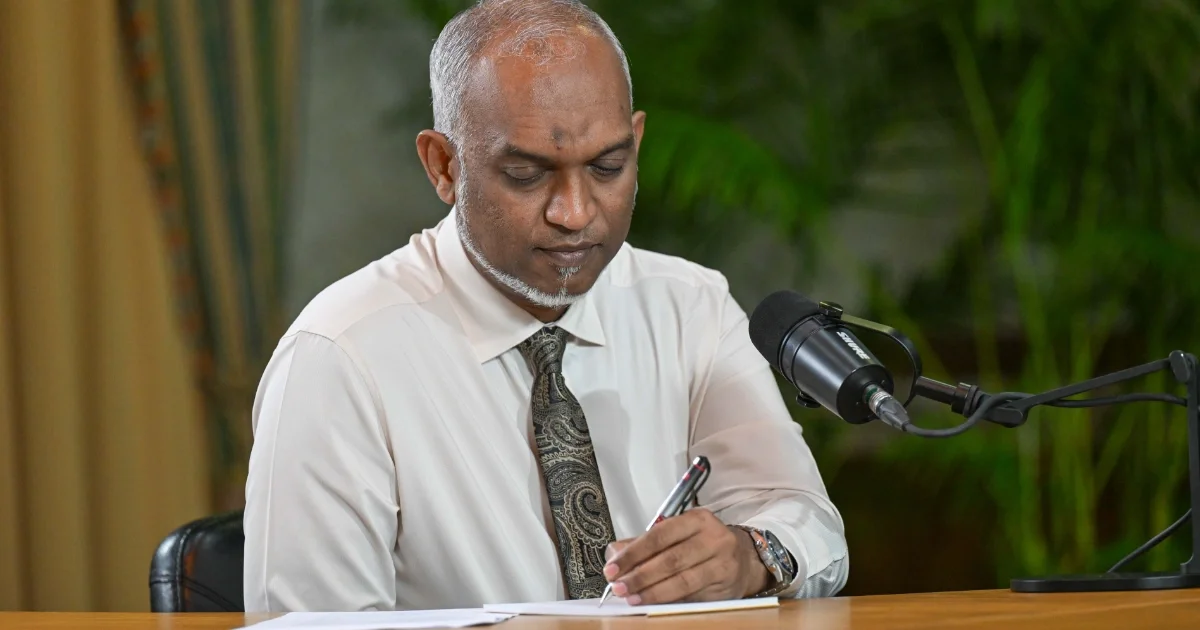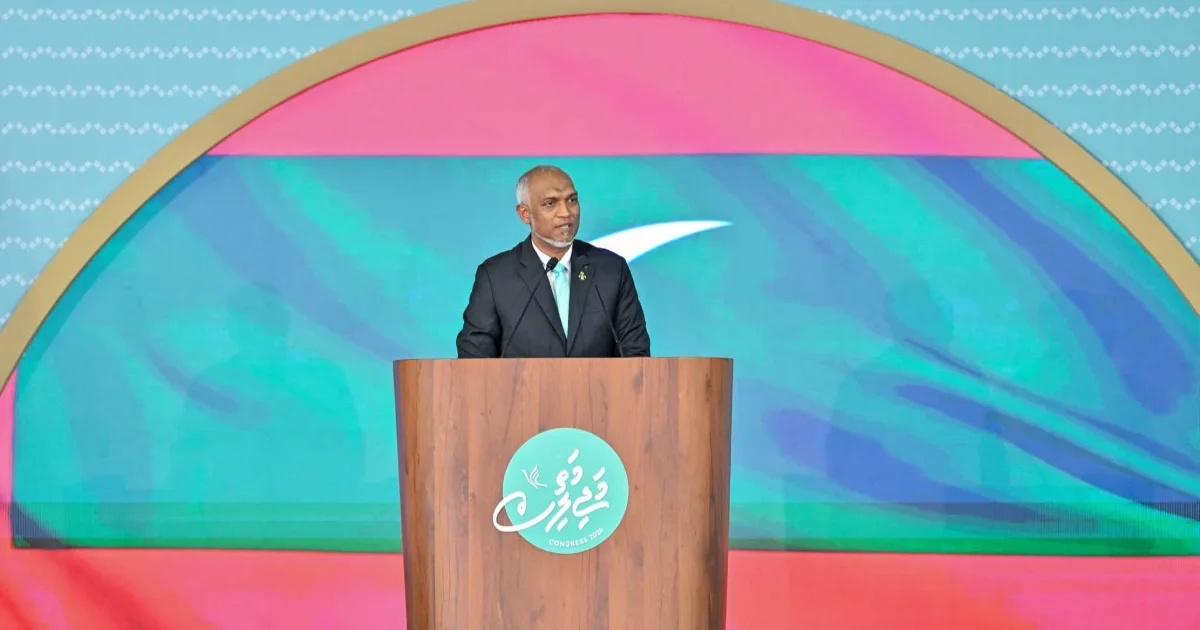
President Mohamed Muizzu stated last Friday that the government’s decision to grant a portion of Rasmalé to Eagle Hills for 99 years will not hinder housing opportunities for any citizen. Rasmalé has been described by the administration as the "total solution" to the housing crisis in the Greater Malé Region.
Speaking on PSM’s "Nation Chat" program, Muizzu emphasised that there have been no changes to the housing master plan envisioned for Rasmalé.
"The hopes of the people will be fully realized through this project. There has been no change; from day one until today, we are proceeding exactly according to that plan," Muizzu said.
"I believe we will be able to provide the [currently announced 15,000] land plots to a vast number of citizens across almost all categories, and there will still be ample space to construct flats in the designated areas."
Muizzu accused those opposing the decision to allocate half of Rasmalé to Eagle Hills of lacking a nationalistic perspective. He reiterated with confidence that the partnership would not obstruct any of the government’s planned housing projects on the reclaimed island.
"No citizen's housing prospects will be hindered. This is a project that will proceed very successfully," he added.
Despite these assurances, the government has decided to grant 500 hectares of Rasmalé’s land to Eagle Hills Developers. If this proceeds, only 510 hectares will remain for the government to fulfil its housing pledges.
Fulfilling Muizzu’s pledge requires at least 1,042 hectares
The reclamation of Fushidhiggaru lagoon—branded as Rasmalé—began on December 18, 2023, with an initial target of 1,153 hectares. However, the plan was later revised, reducing the total reclamation size to 1,010 hectares.
Rasmalé is a project managed by the Housing Development Corporation (HDC). The company’s objective was to develop 65,000 housing units to accommodate a population of 325,000 people, aligning with the current administration’s campaign promise.
"The Rasmalé project inaugurated by President Dr. Mohamed Muizzu is a robust foundation being built for future generations," stated Ibrahim Fazul, then-Managing Director of HDC, during the project’s unveiling on November 13, 2024.
"We have recently resumed this work, which aims to provide 65,000 housing units for a population of approximately 350,000."
Of these 65,000 units, the government has so far only opened applications for 15,000 land plots. On November 17, 2025, Muizzu clarified that out of the remaining 50,000 units, another 10,000 would also be land plots.
"We are issuing 15,000 plots in the first round. In total, Rasmalé will have 25,000 plots. However, Rasmalé will not consist solely of vacant plots; I announced it as a modern eco-city, and an eco-city requires land for various essential services," Muizzu explained.
"The plan includes an area for 25,000 plots, each measuring 1,250 square feet. We are opening 15,000 of those in this first phase."
Based on the President’s figures, if 25,000 of the 65,000 housing units are land plots, the remaining 40,000 units must be flats.
Calculations show that 25,000 plots of 1,250 square feet each total 31,250,000 square feet. Given that one hectare equals 107,639 square feet, providing these plots alone would require 290.32 hectares of land.
To estimate the land required for the 40,000 flats, if we assume a 60-40 ratio—24,000 three-bedroom apartments and 16,000 two-bedroom apartments—and use the sizing standards of the previous administration’s "Fahi Dhiriulhun" flats (900 sq ft for 3-bedroom and 650 sq ft for 2-bedroom units), the total floor area is significant.
Even assuming towers of 12 to 14 stories with a Floor Area Ratio of 4.0, these 40,000 units would require approximately 8,000,000 square feet of land, which converts to 74 hectares.
This means that to build 25,000 plots and 40,000 flats alone—without accounting for a single road, hospital, or school—at least 365 hectares of land are required.
Hulhumalé, one of the Maldives' most meticulously planned developments, allocates only 30% of its land for residential use. The remaining 70% is dedicated to green spaces, commercial zones, and social or industrial infrastructure.
If the 365 hectares required for housing in Rasmalé were to represent 30% of the total land (following the Hulhumalé model), a total of 1,215 hectares would be needed—exceeding the entire reclaimed area of Rasmalé.
Even if the residential allocation were increased to 35% to fit within the available space, fulfilling Muizzu’s pledge would still require 1,042 hectares of land.
No room for additional housing beyond the 15,000 plots
The 15,000 plots already announced (at 1,250 sq ft each) require 174 hectares of land.
If 500 hectares of Rasmalé are given to Eagle Hills, leaving only 510 hectares for the government, a 30% residential allocation would only provide 153 hectares.
Therefore, to accommodate even the first 15,000 plots, Rasmalé would have to be more congested than Hulhumalé. These plots could only be realised if the residential area were increased to 35% of the remaining 510 hectares (totalling 174 hectares).
In this scenario, only 65% of the land would remain for green spaces, commercial, and social use—5% less than in Hulhumalé.
Even using Hulhumalé’s current population density as a benchmark, the remaining 510 hectares of Rasmalé could only support 142,666 people. Even if pushed to the extreme congestion levels of Malé, the capacity would only reach 203,010 people.
Ultimately, the math suggests that the government’s original housing pledge for Rasmalé is impossible to achieve. Beyond the 15,000 plots already announced, there appears to be no remaining land to develop further plots or the promised 40,000 flats.