This is an English translation of Saaif Shiyad's report for Adhadhu.
Dredgers from China and Europe are operating across the inner waters of Male' Atoll with one purpose: to extract every grain of sand from the seabed of these islands formed over millions of years. Fushidhiggaru lagoon, located just 15 minutes from the capital, is rising above the water, reclaimed by sand hauled in the hulls of these dredgers. While the sand is visible, the cost of operating these dredgers remains hidden and unknown, though estimates suggest it exceeds a billion dollars.
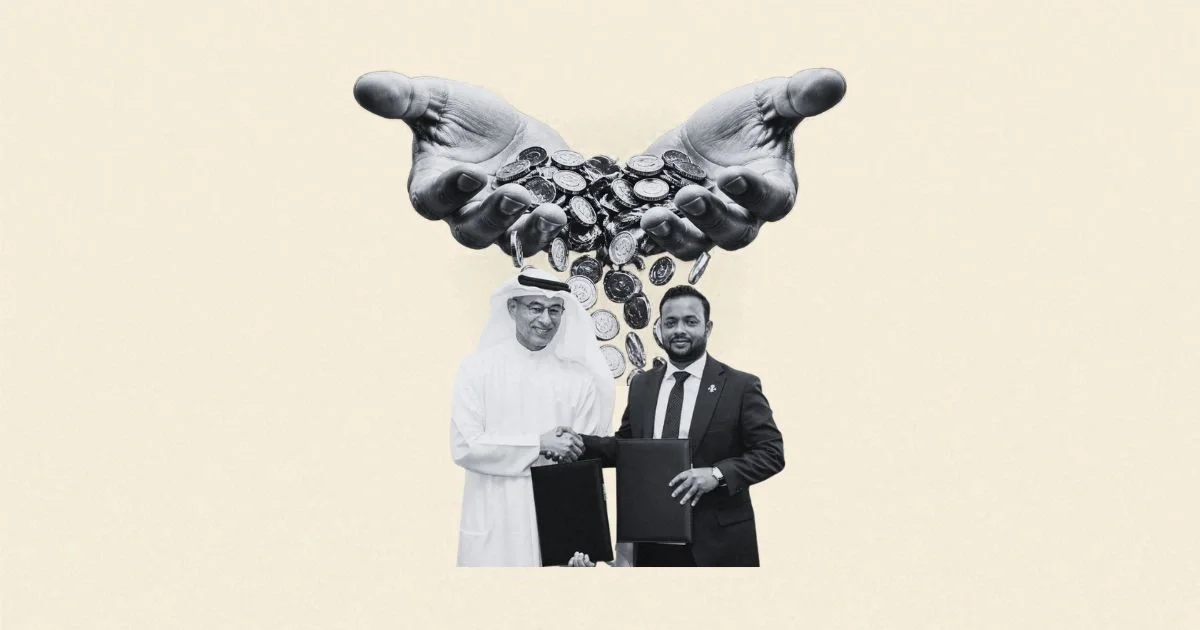
The massive lagoon, where reclamation began in November 2023, has been transformed into land, becoming the largest and most valuable real estate in the Maldives today. However, before the scent of saltwater has even faded from the reclaimed earth, half of this land has been lost to Maldivians for 99 years. Even before the soil of this city could settle, the government agreed to grant 500 hectares of Rasmale' to Dubai-based Eagle Hills.
The government claims this is a $20 billion investment, while international media reports cite it as a $12 billion project. This $8 billion discrepancy is as large as the entire GDP of the Maldives—a testament to the secrecy surrounding the project. Rather than celebrating the arrival of a major investment, many Maldivians are left with profound questions.
At what cost is this company making such a massive investment? What is the price for granting prime real estate near the nation’s main airport for 99 years without a competitive bid? What does the Maldives gain, and what does it surrender in this deal? Is the state receiving a fair price for 500 hectares of land? These are the questions that persist. Based on currently available information, this report seeks to find some answers.
What does the Maldives gain from the deal?
In September, the Maldivian government and Eagle Hills signed a Commercial Terms Agreement. This is a document outlining the primary business principles agreed upon by both parties before a detailed formal contract is signed.
Eagle Hills states that the area will be developed as an integrated model featuring international hotels, resorts, high-end branded residences, a world-class marina, waterfront boulevards, restaurants, and shops, alongside entertainment and healthcare facilities for the ultra-wealthy.
In a post on LinkedIn, Minister of Construction Abdulla Muththalib stated that in exchange for the land at Rasmale', the state would receive revenue and taxes. All services and goods sold there will be taxed at the same rates applied to resorts. The government estimates that once all phases are completed within the next 10 years, Rasmale' alone will attract one million tourists.
The Maldivian government is set to receive 10 percent of the revenue generated from the sale of properties developed by Eagle Hills in Rasmale'. Additionally, Muththalib noted that four percent would be received from every property transaction. The government estimates that $11 billion will flow into the state during the development phase, and claims the project will create 54,000 jobs.
"It is unclear whether the government's purported revenue share is calculated from gross revenue, operating income, or net profit, and whether this includes hotels, resorts, and third-party operators or just the master developer’s income. Until these details are clarified, the actual benefit of a revenue share cannot be estimated," said former Economic Minister Fayyaz Ismail in a statement expressing concern over the Rasmale' project.
The government also maintains that Eagle Hills will build 5,000 housing units in exchange for the land. These three-bedroom apartments are expected to cost around $500 million. While the government does not have to pay upfront for these flats, their cost will be deducted from the 10 percent revenue share the state is due to receive from the Rasmale' developments in the future.
What is the Maldives giving up?
Then there is the matter of the land being lost to the Maldives forever. Five hundred hectares is no small area; only two islands in the Maldives—Laamu Gan and Addu Hithadhoo—are larger than 500 hectares. Due to its proximity to the capital, the land value of Rasmale' would far exceed that of those two islands.
Since no official agency has conducted a valuation, the true value of the 500 hectares being surrendered remains unknown. Even at a conservative estimate of MVR 6,000 per square foot, the land being given away at Rasmale' is valued at MVR 322 billion, or approximately $21 billion. Including reclamation costs, this figure rises to $22 billion.
For Maldivians, the terms of the land grant are even more significant than the monetary value. The government claims the land is being leased for 99 years. However, Eagle Hills has stated that all properties in Rasmale' will be transferable and inheritable, and each time a transfer occurs, a new 99-year lease term will begin. This means if a property is sold with only two years remaining on its lease, the clock resets to 99 years—a practice that contradicts the Maldivian Constitution.
In essence, 500 hectares of Maldivian soil—an area equivalent to 700 football pitches—is being granted to a foreign entity in perpetuity. Even if the government claims the land will revert to the state after 99 years, if foreigners own the buildings on that land, the distinction of who "owns" the soil beneath them becomes practically meaningless.
Rasmale' was reclaimed under the promise of a "total housing solution" for Maldivian citizens, with assurances that not a single grain of sand would be given to foreigners. However, if 500 hectares are handed to Eagle Hills, no further housing projects can be carried out in that city beyond the 15,000 plots already announced. To achieve a "total housing solution," another lagoon would have to be reclaimed.
Had the project gone to a competitive bid, deals with better terms for the Rasmale' land could have been secured. Eagle Hills is not the only real estate company in the world.
A look at other Eagle Hills projects
Whether the Maldives is receiving its "fair share" can be gauged by comparing this to similar projects Eagle Hills has undertaken elsewhere. The company is acquiring waterfronts across Europe and Asia, developing large tracts of land in countries like Serbia, Albania, and Georgia.
| Projects | Maldives (Rasmale' Waterfront) | Serbia (Belgrade Waterfront) | Durrës Yachts & Marina (Albania), | Georgia Waterfront |
| Date signed | September 2026 (commercial terms agreement) | April 2015 | January 2023 | 2025 |
| Headline value | $20 billion - government price $12 billion - newspaper price | $3 billion | $2 billion | $6.5 billion |
| Eagle Hills investment | Not disclosed | $150 million equity + $150 million shareholder loan | Not disclosed | Not disclosed |
| Government share | Unknown | 32 percent | 32 percent | 33 percent |
| Land size | Unknown | 68 percent | 68 percent7 | 67 percent |
| Return for government | No price paid, 99 year lease | No price paid, free 99 year lease | No price has been paid, the land is government equity | No price has been paid, the land is government equity |
| Tax concession | 10 percent of income, tax, 5000 housing units | A percentage of profit | 33 percent profit of joint venture | 33 percent profit of joint venture |
| Bidding process | Government denies any concession | Many concessions | Government denies any concession | |
| Government spending | No bidding | No bidding | No bidding | No bidding |
| Contract transparency | Cost of dredging (estimate over $1 billion) | 300 million Euro | 400 million Euro | Land ownership |
| Lease terms and ownership | 99 years, with renewed 99 years with each transaction | 99 years | State land in a strategic investment fund | JV owns land, freehold allowed for foreigners |
| Residency | Corporate Residency Visa | None | None | None |
| Update | Signing final agreement | 34 out of 60 properties completed | Units unfinished, 60 million Euro earned in pre-sales | First phase, land transfer complete |
In these countries, as in the Maldives, Eagle Hills acquired large land parcels without competitive bidding. In each case, national laws and regulations were amended to facilitate the projects. Information obtained by Adhadhu suggests that several Maldivian laws will also be changed to accommodate this project.
In other nations, joint venture companies were formed between the governments and Eagle Hills to operate the waterfronts. No such company has been announced for the Rasmale' project. The Maldives appears to be the only country not receiving an equity stake in exchange for its land. Serbia, Albania, and Georgia all secured approximately one-third ownership in their respective joint ventures.
While Serbia and Albania eventually disclosed their agreements with Eagle Hills, it is unlikely this government will follow suit, given its reputation for secrecy. Both the opposition and the public are calling for the details to be made public.
"Maldivians want to know exactly what is being given away, under what principles and conditions, for how long, and what the country receives in return. If these questions remain unanswered, all the benefits of Rasmale' will go to the developer and property buyers, while future generations will bear the burden," Fayyaz said.
Comparison with other major foreign investments
The government has been pushing propaganda comparing this deal to previous agreements made by past administrations. They claim that the Nasheed administration’s GMR deal and the MDP government’s Ayla project and Fottheyo lagoon cross-subsidy deals were far more damaging than the Eagle Hills agreement.
However, the 25-year contract to manage Hulhule' Airport during the first MDP government was awarded through a transparent bidding process facilitated by the International Finance Corporation (IFC). GMR, the winning bidder, paid the Maldivian government $78 million upfront.
While opposition parties at the time alleged corruption, an investigation by the Anti-Corruption Commission (ACC) found no evidence of it. When the Waheed administration terminated the contract, the Maldives was forced to pay $271 million in compensation following arbitration. The debt incurred to pay this settlement is a primary root of the country’s current debt crisis.
In 2023, 400 hectares of the Fottheyo lagoon were leased for 99 years to Aman Resorts, one of the world's most exclusive hospitality brands. The company was permitted to reclaim only 120 hectares. The state budget received $37 million in acquisition fees—$17.5 million more than the standard formula published in the Government Gazette would have required.
Similarly, the Ayla project in Noonu Atoll, currently being developed as a township, was leased under a cross-subsidy model. The MDP government leased the lagoon after $22 million was paid into the state budget, and lease extensions were granted only after the Swiss company paid the legally required fees. It was the current administration that introduced significant tax concessions for that project.
"Resorts are also leased for 99 years, but there is a vast difference. We know Rasmale' is intended to bring in and settle foreigners as a business. A resort is leased for 99 years with an upfront acquisition cost," said lawyer Ali Hussain, who filed a case with the Supreme Court to halt the Rasmale' agreement, responding to the government's justifications.
Unlike Rasmale', these previous projects did not involve handing over land reclaimed using billions of dollars of public money for 99 years. Instead, they were projects that paid acquisition fees and continue to pay annual rent in dollars in accordance with Maldivian law. Compared to these, the Rasmale' deal cannot be described as a project that provides adequate value to the Maldives.
---
Granting 500 hectares of Rasmale' to a foreign company for 99 years is not merely an economic decision. The dredgers came from Europe and China, and the sand is being taken from Maldivian seas, but the land is going to the UAE. This is a sensitive issue directly linked to the national heritage of the Maldives, the future of housing, and the nation's sovereignty.
Even when compared to previous major investments, the weight of what is being surrendered in this deal far outweighs the benefits to the state. Unless the secrecy surrounding the agreement ends and the truth is revealed transparently to the citizens, future generations will have to pay the price for this rushed decision.
The lack of transparency in the Eagle Hills agreement and the failure to secure an equity stake—unlike the deals reached by other nations—is a grave injustice. Without a competitive bid, and without acquisition fees or guaranteed rent, the compensation promised to the Maldivian state through various accounting labels is a mere pittance compared to the true value of the land.