Hussein Fiyaz Moosa is the CEO of Adhadhu. This is an English translation of his original Dhivehi comment piece.
Shahzan from Adhadhu has become the first journalist in Maldivian history to be immediately imprisoned simply for asking the President a question. But can the truth behind his inquiry be hidden by locking him in a cell? Can that question truly be silenced?
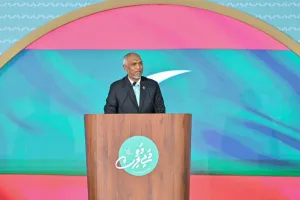
The timeline of events is telling. On May 10, the Criminal Court issued a gag order after pressing Qazf (an Islamic criminal charge of false accusation of adultery or fornication) charges against Adhadhu’s Editor, Hassan Mohamed, and me regarding the "Aisha" documentary, forbidding any direct or indirect discussion of the case. The very next day, May 11, President Muizzu held an official press conference.
While Shahzan is currently serving 15 days in prison over a question asked at that press conference, another journalist, Leevan Ali Naseer, was released on Friday after serving a 10-day sentence for reporting on the court order. Leevan is the first journalist since the adoption of the "Green Constitution" to be imprisoned for a news report.
The names of these two journalists will be written in bold in Maldivian history. Their courage and sacrifice represent a pivotal chapter in the struggle for the independence of the Fourth Estate in the Maldives.
Leevan did not leave Maafushi Prison as a defeated criminal, and neither will Shahzan. This was made clear by the messages both journalists sent from behind bars.
After initially being kept in the same cell at Maafushi Prison, Leevan was moved to solitary confinement on the fifth day. Their imprisonment was a rushed affair, carried out without providing adequate time to seek legal counsel.
For ten days, Leevan was left with only the clothes on his back. Shahzan was permitted only a single change of clothes sent by his family. Both journalists were even deprived of the basic right to make purchases available to other inmates.
These are the true heroes of free speech—those who dared to seek the truth from the highest authority in the land. We salute the bravery of Leevan and Shahzan.
Forcible Removal Over a Question: A Shameful Historic Record
During the President’s Office press conference, Shahzan questioned President Mohamed Muizzu after detailing alleged call logs suggesting the President had contacted a female staff member at late hours.
As the words of the question were uttered, the change in Muizzu’s demeanor was unmistakable.
Unable to contain his reaction, Muizzu interrupted before the question was even finished. The President, who is the subject of the allegations, took it upon himself to "judge" Shahzan, declaring the question a violation of the Criminal Court’s gag order. Without allowing a follow-up, he ordered security forces to forcibly remove Shahzan from the President’s Office.
This, too, is a record for Muizzu: the first time in Maldivian history a journalist has been forcibly removed from a government press conference. At that moment, it seemed Muizzu forgot he was in the President’s Office and acted as if he were in his private residence, Dhimyaath.
Following Shahzan’s removal, the Prosecutor General (PG) immediately forwarded the cases of Shahzan and Leevan to the Criminal Court. Summons were issued instantly. That same night, the President’s Office slammed its doors shut on all Adhadhu journalists.
The Mask of Justice Slips
Muizzu came to power promising that questions would not even be necessary because information would be disclosed freely. He promised a close relationship with the media.
However, whenever a difficult question is posed at a press conference, the response is typically irritable. The fact that Muizzu perceived Shahzan’s question as an accusation or a violation of a court order is no justification for punishing a journalist.
Presidential press conferences are not intended for the President to deliver unchallenged speeches. When the President meets the press, the most vital duty of journalists is to seek clarification on behalf of the public regarding any allegations or misconduct involving the Head of State.
Yet, faced with a serious allegation of misconduct, Muizzu bypassed any investigation and opted for immediate imprisonment. Meanwhile, no action is taken against those who have openly violated the same court order on the streets or from political podiums.
It is becoming increasingly clear that while Muizzu speaks of fairness and justice, he does not practice these values in their true sense.
Answering a question is a matter of choice. However, the inability to provide a spontaneous answer—and the decision to throw journalists into cells because their questions cause personal discomfort—is the height of authoritarianism.
If the Head of State truly loved justice and remembered his oath, Leevan and Shahzan would not be the only ones targeted. If the Prosecutor General brought them to the court’s attention for violating an order, are we to believe no one else has breached it?
President Muizzu himself, PNC Parliamentary Group Leader Falah, and former Presidents Yameen, Solih, and Nasheed have all been accused of violating court orders. Members of Parliament and political activists continue to ignore this unenforceable order daily.
Yet, only Shahuzan remains in a jail cell.
Unyielding in the Face of Intimidation
No matter how long they are held, the spirit of the Shahzan we know will not waver. Leevan’s resilience upon his release proved that he remains unbroken.
On Friday night, Leevan was on "X Spaces" sharing his prison experience. By Saturday night, he was at a protest. Today, he is back in the Adhadhu newsroom, actively practicing journalism.
I have known Leevan for over a decade. Though I have known Shahzan for fewer years, I know both are not cowards who will retreat in the face of intimidation.
Ten years ago, Leevan was arrested alongside me. If he wasn't afraid then as a youth, he certainly won't be now as an experienced professional.
Shahzan’s character is best described by his father, Ahmed Shaz, a former military officer. He said that no amount of intimidation would break his eldest son’s spirit.
His advice to his children has always been: if a bullet is to hit you on the battlefield, it must hit you from the front. If a bullet hits you in the back, it means you were shot while running away in fear.
Shahzan stood his ground with immense courage. The "bullet" Muizzu fired hit him while he was on the front lines, but it failed to defeat him.
Shahzan is one of the most sharp-witted and courageous journalists in the Maldives today, particularly noted for his passion and skill in investigative reporting.
Shahzan will emerge from prison this week stronger than ever. There is no threat that can deter him, Leevan, or the entire Adhadhu team from fulfilling their journalistic duties. They are not afraid. And Shahzan’s question will not be silenced.
--
President Mohamed Muizzu, Prosecutor General Abbas Shareef, and the judges of the Criminal Court should now realize that court sentences and prison cells cannot silence journalists or dry the ink in their pens. It is clear that such orders cannot be used to intimidate or suppress the public.