The world continues to thrive because different things co-exist and function ceaselessly. Natural systems and resources are the soul of this world while human resources and systems created by humans are its pulse. This fact has remained unchanged for thousands of years of human civilization.
These resources and systems change with time, circumstances, places and people, but without them, we cannot survive. Energy networks and the education system. Health services and food. Sewerage and water systems. Transportation and communication. Culture and customs. Public safety and human rights.
All this is accomplished with a reliable financial system. Without money, no need can be fulfilled. However fragile it is, money is the human resource that maintains the order of this world. Despite being a small island in the middle of the Indian Ocean, hundreds of miles away from any other country, the Maldives functions within the international financial system.
Imports of goods, exports of goods, imports of oil and staples, tourist arrivals, medical treatment and education overseas and so on, any money that enters the country comes through that system. Maldivians are linked to the system through the trust of international parties in Maldivian financial institutions.
But as the Police have decided to investigate a decision by the Bank of Maldives (BML) board of directors as a "financial coup", the trust in the country's biggest financial institution has gone up in smoke because of President Dr. Mohamed Muizzu. The unwavering commitment of many people over the years has been labelled a coup. This has caused irreparable damage to the bank and the country.
President's influence on the bank
The BML's decision was not unforeseen. It was an overdue decision forced on the bank. The bank cannot provide dollars they don't have. The decision made by the directors on August 21 was in accordance with Article 15 of the Banking Act.
titledesc
The names of the directors were proposed by the government and approved at the bank's annual general meeting held on May 28.
The government continued to exert influence until the decision to suspend dollar transactions from Rufiyaa accounts was reversed. The bank's CEO Karl Stumke was summoned to the President's Office and the President had a meeting with him.
Once the bank reversed the decision and made a public announcement, four ministers held a press conference at the President's Office. After spending about 40 minutes claiming that the government had not forced the bank to reverse its decision, the Economic Affairs Minister finally said the bank had decided despite direct orders from the President.
"That is not the sort of thing a minister would say at an official press conference. Officials from different levels of the state would always contact those leading government companies. But that is not the sort of thing you announce publicly," said Athif Shakoor, an economic analyst.
Under the Banking Act, the President has no role in running the bank. The word "President" occurs only twice in the act. The regulator of banks is the central bank, Maldives Monetary Authority (MMA).
"What happened is that the bank itself has created doubts that it can ensure the safety of its depositors... The bank has specifically made the statement that no matter how strong the action taken is for the betterment of the bank if the state wants something, we can change it within six hours," Athif said.
"In my opinion, this has brought a huge weakness and vulnerability to the entire financial system of Maldives. I don't think this is the sort of thing that leaders would do."
Financial coup tag
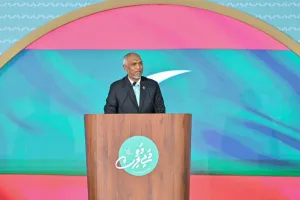
Eventually, the President himself admitted to influencing the bank.
"By talking to the directors they represent and with their support and the support of our directors, then the work that was done yesterday, our cabinet just worked nonstop since this began," the President said Monday night.
It is uncivil for the Head of State of any country to issue directives to its main bank. This is a dangerous step. A bank is a company. The directors will make the decisions. To do otherwise is to take away the credibility of the financial system.
The government then moved on to defame the bank by making serious accusations of an attempted coup against its directors, employees and the entire bank during a political rally. It might be an easy accusation, but a coup is a very serious crime with severe punishments around the world.
"What was done, anyone with common sense would know that all these dots are connected, what was done is, just as Shiyam [Minister Shiyam] also pointed out, it was an attempted coup, by whoever was behind it," President Muizzu said at the rally.
The results of the votes cast in September 2023 and April 2024 are very clear. The opposition parties are not in power at the moment. All the powers of the state were given to the People's National Congress (PNC) by the people's vote. Similarly, the majority of the bank's board will always belong to the government.
With things in this order, it was difficult for many people with common sense to connect the dots as the President suggested and accept this as an "attempted coup." The President himself associating the word coup with the national bank came as a shock to many people.
No trust in financial institutions
The government and the ruling party accused the main opposition Maldivian Democratic Party (MDP) of being a co-conspirator with the bank. The party's chairman Fayyaz Ismail said the bank's coup tag would "shatter the entire financial system of Maldives."
"A bank controlled by the head of state came out and worked with the opposition to change his government. Again, the bank is facing a big shame in the global financial system. My concern is that BML could lose its clearing bank status in the international financial system," Fayyaz said.
A clearing bank is a bank that is authorized to conduct financial transactions between different banks. BML should be a reliable institution for transactions with foreign banks, especially in a country like Maldives where there are few international banks.
Former Finance Minister Ibrahim Ameer said that the government cannot make any progress in getting foreign aid after accusing the bank of a coup.
"No one in the world will give money or invest in that way. Confidence will be lost. So money is not available. The President and his Cabinet are opening the opportunity to big companies to withdraw deposits from the Bank of Maldives," he warned.
Meanwhile, the government has decided to change the laws to solve the dollar shortage problem. The Attorney General made the announcement at the press conference after forcing BML to reverse its decision. That is not a solution, Ameer said.
"Financial difficulties cannot be overcome by changing the laws. They should do it in better ways. The financial records were last released in June. I don't know if the President and the Finance Minister are aware of the real financial situation," he said.
--
The government's financial records have not been published for nearly 70 days. During that period, big changes have been brought to the central bank. Changes have been made to allow the appointment of political employees to the boards of banks. The Bank of Maldives has become a partner in an imaginary coup. The reputation of the financial system has been tarnished in front of the world. Confidence in the banking system has been undermined. This is an irreparable loss that will become apparent years later.
This article was first produced in Dhivehi by Saaif Shiyad.