Every single Maldivian knows the meaning of 'India Out'. The ruling People's National Congress (PNC) coalition, the opposition at the time, came out against the country that had contributed most to the independence and development of the Maldives. They campaigned every day on social media and on the streets.
The main objective of the campaign, the largest in recent history against a government and against another country, was to ensure the removal of Indian military personnel from the Maldives.
The campaign which began against the military expanded to openly oppose India as a whole. Indian leaders and senior government officials were insulted and mocked. I leave it to the readers to find out if there is any link between the puppets mocking Indian leaders during last year's Eid celebration and the campaign to remove Indian soldiers.
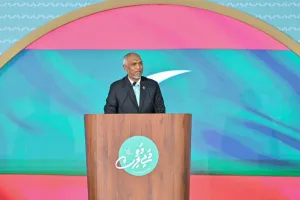
Now let's talk about today. The PNC is in power. The President is Dr. Mohamed Muizzu. Indian External Affairs Minister Dr. Subramaniam Jaishankar visited Maldives last week. On Saturday, he held talks with Maldives' government officials and the government has signed two agreements with India.
If you told a Maldivian that this would happen a year ago, they would say that these were imaginary stories. They will call against fake news. They will advise them to save the country from division. But this is the reality today. India is not out.
With power came stubbornness
This government had the opportunity to move forward with India after the events of the past five years as the opposition. President Muizzu had the option to stop verbal attacks on India. Like all other Maldivian leaders, he had the option to make his first official visit to New Delhi.
However, under President Muizzu, who won 127,000 votes with a promise to withdraw the Indian military from Maldives, his party did not change its policy to move away from India.
President Muizzu's first official visit was to Turkey. After that, he visited China, the PNC's ally and India's biggest rival. These decisions further wounded Maldives-India relations.
The President first launched verbal attacks on India at the airport after arriving from China. At the time of strained foreign relations because of three deputy ministers who insulted Indian Prime Minister Narendra Modi, the president described India as a bully.
Indian Ambassador was also present at the airport when the President said the Maldives cannot be bullied even if it is small. He continued to vow to stop "relying on any one country". This was certainly not with the intention of strengthening relations with India.
Could not remove Indian soldiers, agreed to India's offer
The President asked the Indian Minister who attended his swearing-in ceremony to withdraw the troops from Maldives. There were a total of 88 soldiers, the government said at the time. After meeting Modi on the sidelines of the COP summit, a core group of senior officials from both countries was formed to resolve the issue as the two countries wanted.
However, this did not happen as quickly as the President had hoped. The Indian army could not be expelled from Maldives. At the meetings of the core group, India proposed to keep its two helicopters and Dornier in Maldives. They offered to withdraw the troops and send employees of a government-run company under the Ministry of Defense to operate the aircraft.
It was hard to believe this would happen a year ago, but the government accepted the proposal. The government had given in to India's offer due to its inconsistent foreign and defense policy.
Former Home Minister Umar Naseer is one of the political leaders who is most critical of India's close relations with Maldives's military. He believes that India has brought the government and President Muizzu to their knees. The military is still in Maldives and the operations are ongoing, he said.
"This is the [Indian] military aircraft. It is working for Indian military purposes even now. So even now what they are doing here is carrying out operations here at the behest of the Indian military," he told Adhadhu in a talk show two months ago.
Jaishankar's visit: India still has the upper hand
The official visit of Indian External Affairs Minister Jaishankar made it clear that India determines the course of the relationship between the two countries. Maldives gave a warm welcome to India's most influential minister.
He met with the Foreign and Defense Ministers of Maldives as well as President Muizzu. In a statement, Jaishankar expressed hopes that his visit to the Maldives will "lay the foundation of bigger and better things in the days to come."
This is what the top foreign official of the "bullying" country said about the "India Out" government.
Three days later, he concluded his visit to Maldives by inspecting Indian-aided projects in two of the country's largest cities. Lastly, he visited Addu, where the Indian Army helicopter is still located. It is not clear whether he met with the civilians there to operate the helicopter.
Does the government's foreign policy lack solidity?
Under President Muizzu's "Pro Maldives" policy, he is working to overcome the country's financial situation. The government is certainly aiming to facilitate the repayment of loans with China and India.
The President said he had received China's "green signal" for this on January 13, during his visit to the country.
“When I presented the matters to the Chinese president, he immediately agreed to send a technical team to Maldives to discuss the matter with the relevant officials," he stated.
However, the team has not yet arrived in Maldives. The President also said at the Independence Day rally that China had given the "green signal".
Additional work includes seeking grants. Various delegations of ministers have travelled around the world. Ministers were sent to the South and North as well as the Middle East. The foreign minister also visited the United States.
However, just as China's "green signal" is yet to come, neither the West nor the East has provided much assistance. However, India, which this government treated as the enemy, has extended a helping hand in paying off the debt. At the government’s request, India rolled over USD 50 million in debt in May.
-
Is this the reason for the "change" in the government's foreign policy? Is India giving concessions that the Middle Eastern countries, the United States and China have not given? Or is 'India Out' a baseless, ill-intentioned political "gas" from the start?
This article was first produced in Dhivehi by Ahmed Aaidh.