This is an English translation of Aman Haleem's analysis for Adhadhu.
Credit rating agency Fitch Ratings has assigned Bank of Maldives (BML) a Long-Term Issuer Default Rating (IDR) of 'CCC-'.
In its assessment, Fitch assigned a 'CCC+' rating to BML's local-currency transactions, while noting that the bank's outlook remains "stable."
In simpler terms, the 'CCC-' rating indicates that while the bank is currently meeting its financial obligations, it could face significant challenges in the future if the Maldives' economic situation deteriorates further.
Fitch revealed that BML's rating remains constrained by the financial position of the Maldivian government. In its evaluation, Fitch assigned a Government Support Rating (GSR) of "No Support," suggesting a lack of certainty regarding state assistance in the event of a financial crisis at the bank.
The rating implies that although BML is the largest and most profitable bank in the Maldives, it cannot escape the broader economic challenges facing the country, particularly the ongoing dollar shortage.
The disparity between BML’s actual performance and its credit rating is notable, as the past year was the most successful in the bank's history. BML recorded a net profit of MVR 2.5 billion last year, with total assets growing to MVR 55.8 billion.

BML proposes MVR 55 per share
The national bank's audited financials reveal an operating profit of MVR 2.85 billion and a net profit of MVR 2.24 billion.
However, Fitch downgraded the bank's financial viability score by two notches. The primary reason cited for this downgrade was the scarcity of dollar cash flow. Fitch, along with many experts, views the fact that dollar outflows exceed inflows as the bank's greatest vulnerability.
The Big Picture: A strong bank trapped in a weak economy
The reason a high-performing bank—even by international standards—has received such a low credit rating can be understood by looking at the close link between BML, the Maldivian government, and the national economy.
Lack of government support is a major concern
Earlier this month, Fitch upgraded the Maldivian government's rating from 'CC' to 'CCC-'.
While the Ministry of Finance welcomed this as a sign of economic recovery, reports from the Maldives Monetary Authority (MMA) show that foreign currency outflows continue to significantly outweigh inflows.
Fitch raised the sovereign rating after the government settled a major debt from a Sukuk issued five years ago. To make this payment, the government utilized dollars accumulated over two years in the Sovereign Development Fund (SDF) and exhausted a significant portion of its usable foreign currency reserves.
Although the Sukuk repayment averted a default, usable reserves—which had neared USD 500 million—dropped by more than half to USD 244 million. These usable reserves include USD 97 million invested by the MMA in local banks to maintain the stability of the banking system.

Fitch upgrades Maldives to ‘CCC-’ after sukuk payment
Fitch Ratings upgraded the Maldives' credit rating to "CCC-" following the successful settlement of its sukuk obligations. While the repayment and fiscal reforms reduced immediate default risks, the agency warned that high debt and low reserves remain significant challenges for the nation's financial stability.
The government's dollar shortage means that even if BML faces a liquidity crisis, the state lacks the capacity to intervene. This reality impacted BML's overall rating, resulting in a "No Support" score regarding government backing.
Risk of loan defaults during economic shocks
BML’s financial statements indicate that the bank took on significant risks over the past year. This included the acquisition of the SME Development Finance Corporation (SDFC) and the disbursement of a record MVR 10 billion in new loans.
Following these decisions, the ratio of impaired loans (loans unlikely to be recovered) rose from 6.9 percent the previous year to 7.8 percent, while the total volume of loans issued increased by 22.8 percent.
Fitch issued a warning regarding the bank's loan portfolio, noting that large loans are concentrated in highly volatile sectors: tourism, construction, and transport.
These three industries are deeply susceptible to global shifts and market shocks. For instance, a spike in global oil prices or a decline in tourist arrivals would make it difficult for businesses in these sectors to repay their bank loans.
Will the Dollar Sukuk solve the liquidity crisis?
Fitch assigned the rating as BML prepares to issue a Sukuk on the international market.
BML management and the government have stated that funds raised from this Sukuk will not be used for government expenditure. Instead, the bank intends to use the capital to support the tourism and import sectors.
BML has reported interest from investors in the UK, Singapore, and the Middle East, which is a positive sign of confidence in the institution itself.
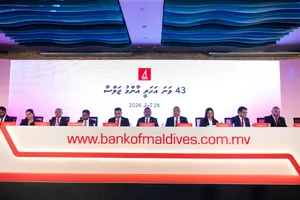
BML seeks USD 300 million in sukuk to ease liquidity crunch
Bank of Maldives is seeking to raise $300 million through its first international sukuk issuance to address a liquidity crunch and boost foreign currency circulation.
However, the Fitch rating suggests that BML will have to pay a high price for this capital. With both the bank and the country rated at 'CCC-', the message to investors is that lending to BML carries high risk.
Consequently, to attract investors, BML will likely have to offer a very high interest rate (yield). This high cost of borrowing will inevitably squeeze the bank's profit margins.
Furthermore, the dollars entering BML appear to be exiting just as quickly, driven by the cost of importing cement, steel, and heavy machinery for new resorts, as well as remittances from foreign workers.
While the Sukuk may provide a temporary reprieve for the dollar shortage, it does not address the root causes of the issue. Instead, it adds to BML's long-term external debt obligations. While the influx of new dollars may offer a brief moment of relief, a long-term solution remains elusive.