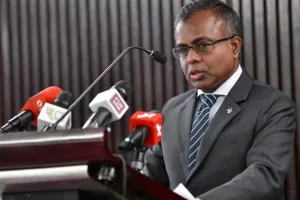
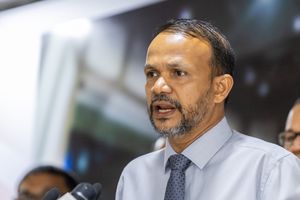
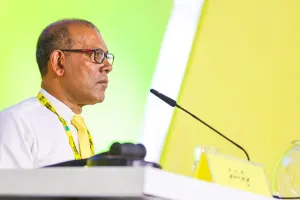
The Governor of the Maldives Monetary Authority (MMA), Ahmed Munawar, has signalled potential regulatory changes to prohibit dollar-denominated salary payments.
The move aims to curb the practice of employees exchanging foreign currency on the black market and to ensure all domestic transactions are conducted in Maldivian Rufiyaa.
Speaking at a press conference held at the President’s Office today, Munawar revealed a strategic decision to transition all financial transactions to the local currency. He noted that a significant volume of financial activity in the Maldives currently occurs in US dollars, and the central bank aims to fully implement these changes by 2030.
"Salaries are currently being paid in dollars, for instance, in companies like TMA [Trans Maldivian Airways] and across the resort sector. These dollar-based salary payments must change. This is the only way to truly increase the demand for the Maldivian Rufiyaa," Munawar said.
The Governor further noted that tourism land rent is currently paid to the government in foreign currency, identifying this as another area requiring reform. He highlighted that the current level of foreign currency usage in the Maldives exceeds 40 percent.
"Macroeconomic adjustments are necessary. Budgetary policies must also align with stabilisation efforts. Our vision is for the Maldives to eventually adopt a managed-float exchange rate system. However, to move toward a managed float, the MMA must maintain adequate reserves," Munawar explained.
The Governor also announced that additional measures are being finalized to monitor foreign currency transactions more closely.
"Currently, those earning in foreign currency can price their services and make payments in dollars. However, even if payments are made in foreign currency, we need to know how that income is being utilised," he said.
Munawar attributed the need for these measures to individuals earning in dollars and subsequently selling them on the black market for profit. During the government press conference, officials expressed strong disapproval of those engaging in such practices.
"We have observed that those receiving income in dollars are selling it on the black market. We can only effectively monitor this if we have the necessary data. This is why we are introducing these legislative amendments," Munawar added.
A significant portion of the expatriate workforce in the Maldives currently receives wages in US dollars. Additionally, many Maldivians employed in the resort sector and at various private companies are also paid in foreign currency.