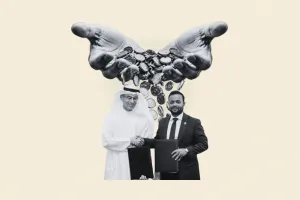
Vitaliy Lyubimov of Ukraine was the first foreign CEO of Maldives Industrial Fisheries Company Limited (MIFCO) in its 32-year history.
He was appointed as the CEO to stabilise the company, which was in crisis mode. His main task was to strengthen the company's management and make MIFCO a profitable company.
However, Vitaliy served only 84 days. On March 3, 2025, he was dismissed and the government appointed Brigadier General (retd) Farhath Shaheer as the new CEO.
During his short tenure, Vitaliy has done some important work. The most notable of these is the appointment of people to positions without yielding to political influence.
He also chose to disclose to the public when there was political influence on the process of appointing a general manager. It boosted public confidence that Vitaliy would work without political influence.
Vitaliy spoke to Adhadhu about his experience at MIFCO and the steps he took to strengthen the company. Below is a transcript of Vitaliy's interview with Adhadhu's Hassan Mohamed.
Introduction:
First of all, it is important to note that the Government of the Republic of Maldives hired me as a crisis manager with the aim of implementing reforms to stabilise and improve the company's operations, eliminating any factors of political influence and corruption.
What institutional challenges did MIFCO face when you took over the company?
At the time I assumed leadership, the company was already facing a number of problems:
- Imperfect operational business processes,
- Deficiencies in the formation and presentation of reporting,
- Operational standards and regulations that required updating,
- Weakened staff discipline.
What was the state of MIFCO when you arrived?
The company was in a critically difficult situation and urgently needed structural modernization of the management system and business processes, as well as an improvement in the moral and ethical standards regarding work attitude and employee motivation. It was very important to build a team-oriented goal-setting culture focused on cost reduction and results—profit.
What were your first steps in reforming MIFCO?
First and foremost, I conducted an audit of all key areas and company assets. Work began on implementing international corporate governance standards, simplifying and increasing transparency, digitizing some business processes, minimizing costs at all levels, and effective personnel restructuring. The main achievement was laying the foundation for sustainable change and growth in economic efficiency.
You stated that you would not allow the company to become politicized. What political challenges did you face, and how did you handle them?
As a professional and experienced manager, I relied solely on fundamental principles of successful business—professionalism, honesty, transparency, and business logic. Like many state-owned companies, MIFCO’s activities involved the influence of various interested parties. There were attempts to exert pressure on management decisions and personnel policies; however, I always acted within internal regulations and ensured open discussion of decisions at the appropriate management levels. My task was to maintain the company’s professionalism and prevent the substitution of business goals with external interests. I firmly believe that the Maldives has enormous potential to develop MIFCO into a model and even key player in the fishing industry in the Indian Ocean region, provided international management ethics standards are upheld.
Your tenure was rather short. Why?
Yes, my contract was terminated earlier than planned. This decision was made for reasons unrelated to the quality of my work and professional activities. Currently, all related matters are being reviewed by the relevant legal and administrative authorities. At the same time, I maintain respect for the Maldivian state institutions and remain open to constructive dialogue. I am convinced that my experience and business ethics can be useful to the Maldives in the future.
How significant was the political involvement in MIFCO’s activities?
A certain level of influence was present in appointments and interference in operational activities. Of course, this hindered the pace of professional and sustainable transformation; however, it did not qualitatively affect the results. Even in such a short period, I was able to simplify key business processes and, most importantly, establish an effective management structure that improved performance indicators focused on profit and cost reduction. Employees at various levels noticed and even felt the positive impact of the introduced changes on MIFCO.
MIFCO was often labeled a corrupt organization. How deep was the problem?
Corruption is a problem faced by many companies worldwide. I cannot comment on the scale, but I can say that within my mandate, I implemented maximum transparency. My goal is not criticism, but constructive development.
Conclusion:
MIFCO is a company with a unique area of activity on the global stage and enormous economic potential. By raising standards of transparency and business ethics, MIFCO can become a national pride, an efficient national enterprise, and an instrument for growing the country’s economic indicators, provided acceptable conditions for professional management are met