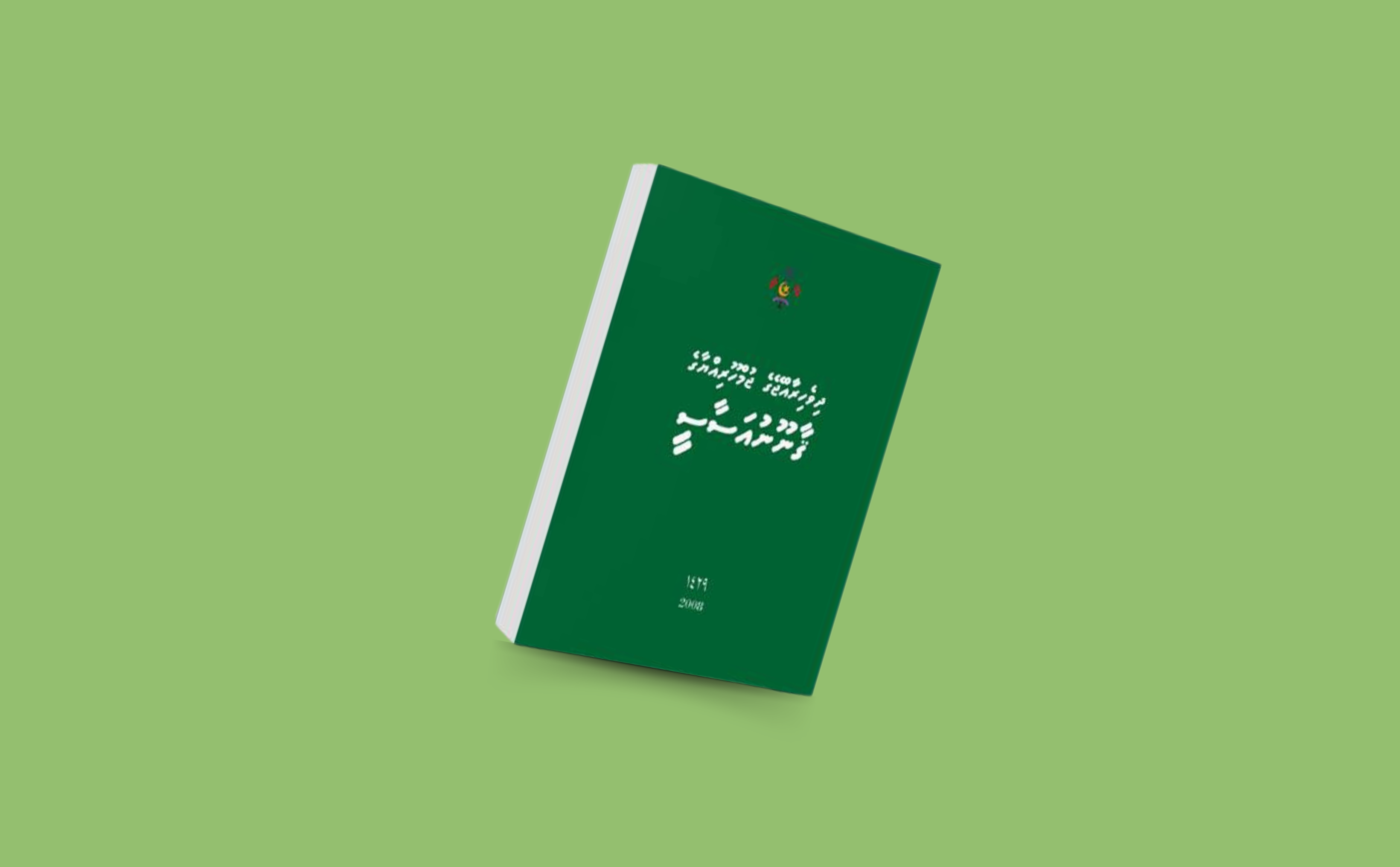
The formulation of the Constitution would undoubtedly constitute the most important and intricate work that has been done within the Maldivian legal system, so far in this century. Prior to the current Constitution, we were bound by the Constitution of 1997 which came into force from 1st January 1998. This was a massive project initiated by the Government back in the day under the pretext of leading the country towards a modern democracy. Regardless, that Constitution which took 17 years into its formation had become unfitting and old within a mere span of 5 years into its existence.
The work for the formulation of the Constitution was initiated as a consequence of calls for reforms through political activism by the opposition. The changes that the majority of the people wish to see would have only seen the light of the day, if such changes had a legal guarantee and such protection could only be afforded by amending the existing Constitution. In light of the increasing internal and external pressures, the Government at the time was forced to commence work on amending the Constitution.
As we mark the 16th anniversary of the current Constitution, this article intends to look at some essential information relating to the work that underwent the formulation of the Constitution.
Announcing the Election of the Special Majlis
The first step following the announcement of commencing the works to formulate a Constitution was to convene a special majlis. According to Article 93 of the Constitution in place at the time, the special majlis were to be convened when the President or the Parliament (Rayyinthunge Majlis) so sees fit, at the order of the President. Hence it was the President, in the exercise of his powers derived from the said provision that decided to convene this majlis. The election for electing members to the Special Majlis was held on 28 May 2004.
Membership roll in the Special Majlis
The Special Majlis that was at the forefront of compiling the current Constitution was composed of 113 members, including 42 elected members of the Parliament, 42 members who were elected to the Special Majlis, 16 members who were appointed by the President for both the Parliament and the special Majlis and 13 cabinet ministers.
The first sitting of the Special Majlis and the Speakership
The first sitting of the Special Majlis took place at 09:00 am on 19 July 2004, with 100 out of the members of the Special Majlis in attendance. The morning session of this sitting was chaired by the temporary speaker of the special majlis, the member of the President, Mr. Abdullah Hameed. The number one item on the agenda was the commencement of the sitting. The words used by the Speaker in inaugurating the sitting were “this sitting is being commenced with offering sincere respect from the bottom of my heart to all honorable members of the special majlis.”
The subsequent item on the agenda was proclaiming the letter sent by the President to the Majlis to convene the Special Majlis. This letter was read out by the Secretary General of the People’s Majlis, Al Usthaz Mohamed Nasheed.
Electing a speaker for the Special Majlis was item number three on the agenda. Before opening up to the floor for submitting nominations for the position, the chair first announced that the vote shall be taken by a show of hands (poll). This proposition was vigorously opposed by the newly elected members to the Special Majlis. With the escalation of this debate, the chair decided to take a vote on the manner of voting itself. Mr. Ahmed Nazim, member for Meemu Atoll proposed to opt for an open vote, which was seconded by Mr. Abdullah Yameen, member for Noonu Atoll. When a vote was called upon this proposition, 69 members voted in its favour and 15 members voted against it. A total of 84 members participated in the vote. Two names were nominated for the position of speakership consisting of Mr. Qasim Ibrahim, member for North Ari Atoll and Mr. Abbas Ibrahim, member for North Huvadhoo Atoll. Votes were called in for these two nominations separately. While Qasim Ibrahim obtained 5 votes in favour and 79 against him, Abbas Ibrahim got 71 votes in favour and 13 votes against him. Accordingly, Abbas Ibrahim was elected Speaker of the Special Majlis assembled to compile the Constitution.
Composing the Drafting Committee
Since the convening of the Special Majlis, about one and a half years lapsed without any constructive work being done on objective for which this Majlis was established. Much of this time was spent on works facilitating the Majlis sittings to be opened up to public, broadcasting of these sittings and formulating the Parliamentary procedures and rules. At the time, a model paper titled “Model Constitution” had already been submitted to the Special Majlis. However, opposition to this paper on the basis of it allegedly being a conspiracy to deviate the work of the compilation of the Constitution according to the whims of the Government, the members proposed to establish a Drafting Committee among members of the Majlis. It was also decided to appoint an international expert to assist the Committee. In this regard, with the assistance from UNDP, the Canadian national Professor Schmeiser was appointed to the task.
The first session of the Drafting Committee took place on 18 January 2006, nearly one and a half years after its establishment. Professionals who were appointed to assist the Committee were Al Usthaza Dheena Hussain, Al Usthaz Hassan Latheef and Al Usthaz Ahmed Abdullah Afeef.
Number of sessions of the Drafting Committee
A total of 219 sessions are recorded to have taken place in respect of the works of the Drafting Committee, the latest of which was held on 16 June 2008.
Number of sittings of the Special Majlis
The Special Majlis conducted a total of 272 sittings. The last of these sittings took place on 26 June 2008.
Vote on Passing the Constitution
Even at its inception, there has been a prolonged delay in commencing the work of drafting the Constitution. Notwithstanding that the establishment of the Drafting Committee dragged on amidst the political chaos and the bureaucracies for about one and a half years, once established, the Drafting Committee was steadfast in its work. In spite of this steadiness, there were concerns that the Constitution could not be completed prior to the date of the Presidential Election. In order to curtail this and speed up the process, Mr. Ibrahim Ismail, Member for Male’ proposed that each chapter of the Constitution that is debated and passed upon is sent to the Majlis floor for a vote as it finishes. Before this proposition was passed, the procedure was for the whole Constitution to be debated on the floor after it had been fully drafted.
The vote for the passing of the Constitution was carried out on 26 June 2006 on the last sitting of the Majlis. By this time, most of the chapters of the Constitution had already been voted upon and passed. On this day, the first vote was taken regarding amending certain typographical errors that were identified in the Constitution. 73 members voted in favour of this amendment, as per the advice from the professionals. 93 members were in attendance at this sitting. The next vote was called in to pass the Constitution with the inclusion of certain amendments to words or expressions used.
This was followed by the final vote to pass the Constitution with all of the above changes. 67 members out of the 94 members present at the time voted in favour of passing the Constitution. 5 members abstained from the vote and 15 members voted against passing the Constitution. Afterwards in this sitting, it was also decided to send the Constitution for ratification by the President.
Ratification of the Constitution
Massive protests erupted in Male’ in the month of July 2008 on the basis of rumors that the President had plans to refer the Constitution back to the Majlis, without ratifying it. All the while, continuous protests took place near Theemuge and the President’s Office, yet there was no comment from the Government on the reasons for the delay in ratifying the Constitution. Eventually, the President signed the decree to ratify the Constitution on 7 August 2008.
Salaries of members of the People’s Special Majlis
A member of the People’s Special Majlis was paid a salary of 7000 Maldivian Rufiyaa at the time and there was no additional allowances allocated. However, members of the Special Majlis who also served as a member of the Parliament or the Cabinet were entitled to salaries for both positions.
Amendments to the Constitution
Since its enactment, the current Constitution has been amended 6 times thus far.
- First Amendment –Amended the criteria for Presidential Candidate, limiting the age group of Presidential candidate for the age group between 30 years to 65 years (25 June 2015)
- Second Amendment –Introduced Chapter 15 to the Constitution containing rules on leasing out land on freehold basis to foreigners (23 July 2015)
- Third Amendment –Annulled the maximum age limitation on Presidential candidate and amended the criteria to allow for any person above the age of 35 years or above as qualified to contest as a Presidential candidate (3 December 2018)
- Fourth Amendment –Reintroduced the provision affirming that no part of the Maldivian Land could be owned by foreigners and stipulated that no land could be leased to a foreigner for a period longer than 99 years and annulled the Chapter 15 that was introduced by the Second Amendment to the Constitution (23 April 2019)
- Fifth Amendment –Detailed the provisions pertaining to the composition of the local councils under the Decentralization chapter and increased the tenure of the local councils from a three year term to a five year term (8 December 2019)
- First Amendment to the Fifth Amendment –Provided for automatic extension of the tenure of the existing local councils elected in 2017, if the election was unable to be held upon the expiration of the existing tenure. This amendment was introduced as a result of the difficulty to hold the local council election due to the national health emergency due to the Covid19 Pandemic (2 June 2020)
Some notable facts
- No single sitting of the Special Majlis took place with all of its members in attendance
- A total of 1469 days were spent on formulating and passing the Constitution. This is equivalent to 4 years and 8 days.
- The preceding Constitution was formulated within a period of 17 years. The Special Majlis to formulate that Constitution was convened on 29 November 1980. The Constitution was sent for its ratification on 6 November 1997. Between those two dates, that is a period of 16 years, 11 months and 9 days.
- The speeches and statements made by members in the Drafting Committee have not been recorded in verbatim, due to which it is unclear or difficult to decipher the intentions of the framers as to inclusion of certain provisions. Irrespective of this, the members had also voted to pass the minutes of the Majlis, although the records of the speeches had not been penned down in the minutes.
- The members who were appointed by the President were shuffled twice.
- The majority of the Majlis that compiled the Constitution were with the Government at the time. However, the majority of the changes to the Constitution were passed as desired by the opposition. This was allied to the leeway employed by the academics from the Government’s side and also because the citizens were closely observing the entire process.
While the current Constitution marks 16 years into its life, today once again there are talks of amending or revisiting the Constitution. Changes are indeed the most unavoidable reality of the natural world order. Good changes that cater to the changing times should always be accommodated and yet, if amending the Constitution is a procedure that repeats its course every 5 years, there would be a complete loss of confidence in the Constitutional governance and its supremacy.
This article was first produced in Dhivehi by Mahfooz Saeed and translated into English by Aishath Sheena.