

Dr. Henry Throop is a Program Scientist in the Planetary Science Division at NASA. His research focuses on the outer solar system and he has published over 40 articles in scientific journals, on topics ranging from planetary rings, to planet and star formation, to astrobiology and the origins of life, to searching for (and co-discovering) Pluto's smallest moon, Styx, in 2012.
Throop is an expert in the analysis and modeling of planetary rings, including the dusty rings of Jupiter and Saturn, and searches for rings at Pluto and Arrokoth. Throop was a member of the science team for NASA’s New Horizons mission, and was involved in its historic encounters with Pluto in 2015 and MU69 Arrokoth in 2019.
Throop visited the Maldives on the invitation of the U.S. Embassy Male’ for a series of Astronomy programs at Hulhumale, Male’ and Kaafu Huraa. He sat down for a conversation with Adhadhu, to speak about his work, the sessions in Maldives and other interesting topics.
1. Was there anything at an early age that nudged or pointed you toward an interest in science?
I've always enjoyed science, taking things apart and rebuilding them. I remember going outside and looking up at the Orion constellation with my mom. I wasn't that much into astronomy, but then I got into astronomy. During university and during post-graduate, I really ended up enjoying it a lot.
2. What pushed you towards choosing this career?
So when I was in secondary school, I had a physics teacher who was just fantastic. He really made us appreciate and see the physics in everything around us. I thought, man, you can see, physics everywhere, physics is everywhere. So I enjoyed that, I studied physics as an undergrad in university. And I was looking for what to do afterwards. I was looking at graduate programs in astronomy and it seemed like a fascinating world. And I entered a postgraduate program to get my MSc and PhD. From there it was just such a pleasure to be involved in the field.
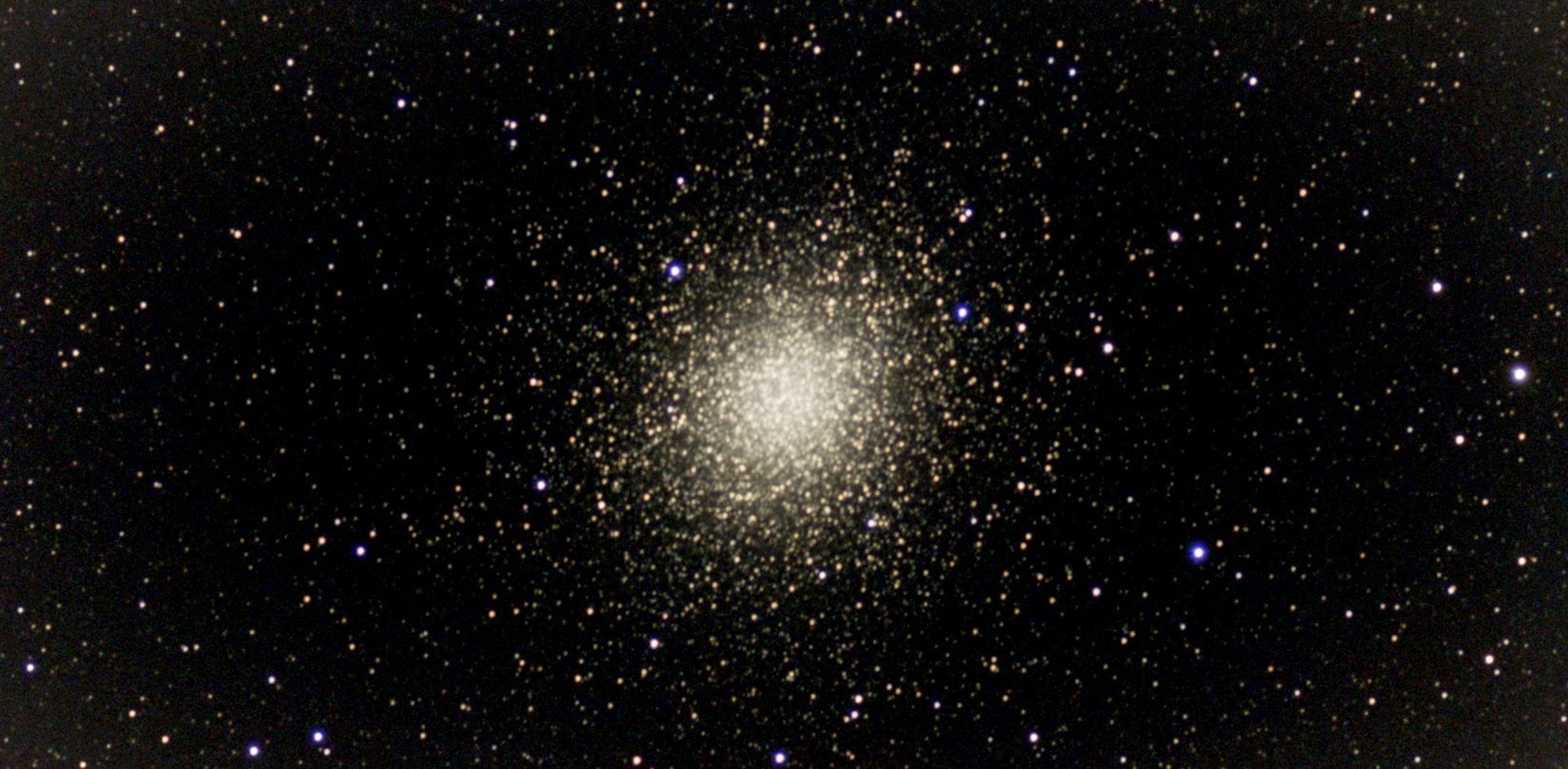
A cluster of stars.
3. What do you like best and least about your job?
What I like most about it is that astronomers get to explore the world around us and contribute to the advance of knowledge. If you look back 400 years ago, we didn't know much about the universe around us. We didn't know what the planets were, we didn't know what the stars were. We didn't know how the sun and the moon and the earth and everything interacted. And now, through the hundreds of years of, thousands of people, over this time working together we really have an understanding of the structure of the universe and how things work in the universe.
4. Tell us about your visit to Maldives. How was the reaction during your sessions so far?
It's been so exciting to be here in the Maldives. I have visited a number of schools. I have done some community programs. I have visited one of the islands. And the reaction is always quite exciting to hear what NASA is doing. I'm excited to talk about the various NASA projects. And then, we've also been taking telescopes around. We've been looking at the sun. Because we've been doing this during the day. The sun is the closest star to us and really is one of the coolest things in the sky to look at whether it's daytime or it's nighttime. The sun is, out of all the objects in the sky, the sun is one of the most interesting and dynamic and constantly changing. So that's been really fun to do with the students and the community members.
5. What are some of the most common questions you face from enthusiasts?
Well, one of the most common questions I get as an astronomer is what I think about aliens and what I think about life in the universe. And that's actually the subject of a lot of the research NASA is doing, are we alone in the universe? Is there life elsewhere? Either in the solar system or beyond the solar system. And so that's a question which I was asked so many times this week. It's something I addressed in a bunch of the talks that we gave. Also, talks about the various projects that NASA and other international space agencies are doing to explore the origin of life and see if there is life beyond the Earth, beyond the solar system elsewhere in the universe.
6.. What are some of the major unknowns that astrophysicists are trying to solve?
I think that for me, the biggest question really is, Is life unique in the universe? Are we the only ones here? Or is there life elsewhere in the universe? We have very huge questions involving the origin of the universe, but we are starting to put all this together. The more we see, the more we have unknown questions, both with the origins of the universe. The biggest question for me really is that, whether we are alone in the universe or whether there is life in our solar system and whether there is life outside our solar system. And so, a lot of the projects which NASA is working on either directly or indirectly are addressing that big question.
7. In your opinion, what is the likelihood of finding life on another planet?
To me, you look at the size of the universe and just in our galaxy here, the Milky Way galaxy, we have about a hundred billion stars. That's a one with eleven zeros after it. And then, in the rest of the universe, you have a hundred billion galaxies, the galaxies are those spiral-shaped clusters of stars. And maybe each star may have ten planets around it. So you multiply this all together and you have this huge number. It's actually a one with 23 zeros after it. That many planets are in the universe. And I think, just statistically, the odds have got to be that there is probably life somewhere out there among all those stars in the universe.
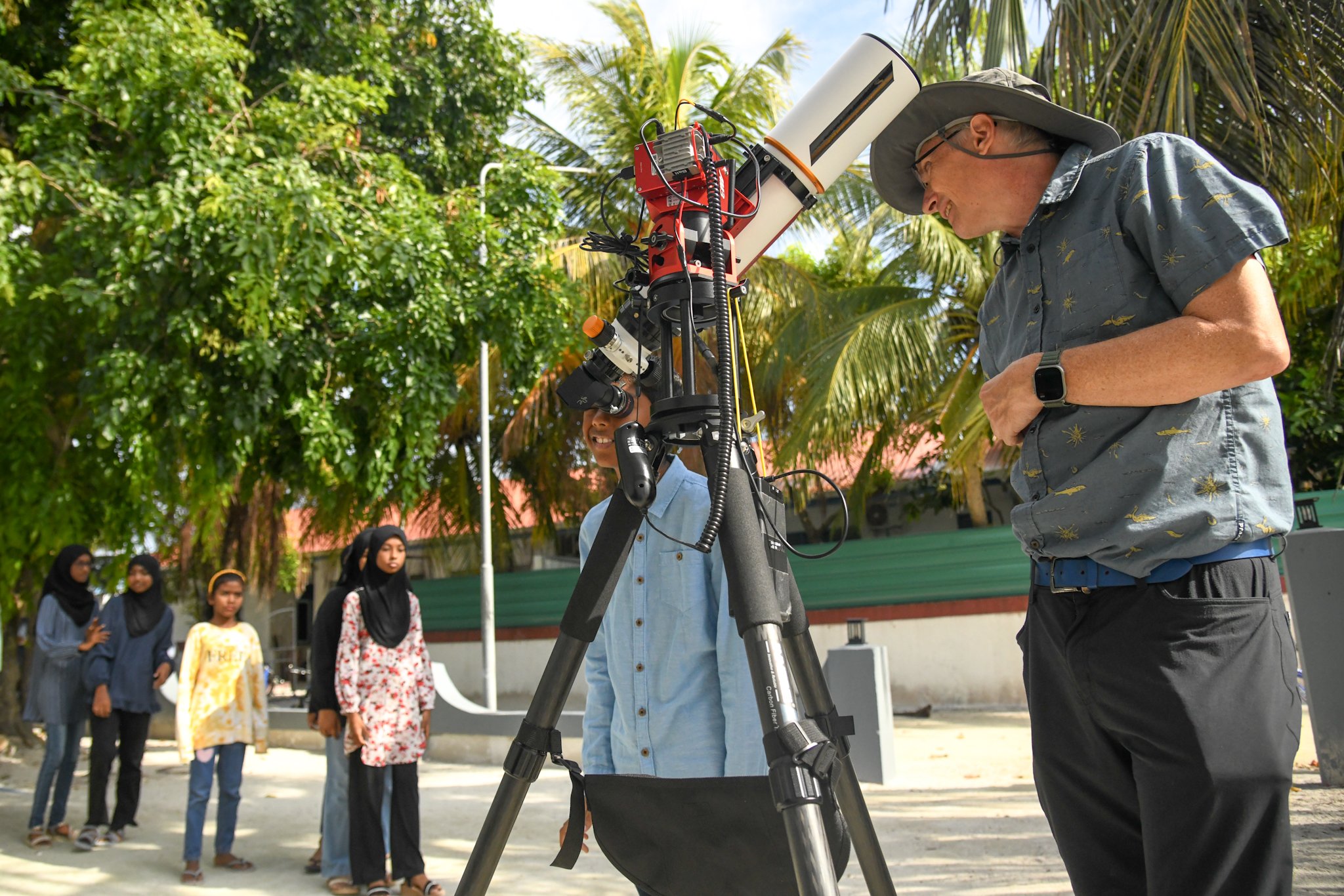
Dr. Throop during a community program.
8. What is the most Earth-like planet we have found?
So, you can answer that in our solar system and beyond our solar system. In our solar system, basically what we are looking for is, I mean the Earth is very unique. The earth is kind of at this balance point. It's not too hot because it's not too close to the sun and it's not too cold so it's not too far from the sun. We are at the perfect balance point where we have all this liquid water. Liquid water is great for life. And as we move further out in the solar system, it gets a little bit colder. There may be some places like some of the moons of Jupiter and Saturn where there are environments where life could be, could exist as well. We are looking at that. Out beyond the solar system, in other planetary systems, there are so many other planets. Now, we can't see them as well, nearly as well as the planets in our solar system. Because of this, we have to use telescopes and we can't visit them with a spacecraft. But there are hundreds of thousands of other planets out there. Many of them have similar temperatures and similar compositions from what we can see on many parts of the earth.
9. How can astronomy improve life on Earth?
That's a great question. So NASA studies essentially everything in the universe. We study the large-scale structure of the universe, We study the stars and the Milky Way galaxy down to the solar system, down to the sun, and the moon and also the Earth itself. NASA doesn't study below the Earth and the interior of the Earth as much, but NASA has a number of satellites for just studying the atmosphere and the oceans of Earth. One of NASA's roles is to make all this data available, all free for anybody on the Earth who wants to download it and study it. There are many people who are looking at the NASA satellite data about global warming, climate change and sea level rise, and can use that in setting public policy, understanding the changes and the changes that we need to make as humans to counteract climate change.
10. Now, let's talk about the New Horizon mission. How would you describe your role in the mission?
So I was one of the science team members on this mission and there are many, many different roles that all of us did. The New Horizons mission was a NASA mission that launched in 2006. From the Earth, it took nine years to get to Pluto. Pluto is the largest unexplored body in our solar system. And then it kept on going, after 2015 and it's still cruising outward and exploring the outer reaches of the solar system. So I was involved in many of the investigations. I was looking at rings and dust at Pluto and at Arrokoth, which is a little baby planet, planetesimal that we look at out beyond Pluto.
11. What are the most recent interesting developments from the mission?
With the New Horizons mission, it went past Pluto in 2015. And then continued outward into the outer solar system. With every NASA mission, if it's returning good science, we want to keep that science coming back to Earth. There are no more planets out there right now. But there are some small Kuiper Belt objects that we are studying. And most importantly, it's actually studying the sun. We can study the solar wind, we can study the magnetic fields in the sun, we can study the particles that are coming out of the sun and we can see how all that interact with the environment of space, and that may be the most interesting thing the New Horizons mission is now doing.
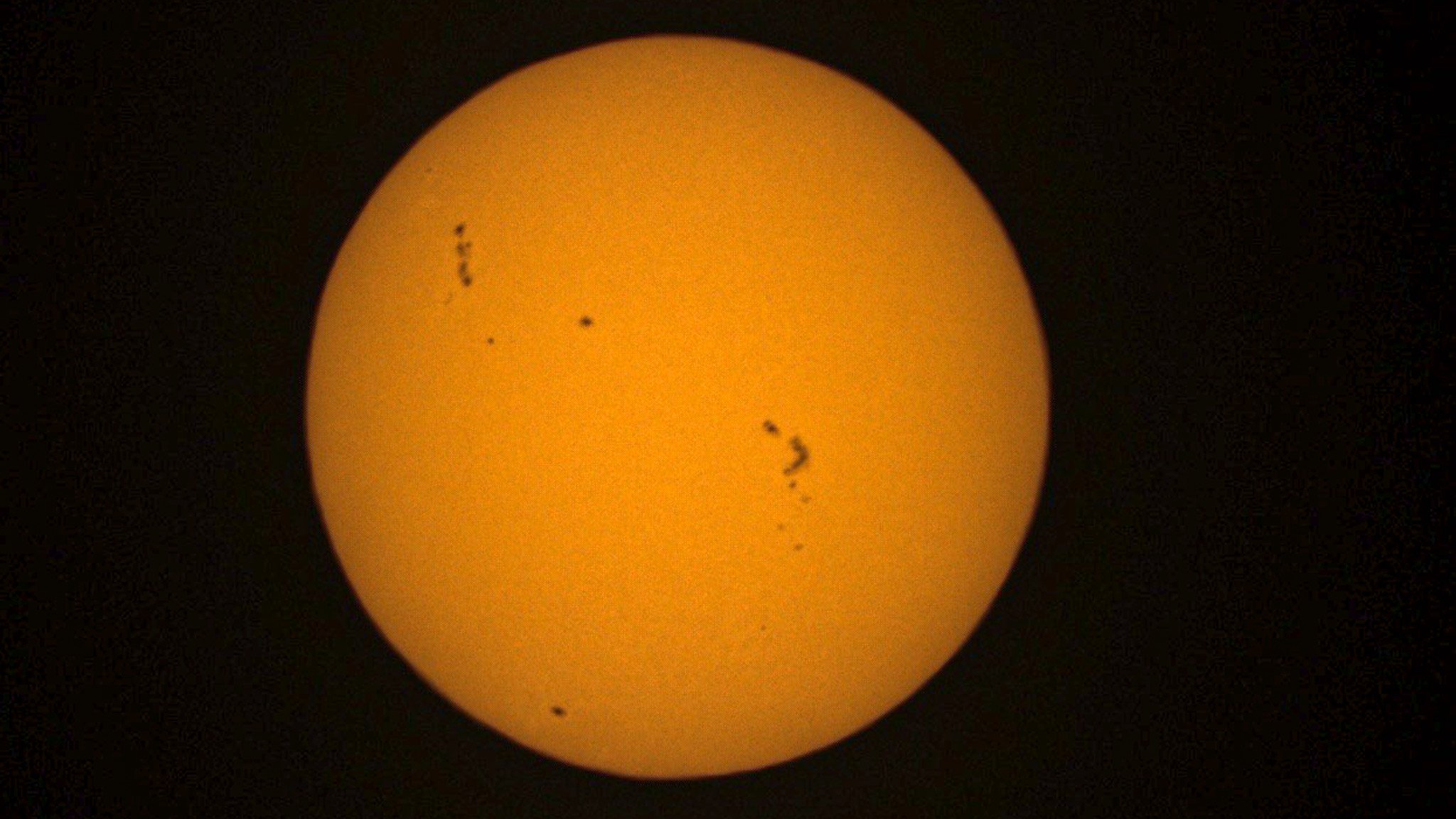
The sun seen from a telescope.
12. Would Pluto be your favorite planet?
Go, Pluto! You know, what's great about Pluto is that 20 years ago the best picture you could take of Pluto was from the Hubble space telescope, but it was one pixel across. But now with the New Horizons mission, we just have a revolutionary new understanding of Pluto. We've got these images that are really thousands of pixels across. And what we have found is that Pluto is not this small dead icy world. But, it's so geologically active. We've got volcanoes of ice going off on it. You've got these tall four kilometres of ice which are taller than many other mountains that are in many other planets that are in our solar system. We've got these regions with a bunch of organic molecules. Not meaning life, but meaning some chemicals like hydrogen and carbon that go into life, but not life itself. So we've got these organic molecules over here, we've got these vast seas, essentially of frozen nitrogen, an atmosphere which is really dynamic, constantly changing, so it's such an exciting place. I mean it's got to be the best planet out there.
13. Can you tell us about your experience in the discovery of Styx?
So I was part of the team that discovered Styx. There were about ten of us on the team. We used the Hubble space telescope and we actually looked for something else. We were looking for rings of dust around Pluto. We wanted to search for those because we wanted to make sure that the path the New Horizons spacecraft was taking past Pluto was going to be safe. Because of the speed that we were going, even flying through a cloud of dust could be dangerous for the spacecraft. And, when these images came down, then the team looked at them, and one of the team members saw the image of the new satellite on it and that was the discovery of Styx which is the fifth moon going around Pluto.
14. What advice would you give to a student with a keen interest in astrophysics and cosmology?
The advice I would give to students is if you have something which really drives you, keep at it. Study what you can in school and go to university. Whether you are studying physics, whether you are studying chemistry, astronomy or biology, whatever it is, if you have that thing that really drives you, go for it. And then once you get to university look at postgraduate programs if you are still interested and passionate about it and want to contribute to the research that is happening. There are many postgraduate programs in the US, where you can get an MSc or PhD. In many cases, in areas of astronomy and physics, the US government will pay for your postgraduate studies because education is so important to the US and NASA, educating students so we can have a growing number of academically trained astronomers, astrophysicists and scientists in the world.
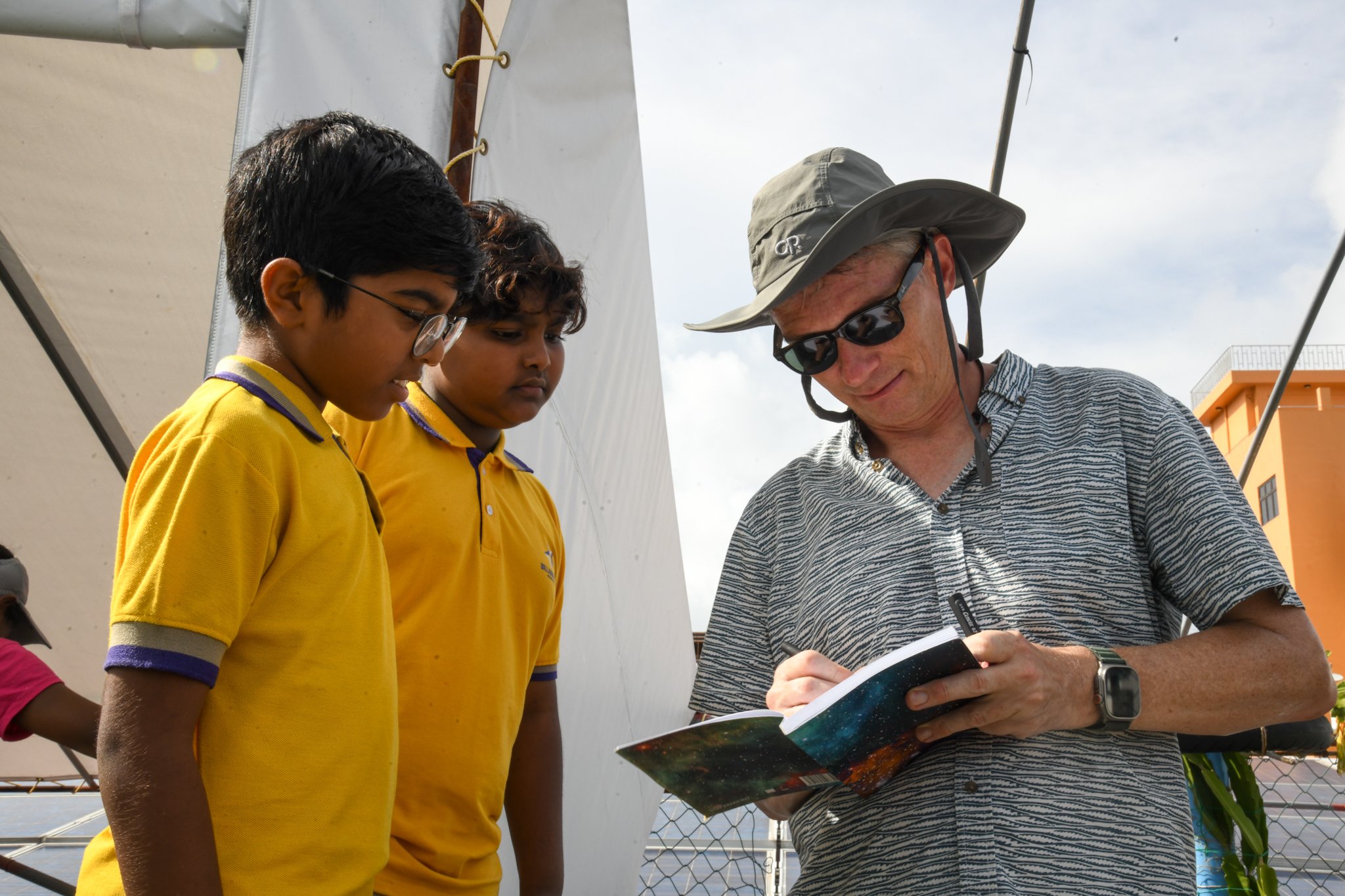
Dr. Throop with Maldivian students.
15. How do you see the future of this field for the Maldives?
There are so many students who came out to me and said I really want to be an aerospace engineer or I really want to be an astrophysicist or I want to be an astronaut. And it is so many students in Maldives who resonate with it. It was just, probably more than anywhere else that I've talked of it. I know that those kids are telling the truth and I know so many of them are going to end up being able to do that. And it's exciting to see that, it's really great.
15. Who inspires you?
I'm inspired by people who are curious. People who are curious and ask questions and go off and answer those questions. That's how we contribute to the state of knowledge in the world increasing. I think it's fantastic. You look at what we had four hundred years ago or a thousand years ago. Our understanding of how the world worked, but you compare that with now and we are advancing in our knowledge of just understanding the physics in the world and astronomy and the structure of the universe so strongly that it's all due to individuals who are curious and trying to answer those questions about the world around us.