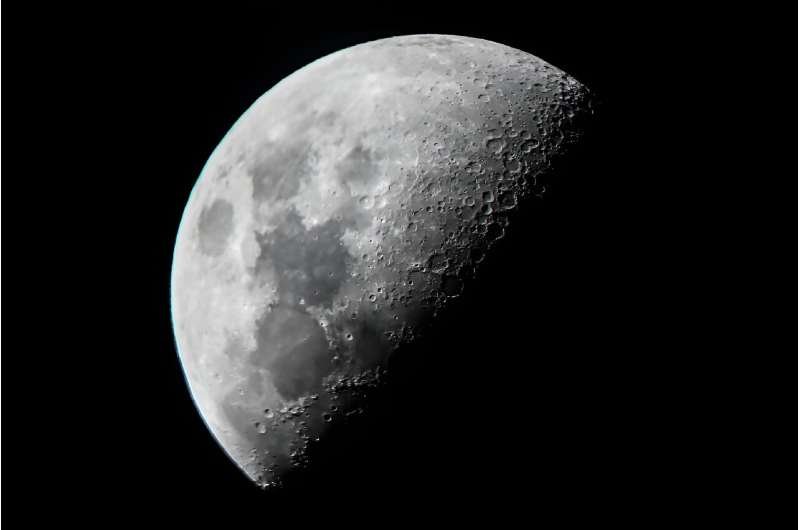
Paris, France (August 20) - The crash landing on the Moon of Russia's Luna-25 probe is the latest twist in an international push to return to the Earth's natural satellite that has drawn in the world's top powers and new players.
Technology, science and politics are all essential factors in the Moon race.
Here is the latest on various missions:
Russia's Luna
The launch of Luna-25 on August 11 was the first such Russian mission in almost 50 years and marked the beginning of Moscow's new lunar project.
On August 16 the lander was successfully placed in the Moon's orbit but on Sunday, space agency Roscomos announced it had "ceased to exist following a collision with the Moon's surface".
"Measures taken on August 19 and 20 to locate the craft and make contact with it were unsuccessful," the agency added.
It had been set to land on the Moon's surface on Monday and remain there for one year to collect samples and analyze soil.
Russian President Vladimir Putin has been working to strengthen space cooperation with China after ties with the West broke down following the start of Moscow's invasion of Ukraine in 2022.
Moscow had hoped to build on the legacy of the Soviet-era Luna program, marking a return to independent lunar exploration in the face of financial troubles and corruption scandals at its space program and growing isolation from the West.
China's great leap
China is pursuing plans to send a crewed mission to the Moon by 2030 and build a base there.
The world's second-largest economy has invested billions of dollars in its military-run space program in a push to catch up with the United States and Russia.
China was the third country to place humans in orbit in 2003 and its Tiangong rocket is the crown jewel of its space program, which has also landed rovers on Mars and the Moon.
The unmanned Chang'e-4 rocket landed on the far side of the Moon in 2019. Another robot mission to the near side raised the Chinese flag there in 2020.
That Moon landing brought rock and soil samples back to Earth, the first time that has been done in more than four decades.
NASA's Artemis
NASA's Artemis 3 mission is set to return humans to the Moon in 2025, including its first woman and first non-white astronaut.
Under the Artemis program, NASA is planning a series of missions of increasing complexity to return to the Moon and build up a sustained presence so it can develop and test technologies for an eventual journey to Mars.
Artemis 1 flew an uncrewed spacecraft around the Moon in 2022.
Artemis 2, planned for November 2024, will do the same with crew on board.
NASA sees the Moon as a pitstop for missions to Mars and has done a deal with Finnish mobile firm Nokia to set up a 4G network there.
However it has said the Artemis 3 mission may not land humans on the Moon. That will depend on whether certain key elements, including the landing system developed by SpaceX, are ready.
Elon Musk's firm SpaceX won the contract for a landing system based on a version of its prototype Starship rocket, which remains far from ready.
An orbital test flight of the uncrewed Starship ended in a dramatic explosion in April.
New players
Recent technological progress has reduced the cost of space missions and opened the way for new players in the public and private sector to get involved.
India's latest, Chandrayaan-3, entered the Moon's orbit earlier in August. It will carry out India's second attempted lunar landing later this month.
But getting to the Moon is not an easy task. Israeli non-profit organization SpaceIL launched its Beresheet lunar lander in 2019 but it crashed.
And in April this year Japan's ispace was the latest company to try, and fail, at the historic bid to put a private lunar lander on the Moon.
Two US companies, Astrobotic and Intuitive Machines, are set to try later in the year.
This story was produced by AFP.