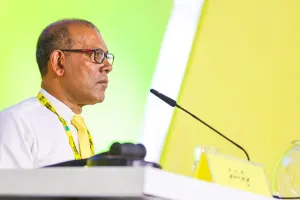
Former Pension Office Chairman Ahmed Inaz has criticized the government, stating that authoritarian policies will not resolve the ongoing dollar shortage.
Inaz’s criticism follows reports that the government is seeking to amend laws to prohibit media coverage of rising dollar rates and to penalize businesses selling foreign currency above the official exchange rate.
In a post on X on Wednesday, Inaz argued that foreign exchange trading is a market-driven economic activity that cannot be controlled through authoritarian policies or legislation.
"A structured market within the economy [foreign exchange trading] cannot be controlled through authoritarian policies and laws. Nor will it provide a solution to the current market volatility," Inaz said. "Do not defy economic fundamentals."
Inaz resigned from his post on February 1 over the government’s decision to print money, warning that such a move would cause significant economic damage.
The government has already injected 2.4 billion Rufiyaa into the economy through money printing, equivalent to approximately one percent of GDP. The surge in the price of goods and the dollar rate followed this expansion of the money supply.
The opposition has also heavily criticized the move to restrict media reporting on the dollar rate. Former President Ibrahim Mohamed Solih was among those who voiced concerns.
"If the price of the dollar rises, it must be disclosed. If it falls, that too must be disclosed. There is no benefit to be gained by passing laws that obstruct journalism," Solih stated in a social media post.
The government’s move to restrict reporting on the exchange rate comes shortly after Economic Minister Mohamed Saeed suggested that the dollar rate was increasing because two news outlets were reporting on it.
The black market rate for the US dollar currently stands at 22.85 Rufiyaa. Experts attribute the hike to increased dollar expenditure, a lack of foreign investment, the pressure of a $500 million Sukuk repayment, and excessive state spending.