Former President Abdulla Yameen has expressed skepticism over the government's measures to resolve the ongoing dollar shortage, warning that the economy faces turbulent days ahead.
Speaking at a gathering held at the People's National Front (PNF) office, Yameen emphasized that overcoming the current economic crisis requires an influx of foreign currency into the country, which must then be managed effectively by the government. However, he noted that the steps taken by the administration thus far do not show signs of achieving this goal.
"I still do not see commodity prices falling or being controlled by the end of this year, nor do I see the exchange rate becoming more favorable than it is now through these measures. I want to convey this clearly to the public," Yameen said.
"Therefore, I would say the economy is heading into a period of severe storms. Difficult days are still ahead."
Elaborating on the issue, Yameen said that one of the main reasons for the skyrocketing value of the dollar is the excessive amount of Maldivian Rufiyaa circulating within the economy.
He noted that to address this, commercial banks have been instructed to increase their Minimum Reserve Requirement (MRR) at the central bank. However, Yameen expressed doubt that this move would sufficiently "mop up" the excess liquidity in the economy.
"I want to say that this is too little, too late. It is far too late to take action, and what has been done is very minimal. The directive issued will not facilitate a large-scale mop-up," Yameen said.
A liquidity mop-up refers to the process of withdrawing a portion of the local currency in circulation into the central bank. Typically, this is achieved through Open Market Operations (OMO), where the government sells securities or bonds to commercial banks.
Yameen highlighted that at a time when the economy is so constrained, the greatest need is for investment. He claimed that currently, the only significant economic activity is the payment of salaries to government employees.
"Money needs to be spent, but it must be spent on economically productive or income-generating activities. We need to invest and take such steps if we want to strengthen the economy. But the people have no money," Yameen said.
"In this situation, banks and lenders are being told: 'If you have 100 Rufiyaa, give 35 to the central bank.' Then, they will only have 65 Rufiyaa left to issue as loans."
Yameen warned that if banks wish to maintain their previous lending volumes after the mop-up, interest rates would rise significantly. This, he argued, would result in the prices of goods and services increasing even further.
However, Yameen noted that if the decision is maintained consistently over time, it could eventually yield some positive results.
Furthermore, Yameen criticized the decision to abolish the optional 500 Rufiyaa exchange per tourist and instead mandate that resorts convert 20 percent of their total revenue into local currency.
"Most researchers at the central bank are well aware that many resorts do not operate with such high profit margins. It is unclear whether many of these establishments have even finished repaying the loans taken for their construction and investment," Yameen said.
Pointing out that resorts operate while servicing debts taken for their development, Yameen warned that attempting to solve every issue through legislation would lead to adverse consequences.
The Maldives Monetary Authority (MMA) announced last Tuesday its decision to scrap the optional USD 500 exchange per tourist. The MMA stated that the change was being introduced because the optional nature of the regulation led to discrepancies in the amounts exchanged between high-end resorts and other establishments.
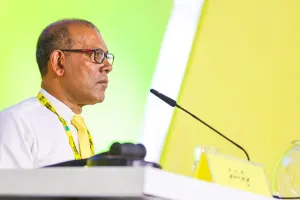
Former President Mohamed Nasheed also criticized the MMA’s proposed changes during an MDP protest titled 'Dhathivejje' held in Male' on Thursday night. Nasheed stated that a realistic assessment of the 20 percent mandatory exchange would reveal the potential shock to the tourism sector.
"Twenty percent is not the profit. No one can believe that the profit margin for any resort is currently 20 percent. If you look at the real picture and the actual figures, it is clear that the tourism industry will face a massive shock if forced to exchange 20 percent," Nasheed said.
Nasheed added that if businessmen are prevented from moving the money they earn, their concerns might lead them to withdraw their capital from the Maldives altogether.
The government has already submitted the proposed legislative changes to Parliament.