It has been revealed that the Memorandum of Understanding (MoU) signed for discussions to hand over the main commercial port operated by Maldives Ports Limited (MPL) to a Philippines company for 25 years results in the state suffering a huge loss whether the port is handed over to the company or not.
On March 28, MPL signed a 10-page "Memorandum of Understanding" with Philippines-based International Container Terminal Services Inc (ICTSI). A copy of the MoU was circulated on social media and Adhadhu can confirm it is the original MoU.
The document appears to be a legally binding agreement rather than a MoU between two companies. The MoU expires on June 28, but the port has not yet been handed over to ICTSI.
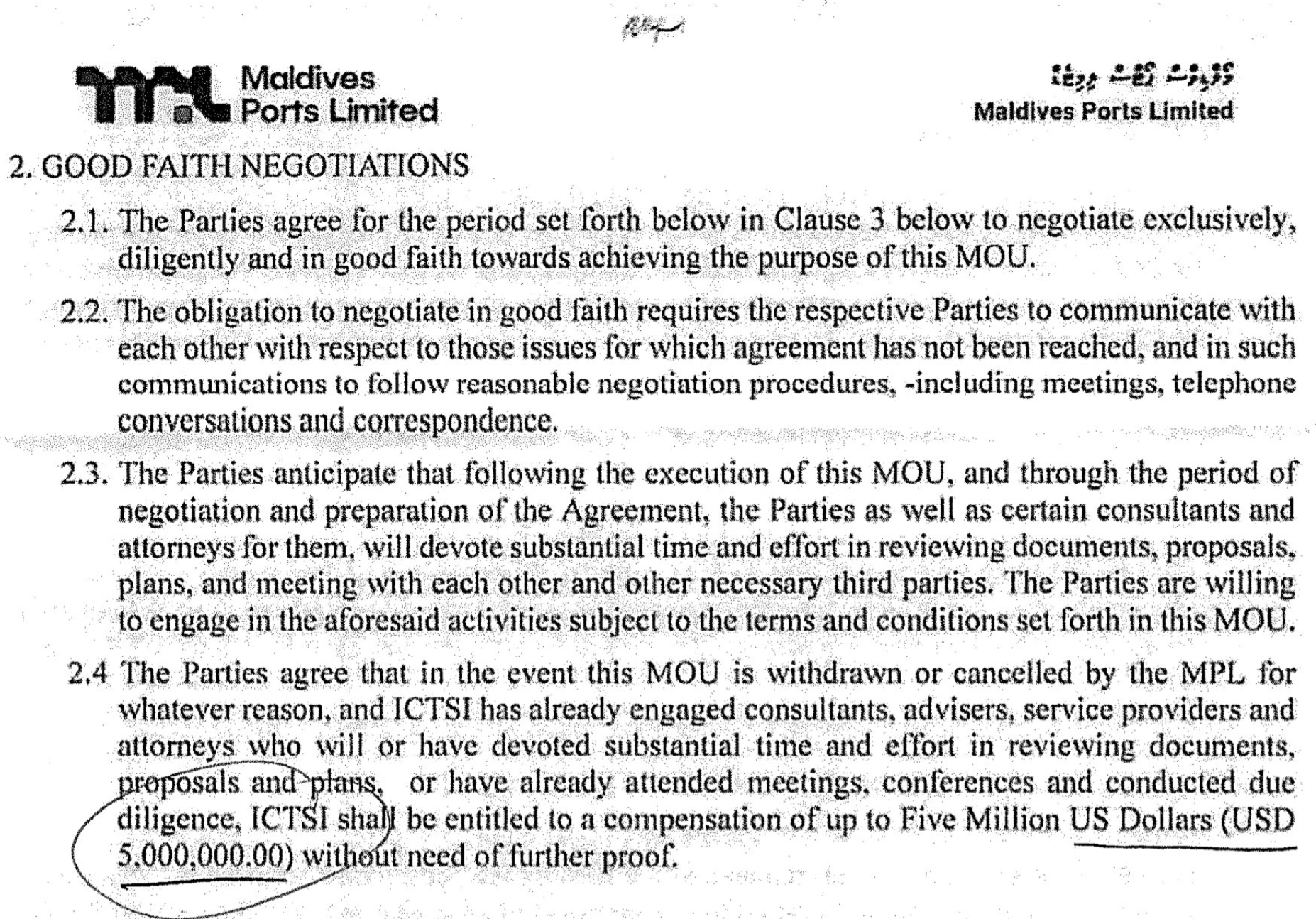
Clause 2.4 of the MoU.
titledesc
The agreement was signed under the title "Exclusive Negotiation Towards Construction, Operation, Management and Finance of a Seaport at the Island of Thilafushi Kaafu Atoll, Republic of Maldives."
No choice but to pay USD 5 million
Three parts of the 11-clause agreement stipulate that MPL must pay ICTSI USD 5 million or MVR 77 million for work done by the company even if ICTSI does not provide any evidence.
Clause 2.4 of the MoU signed between the two companies states that if MPL refuses to hand over the port for any reason or cancels the MoU, the company will have to pay USD 5 million to ICTSI.
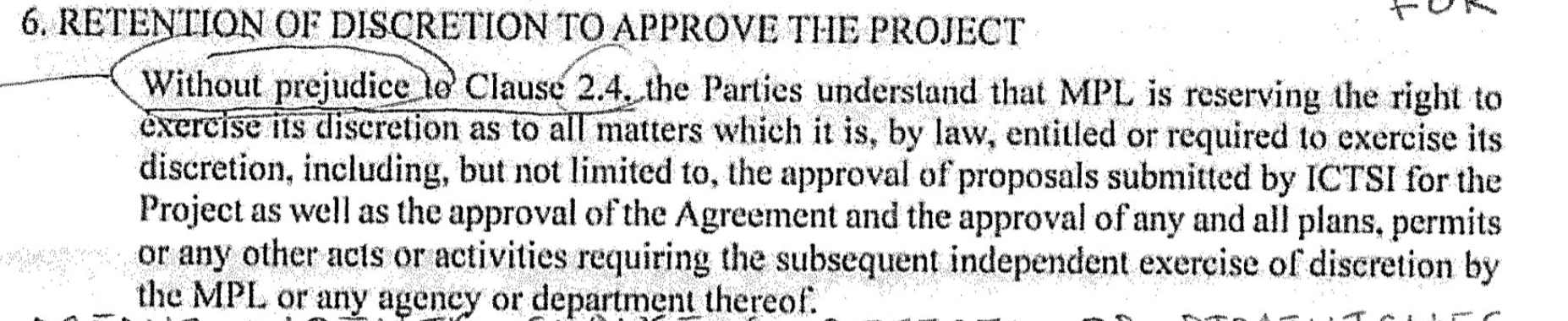
Clause states MVR 77 million must be paid.
As a reason, ICTSI stated that it had worked with consultants, advisors, service providers and legal teams. Accordingly, it states that MPL owes USD 5 million as ICTSI spent considerable time and energy reviewing paperwork, developing proposals and plans, and holding meetings.
This clause alone shows that it was included in the MoU after an informal agreement was reached with the Philippines company and the company was aware of this. But there is no reason to pay for the company when an agreement has not been signed with MPL.
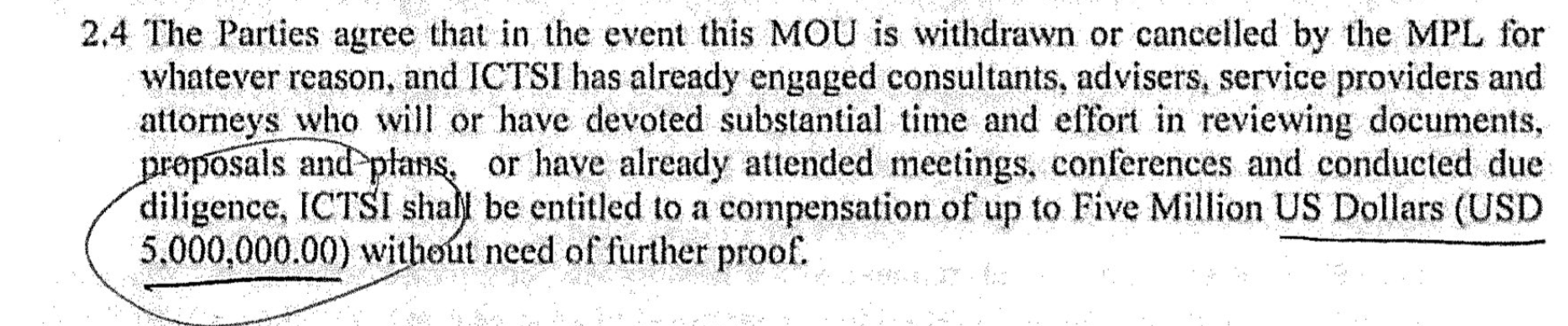
This clause highlights payment to ICTSI.
Clause 5 of the "MOU" deals with the matters relating to entering into an agreement. It stated that an agreement had not yet been reached between the two companies and that the terms would be implemented once the final agreement was implemented by both companies.
However, the next part states that Clause 2.4 shall not be included when interpreting Clause 5. This means that USD 5 million is the amount MPL will have to pay if the agreement is not signed.

Clause says MPL must pay if agreement is not signed.
Clause 6 of the MOU stipulates that MPL has all discretion and authority to evaluate the proposals submitted by ICTSI, give approval to the agreement and decide all plans, permits and all other aspects of the project.
However, the next part again states that Clause 2.4 shall not be included when interpreting Clause 6. Therefore, MPL is obliged to pay USD 5 million. It is not at the discretion of the company.
Summary of the signed "MoU"
The MoU includes the Thilafushi project, the operation of a free zone and handing over the redevelopment of the Male' commercial port to ICTSI. The first phase of the port will be completed within two years. The company has submitted two models for port operation to the government.
The first option is to develop the port and for ICTSI to run all the cargo operations and the facilities. Under this model, all MPL assets will be in the company's name. There is a fee to be paid to the government, but the amount is not clarified.
The second model is to operate the port on a joint venture basis. ICTSI of the Philippines will hold 45 percent of the company while MPL will hold 55 percent.
The company proposes to take over the properties for 25 years with an option to extend by another 25 years. Therefore, if an agreement is reached, Maldives' main commercial port will be operated by a Philippines company for half a century.
According to the MoU, by the end of the first phase, the port will have a capacity of 300,000 containers and the Male' port will be redeveloped to include a commercial port and a yacht marina.
ICTSI will invest in the free zone next to the Thilafushi port and will establish an integrated maritime and logistics hub there. ICTSI believes this project will increase Maldives exports and improve the supply chain.
If an agreement is reached under this MoU, all fees for the main commercial port of Maldives will be determined by ICTSI of the Philippines. MPL would receive towing fees, pilot fees and dredging and maintenance fees. The port’s main revenue is container fees which will go to the Philippines.
The MoU states that employees working at the Male' commercial port will have the opportunity to move to Thilafushi port. The two companies had signed to include the details in the final agreements.
This article was first produced in Dhivehi by Adhadhu's Saaif Shiyad.