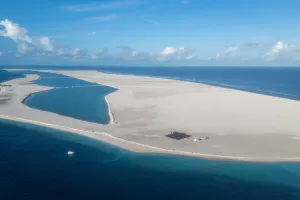
Housing Minister Abdulla Muththalib has revealed that 500 hectares of land for the Rasmalé Waterfront and Marina project were granted to UAE-based Eagle Hills without any lease acquisition costs or land rent for the duration of a 99-year lease.
In a detailed post shared on LinkedIn regarding the project, Mutthalib clarified that Eagle Hills is not required to make any upfront payments for land acquisition or ongoing lease payments for the site.
The Minister explained that the government waived these fees to secure a long-term revenue model throughout the project's lifecycle. Unlike the standard model for resort development, the government will instead generate income through direct revenue shares and taxation.
The revenue structure for the Rasmalé project includes
- Taxes on all services and goods sold within Rasmalé, charged at standard resort rates.
- A 10 percent share of the sale price for all units developed and sold by the developer.
- A four percent fee on every property transaction within Rasmalé.
Defending the decision to waive land rent and acquisition fees, Mutthalib stated that the government’s objective was to guarantee sustained Tourism Goods and Services Tax (TGST) revenue. Noting that TGST is the state’s largest source of income, he argued that this model is more profitable in the long term.
To support this, Mutthalib highlighted that tourism land rent generated MVR 1.88 billion in 2024 and MVR 2.07 billion last year. In contrast, TGST collections were five times higher, reaching MVR 9.6 billion in 2024 and MVR 10.9 billion the previous year.
"Acquisition fees and lease extension fees are one-time payments received in the years they occur. Consistent, growing revenue is derived from activity-based taxes: guests arriving, spending, and returning," Mutthalib said.
The government estimates that once all phases of the project are completed within the next 10 years, Rasmalé alone will attract one million tourists annually. Furthermore, the state expects to see an inflow of $11 billion during the development phase of the project.
Additionally, the government stated that the project is expected to create 54,000 jobs. Eagle Hills has committed to an investment of $12 billion for the project—an amount roughly $5 billion higher than the Maldives' total GDP.