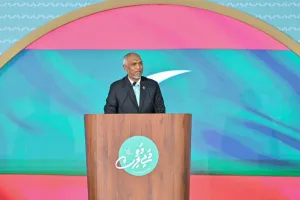
In last year's presidential election, President Dr. Mohamed Muizzu ran an extraordinary campaign.
One of the biggest elements of his campaign was the social media posts and selfies. President Muizzu took hundreds of photos from every island he visited and every rally he attended.
During and after the campaign, President Muizzu appeared close to the cameras. Thousands of photos of President Muizzu praying, having coffees and attending public places were immediately published on various platforms.
However, photographing the President has suddenly become a huge issue after Muizzu and his family were photographed in a shopping mall in Singapore on August 26 while on an unofficial visit.
The government claims the photo has caused the loss of President Muizzu's privacy. and that his security had been breached. Police stood quickly to investigate the case, identified the photographer and confiscated his phone when he arrived in Male'.
Democratic backsliding
One of the most distinctive features of former President Maumoon Abdul Gayoom's regime, who ruled the Maldives for 30 years without giving space for an opposition ideology, was that he did not allow criticism and the respect and dignity he demanded from the people.
Those who faced measures for criticising Maumoon include poets, singers, writers, journalists, film stars, painters, sportsmen, religious leaders, students, civil servants and politicians.
Before Maumoon's regime was changed in the country's first multi-party election in 2008, the first thing that had to be done was to explain to the people that the President of the country is a servant of the people. Maumoon's downfall came soon after the people realised the leader's responsibility was to serve the people instead of holding onto power by force.
After Maumoon, four Presidents ruled this country. Right now, the people are seeing the fifth presidential term with President Muizzu. All five Presidents since 2008 have shown signs of good governance and dictatorships.
However, since Maumoon's rule, there has never been an issue with photographing the President. It is not a criminal offence. But it now appears that the country is backsliding in its long journey towards democracy.
Photography prohibition: No legal basis
The photo of the President in question was not taken while he was in a private place. He was in a public place at the time.
Paragon Medical in Singapore is not a private place for any individual. It is not a closed place. People do not move around the building in secret. President Muizzu was also not moving around in secret.
The government accused the man who took the President's photo with three serious criminal offences. They are;
- Section 231 - Unlawful Eavesdropping or Surveillance
- Section 233. Unlawful Disclosure of Information
- Section 615(4) - Persistently follows a person in or about a public place or places
A legal expert told Adhadhu that the criminal charges against the photographer were baseless and an act of intimidation. The offences mentioned in the charges are not meant to be used in such situations, he said.
"One thing should be committing the said offence intentionally. Taking photographs to create a fearful atmosphere. There are such conditions in the sections. The photographer did not disturb the President. He did not stop him from walking around or step in front of him," he said.
Shameful and dictatorial character
Many people have expressed concerns about the serious criminal charges against the man who photographed the President. They include economists and opposition political party leaders.
Some experts say the government's criminal charges against the photographer were a direct threat of intimidation.
"If they are leaders of the country, their photos will be taken. It should not be a security issue. He is not an ordinary person. The President can be photographed wherever he is. Leaders go to ordinary people's homes and take pictures, but that doesn't become a problem," said Ahmed Mohamed (Forme) who studied human rights.
Forme said such harsh actions show the true character of a leader and are characteristics of a dictator.
"These things also show very authoritarian characteristics. It's like letting the cat out of the bag. We're seeing the taste of dictatorship again," Forme said.
The opposition Maldivian Democratic Party (MDP) has also condemned the criminalization of taking photos of the President. MDP Chairman Fayyaz Ismail said the ban on photography was a signal that the state was losing "the characteristics of the rule of law."
"While there is no law prohibiting the publication of photographs of the President in public, it is concerning that court orders have been requested and issued to seize private property in connection to a criminal accusation over this act. This is a green signal of danger showing the loss of the rule of law in this state. I call on the President not to disrupt the justice system for his personal reasons,” Fayyaz said on September 1.
Former Defense Minister Mariya Ahmed Didi also criticized the government.
"The government's claim that there was a security breach by taking a photograph is putting a huge accusation against the Singapore government. This is a big atrocity this government is committing against Maldivians to intimidate them without regard to the rule of law."
---
There are no real issues with taking President Muizzu's photo and it is not a punishable offence. People should have the freedom to photograph the President in public places and the government must be ashamed of turning it into a criminal offence.
This article was first produced in Dhivehi by Hassan Mohamed.