Muizzu says he supports anti-defection bill

Mar 30, 2024, 8:17 AM
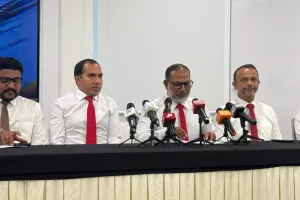
President Muizzu with some MPs that left MDP to join PNC. -- File Photo

President Muizzu with some MPs that left MDP to join PNC. -- File Photo

President Dr. Mohamed Muizzu has said he supports the anti-defection bill proposed by the opposition Maldivian Democratic Party (MDP) although 13 MDP MPs joined his People's National Congress (PNC) after he assumed office.

In an interview with Sangu TV yesterday, the President said the right thing to do is to remain in the party, but the MPs that left MDP did so due to acceptable reasons.

“We have MPs who changed from MDP. They changed for very legitimate reasons. But as a principle, I believe the best way is to stay in the elected party,” he said.

The President said that membership of parliament is obtained by selling certain policies on the ticket of a particular party.

"The most ideal way is to stay in the party. That's the social contract with the people. So as a principle, I support the [anti-defection] bill," he said.

The Parliament committee passed the anti-defection bill on March 27. But the bill still needs to be approved by the Parliament floor.

According to the anti-defection bill, MPs who won on party ticket must resign from their seat if they decide to leave the party.

If an MP is expelled from the party, the Elections Commission (EC) must take a vote in their constituency to see if the people wish to have them as the MP.

Comments

Read More

Latest News

Two teachers arrested for sexual abuse of minors

Two 52-year-old teachers were arrested on a southern island for the alleged sexual abuse of three minors. The first suspect was detained for abusing a 16-year-old, while the second faces charges involving girls aged 12 and 13. Both men have been remanded in custody as police continue their investigation into these serious allegations.

Male’ City Council backs movement against Rasmale' deal

The Male’ City Council has pledged full support to the "Maldivian Land for Maldivians" movement. Led by former Minister Imran Abdulla, the group opposes the Rasmalé project’s land allocation to foreign firms. The council, as a key stakeholder, aims to address housing concerns while aligning with public sentiment against the deal.

Details of nine rape suspects publicised after remand extended

A court has remanded nine suspects following the alleged sexual assault of a 22-year-old woman and several minors in Huvadhu Atoll. Remand periods for the men range from five to 90 days as a specialized team investigates the case. Authorities are treating the matter as a serious offense while withholding location details to protect the victims.

"Rasmale' deal offers no financial benefit to the state"

Expert Ismail Zariyand claims the Rasmalé project offers no financial benefit to the state over the next decade, contradicting government profit projections. He argues that infrastructure needs and slow construction will delay social benefits, with only a fraction of promised housing likely completed by 2028.

Massive fire destroys Shaviyani Funadhoo’s only petrol station

A massive fire destroyed the only petrol station in Shaviyani Funadhoo, spreading to nearby warehouses and causing a fuel crisis. While several buildings were damaged and minor injuries were reported, the blaze is being contained by residents and MNDF. The council is now seeking government aid to restore the island's essential fuel supply.

"MPs face financial hardship after spending on constituents"

MP Ahmed Azaan claims many Maldivian lawmakers face financial hardship because they spend most of their salaries on constituent requests. He argues that local cultural expectations for MPs to fund personal needs and community events make comparisons to foreign legislators' wages unfair, as those nations provide separate administrative funding.

Exclusive: Cabinet approved changes for foreign land ownership

The Maldivian Cabinet approved constitutional amendments to allow foreign land ownership and create real estate development zones. Despite being passed in 2025, implementation was delayed due to political setbacks and public sensitivity. The government also prepared a PR strategy to manage potential backlash over the controversial policy.

Newsletter

Get the latest news delivered straight to your inbox