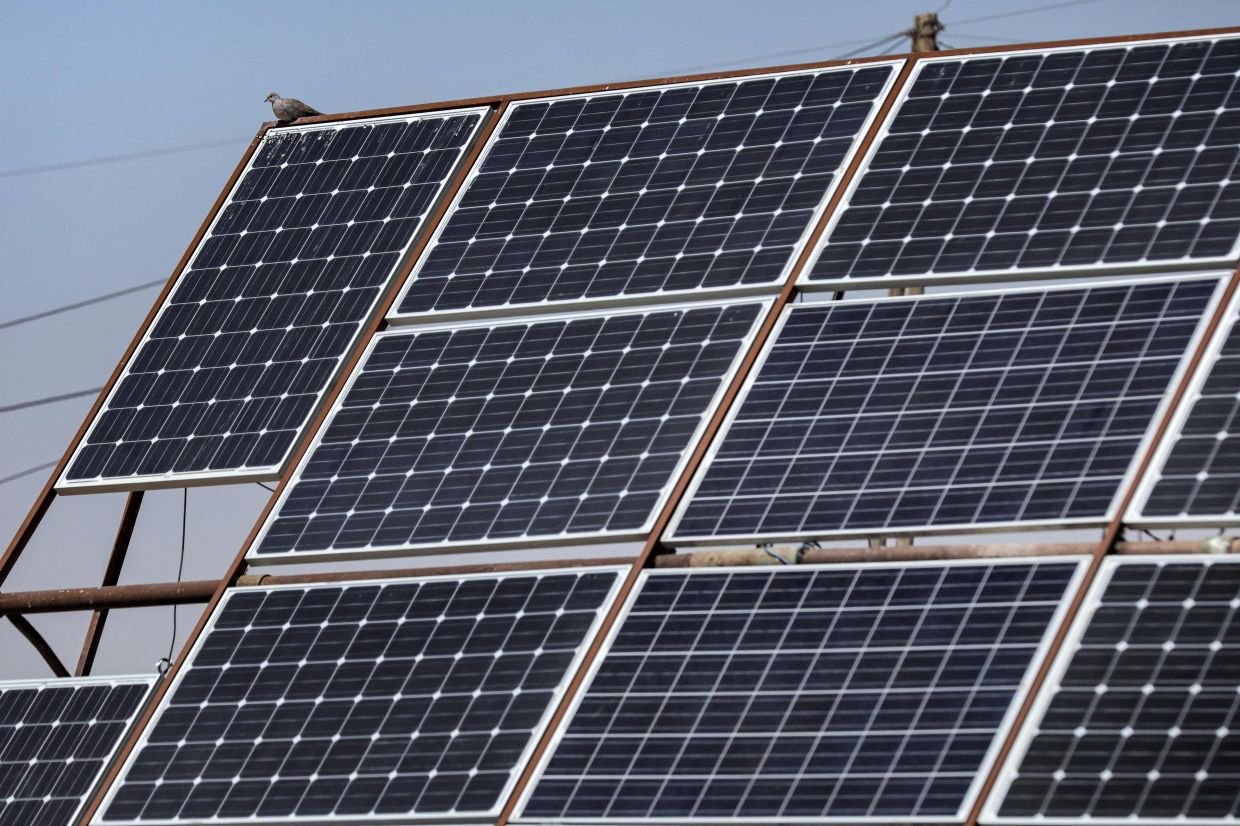
As the world pivots from planet-warming fossil fuels to renewable energy, a new pollution problem is rearing its head: What to do with old or worn-out solar panels?
Thousands of photovoltaic slabs are being installed across the United States every day, particularly in the sunny west and south of the country, as states like California race towards greener energy production.
But with an expected lifespan of around 30 years, the first wave of solar installations is now coming to the end of its usefulness, sparking a rush to recycle things that might otherwise end up in the landfill.
"What is about to happen is a tsunami of solar panels coming back into the supply chain," said Adam Saghei, chief executive of Arizona-based We Recycle Solar.
"One of the challenges with any industry is, there hasn't been that much planning for a circular economy.
"(Solar) is a sustainable form of energy; there needs to be a plan for the retirement of those assets."
Saghei's plan involves, among other things, reusing panels.
Anywhere up to five percent of panels either have a minor production defect or get damaged during transport or installation.
These still-working panels can be refurbished and diverted to other markets, often abroad, Saghei says.
But for the panels that no longer function - either because they're decrepit, or because they were damaged beyond use during installation, or smashed by hailstones - there's treasure to be found.
"We're doing what's called urban mining," says Saghei, refering to a process that took his engineers three years to perfect.
That mining recovers silver, copper, aluminium, glass and silicone - all commodities that have a value on the open market.
While the uses for the metals might be obvious, what to do with silicone and glass is less so, but nonetheless intriguing.
"You can use it for sand traps on golf courses, you can refine it for sandblast mix, you can also use it for the stones or the glass mix that you get for outdoor fireplaces," says Saghei.
With capacity to process up to 7,500 panels every day at the plant in Yuma, a surprisingly small amount goes to waste.
"Depending on the make and model of the panels ... we're able to get up to 99 percent recovery rate."
Logistics
For Meng Tao, who specialises in sustainable energy infrastructure at Arizona State University, developing an efficient lifecycle for solar panels is a pressing issue.
With the United States among countries committed to weaning itself off fossil fuels following a landmark COP28 climate agreement, solar panel installation looks set to increase to a peak two decades from now.
"Once it matures, then the annual installation and the decommissioning will be about the same," he told AFP.
"But for the next 20 years ... at least for the next 10 years ... we'll just have more installations than retirements."
The problem with recycling, he says, is not just that the value of recovered materials from panels can be relatively low, but also the logistics.
With panels distributed to thousands of sometimes far-flung rooftops, it can cost a lot of money just to get them to a recycling centre.
And unlike some jurisdictions, the United States imposes the cost of removal and recycling on the end user - making it more attractive for households just to dump their old units at the local landfill.
"There has to be some policy support" to plug the gap between what consumers will pay and the total lifecycle cost of the panels, says Tao.
Growing Market
For Saghei, as for any business leader, profitability is important.
"You don't see too many getting into the business because recycling has a cost. It's not free. It's labour intensive. It's energy-intensive," he says.
But he does see a way forward.
Recovering materials from old solar panels that can be put back into new solar panels is - he is convinced - a winning proposition.
"These are markets that are growing," he says.
"Right through this process we are able, once the industry scales to even larger figures, to put those raw commodities back into the supply chain.
"What's exciting is we're at the forefront."
This story was produced by AFP.