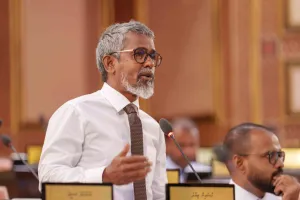
Former President Abdulla Yameen told the High Court on Wednesday that he refused to cooperate with the police investigation into alleged corruption in the Vaavu Aarah lease and decided to defend himself at trial because of harassment from the institution.
The Criminal Court sentenced Yameen to 11 years in prison and imposed a USD 5 million fine over the Aarah resort deal, which was part of the Maldives Marketing and Public Relations Corporation (MMPRC) corruption scandal that occurred during his administration.
In the guilty verdict, then-Chief Judge Mohamed Shakeel noted Yameen's failure to produce evidence during the investigation stage to show that his transaction with MP Yoosuf Naeem was an "innocent" dollar purchase.
At the High Court hearing yesterday on the appeal of his conviction, Yameen said he did cooperate with the police at first concerning alleged corruption in the leasing of Aarah and Raa Fuggiri.
"...but because the police changed the statement and kept summoning me frequently to answer further questions, I told them what you're doing now is harassing me. That's why I told them I would defend myself further during the trial," he explained.
"That was how hard and difficult it was then," the opposition Progressive Party of Maldives-People's National Congress (PPM-PNC) coalition's leader said.
Section 47(b) of the criminal procedures law specifies circumstances where the right to remain silent could be restricted.
The section states that if the information provided to the investigation in some types of criminal offenses could be used in support of the accused, the right to remain silent cannot be exercised and the information must be provided to law enforcement agencies.
At the hearing that took place from 2 pm to 5:15 pm, both defense lawyers and Yameen himself answered questions posed by judges.
Judges asked about a letter that Yameen sent to the bank stating that the money from Yoosuf Naeem was a campaign donation, which was contrary to his later claim in court that it was from a currency exchange transaction.
Yameen said that the letter submitted as evidence by the prosecution was fake. He raised questions about the letter's authenticity as half of it was typed and the rest was handwritten.
Aarah case
According to the charges raised by the state, Vaavu Aarah was transferred to the tourism ministry on August 9, 2015. A company called 2G Pvt Ltd with a 99 percent stake owned by the co-defendant Yoosuf Naeem was created on August 13, 2015.
On September 8, 2015, 99 percent of shares in 2G Pvt Ltd were sold to LA Resorts Pvt Ltd.
When the MMPRC handed over Aarah to 2G on September 9, 2015, LA Resorts gave a check of USD 1 million to the MMPRC as the island’s lease acquisition cost and a check of USD 1 million to Yoosuf Naeem.
On September 13, 2015, when the money was deposited to Yoosuf Naeem’s account, a check for USD 1 million from the account was given to President Yameen on September 15, 2015. Two days later, the money was deposited to an account opened under Yameen’s name at the HSBC Bank, according to the prosecution.
Both Yameen and Yoosuf Naeem pleaded not guilty to the charges. The transaction between them was a sale of US dollars for Dhivehi Rufiyaa, they said, claiming it was unrelated to the leasing of Aarah and denying any act of corruption.