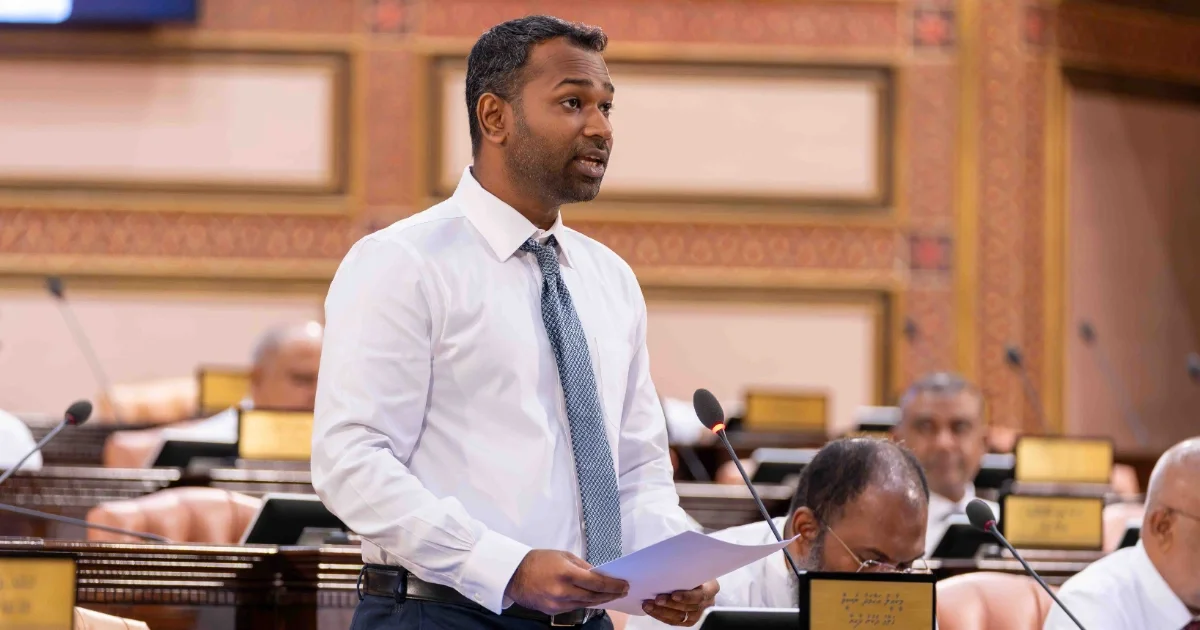
Ibrahim Falah, the Parliamentary Group Leader of the ruling People’s National Congress (PNC), has characterised former Foreign Minister Abdulla Khaleel as an individual who prioritises personal interests over the national interest.
Falah made these remarks when questioned about a response he gave to a post on X by Khaleel. In his post, Khaleel expressed concerns regarding the Rasmalé project, which involves the permanent allocation of 500 hectares of land to Eagle Hills, a company based in the United Arab Emirates.
"I am surprised that Khaleel, who served as Foreign Minister, is opposing the Rasmalé project. My previous assessment of him was wrong," Falah stated in his post responding to Khaleel.
When asked to clarify what he meant by his previous assessment being "wrong," Falah explained that he had previously believed Khaleel was someone who put the country before his own interests.
"[I previously thought Khaleel was] someone who prioritises the nation over personal gain," Falah said.
When further pressed on whether he now believes Khaleel prioritises personal interests over the country, Falah replied, "Very much so."
Falah’s comments follow Khaleel’s public call for the government to address and clarify public concerns surrounding the Rasmalé project.
"There are significant and sensitive public concerns regarding the Rasmalé investment. I believe that as leaders appointed to protect the rights of the nation and its people, the government’s responsibility is to provide answers that address these concerns," Khaleel wrote on X.
The questions Khaleel urged the government to answer include
- How much has the state spent on the Rasmalé reclamation so far?
- Has the land and the surrounding lagoon at Rasmalé been valued? If so, what is the valuation?
- Is there any upfront payment from the investment? If so, how much?
- There are significant discrepancies between the figures cited by the investor and those cited by some government officials. Therefore, what is the projected tax revenue within the Maldives' legal framework? Aside from business taxes, what do the state or the people gain from this project, and over what period?
- Is land ownership being granted permanently? Does a new 99-year lease period begin every time ownership is transferred?
- Are the 5,000 housing units being built using state funds or not?
- Will any rights of the state or the people be lost as a result of this investment?
A big concern for many Maldivians is that the project is being developed in a manner that allows foreigners to reside in Rasmalé for long periods.
The government has allocated the land for Rasmalé without charging a land acquisition fee or ground rent. Instead, the state will receive a 10 percent fee when the developer first sells a building, along with a 4 percent fee from the buyer. A 4 percent fee will also be collected every time ownership is transferred.
Although the government maintains that Rasmalé has been leased for 99 years, Adhadhu understands that the current agreement could lead to a total loss of the land. Under the terms, if a property owner in Rasmalé sells or gifts the property, a new 99-year lease term begins.
The government has not made the agreement with Eagle Hills public, despite widespread concerns regarding the deal.