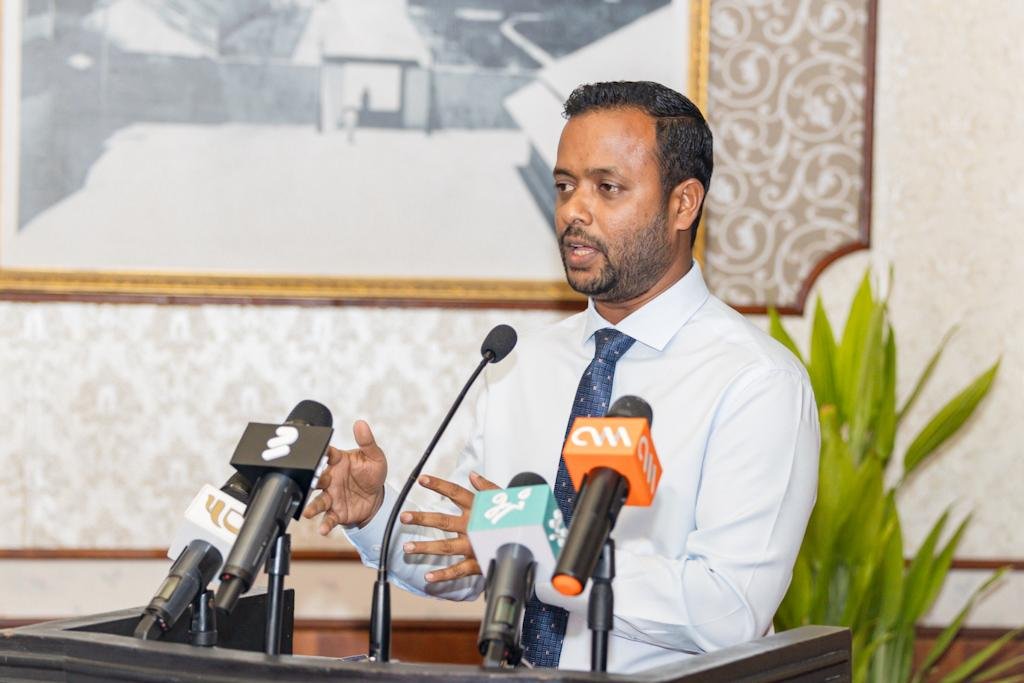
A day before its term ended, the previous government signed a supplementary agreement with Afcons and extended the completion date of the Thilamale’ bridge to September 30, 2026, Infrastructure Minister Dr. Abdulla Muththalib said on Thursday.
Briefing the press at the ministry about the bridge project, Muththalib said the previous government signed the supplementary agreement with Afcons after the company became certain that it could not complete the bridge on time.
The decision was made because the government failed to hand over land that needed to be provided to the contractor and in order to avoid large fines that the contractor would incur due to its failure to meet the deadline.
“A supplementary agreement was signed a day before the new government assumed office. According to that agreement, the completion date is now September 30, 2026,” Muththalib said.
The new government will fully respect the agreement signed with Afcons but will discuss with the company and seek to expedite the work, he added.
The previous government awarded the Thilamale’ bridge project to Afcons on September 16, 2021 to be carried out in two phases. Both sides agreed that connecting the bridge from Male’ to Gulhifalhu would be completed in 27 months.
It was agreed that the bridge would be connected to Thilafushi in 37 months under the second phase.
However, under the supplementary agreement signed with Afcons by the previous government, the first phase was extended to 51.5 months and the second phase was extended to 45 months.
Infrastructure Minister Muththalib told the press that the project became prolonged because Afcons lacked the experience and competence for the work. The company underestimated the scope and difficulty of the project, he added.
Bridge construction in the Maldives is harder than elsewhere in the world, he explained.
“That’s because it’s being built in a gulf in the sea with strong currents. There are also monsoon swells and large waves. Along with that, the geotechnical - meaning the condition underwater is not as uniform or the same as in other countries,” said Muththalib, who had been actively involved in the development of the Sinamale’ bridge.
As Afcons lacked the experience in building bridges in countries such as the Maldives, the company had been unprepared and needed time to learn and adjust, he said.
“What we can do now is to find a way to move forward and ensure that it doesn’t slide from this schedule. We respect that agreement. However, we will talk to the contractor and try to speed up what can be speeded up,” Muththalib said.
About 1,500 Afcons workers are engaged in the bridge project. When the project was initially awarded, the bridge was due to be connected to Gulhifalhu by next month and to Thilafushi by May next year.
But progress was slow and work fell far behind schedule.
The "Greater Male' Connectivity Project" is the largest infrastructure project undertaken in the Maldives to date. The 6.7km bridge and causeway is to connect Male’ to Thilafushi.
The project is funded by a USD 400 million loan from India's Exim Bank and a USD 100 million grant from India. The previous government estimated that the bridge project would cost USD 500 million without Goods and Services Taxes (GST).
Afcons, a majority stake of which is owned by India’s Shapoorji Pallonji Group, has successfully completed large infrastructure projects in India.
A company that also has ties to India’s Tata company, Afcons’ projects include the Trans-Gabonese Road that connects Gabon’s east and west, and the Volta railway bridge in Ghana, which was undertaken with a USD 100 million loan from the Japanese government.
Afcons won the bid for the Thilamale’ bridge project after competing against two other bidders, India’s Ashoka Builders and Larsen & Toubro.
The technical evaluation team for the bidding process was assisted by MS Arup, a company hired by the previous government for consultancy work on the project.