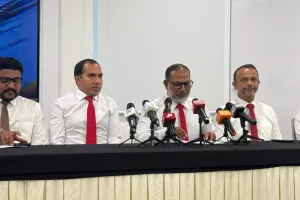
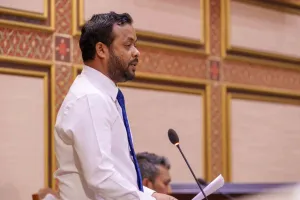
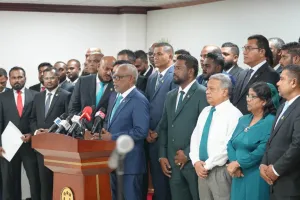
Former Chairperson of the opposition Maldivian Democratic Party (MDP), Fayyaz Ismail, has questioned why Attorney General Ahmed Usham is talking about the need for a new real estate law while the government characterises the Rasmalé project as a tourism venture.
In an article published in the Maldives Independent, Fayyaz expressed deep concerns regarding the Rasmalé project and offered his perspective on how such a large-scale development should be managed.
"The Maldives needs foreign investment. Our economy cannot grow, diversify and create enough opportunity without attracting serious international capital," the former Economic Minister wrote at the beginning of his piece.
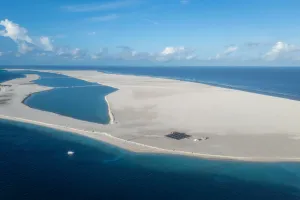
However, Fayyaz emphasised that investor confidence can only be secured through transparency and a clear legal framework. He noted that the agreement under the Rasmalé project—which grants 500 hectares of reclaimed land near the capital to Eagle Hills—raises significant questions when measured against these standards.
"The Muizzu administration has entered into a ‘commercial terms agreement’ with Eagle Hills involving more than 500 hectares of Rasmalé, but the public has yet to see a word of the agreement. There are no published commercial terms, no legal framework, no clue, really, what the developer’s investment obligations are or the conditions under which the land ultimately reverts to the Maldives," he wrote.
Fayyaz further questioned why AG Usham is discussing a new real estate bill if the government maintains this is "just another tourism development," and pointed out discrepancies between the figures provided by Eagle Hills and those cited by the government.
The current Tourism Act already allows for real estate development and long-term leasing.
However, in a September 29 X post, Usham stated that the Rasmalé project could proceed only once the necessary laws are passed by Parliament.
"The project planned for Rasmalé will be governed under the Real Estate Act currently being drafted," Usham said. "Before the project commences... relevant laws must be passed by Parliament."
Later, during PSM's "Ahaa" public forum, Usham explained that the Real Estate Act is necessary to establish an industry that currently does not exist in the Maldives.
"The government is working to establish an industry that is not currently present in the Maldives. This means we are attempting to create a real estate market in the Maldives that is not a tourism product," Usham clarified.
Despite this, the government has maintained until now that the project is designed to generate significant revenue through the Tourism Goods and Services Tax (TGST). This projected revenue was the justification given for granting over 500 hectares of Rasmalé land without an upfront fee.
The government’s narrative—claiming Rasmalé is a project to introduce a non-tourism real estate market—is inconsistent with its financial justifications.
Discrepancies in Figures
Beyond the narrative contradictions, Fayyaz highlighted major issues with the figures being presented.
"While government ministers claim the project is valued at $12 billion or $20 billion, these figures appear baseless. $20 billion is nearly three times the GDP of the Maldives. Eagle Hills suggests this figure represents the estimated revenue if all land is developed and attracts one million tourists annually. That would account for 40 percent of the entire Maldivian tourism industry. Such imaginary calculations would not be accepted by economic experts," Fayyaz wrote.
Furthermore, Fayyaz highlighted confusion regarding the lease period. Eagle Hills' initial statement suggested a 99-year lease that would reset each time the property was sold or inherited. Following public backlash, Eagle Hills removed that section from its statement.
"Even though the statement was amended, the government has not disclosed what is in the actual agreement. Additionally, details regarding how residency visas will be granted to buyers and which laws will govern the area remain shrouded in secrecy," Fayyaz stated.
Fayyaz also noted that while Rasmalé is marketed as a housing solution for Malé, it remains unclear how public housing pledges will be met after granting 500 hectares of the most valuable land to a foreign firm.
He pointed out that when Eagle Hills operates in countries like Albania and Serbia, those governments publish the agreements and even secure state equity in the projects.
Fayyaz called for five conditions to be met before the project proceeds:
- Making the agreement public.
- Clarifying the questions surrounding the 99-year lease term.
- Conducting an independent valuation of the land.
- Disclosing details of the 10 percent revenue the government is to receive.
- Submitting the agreement to Parliament for oversight.
The reclamation of Rasmalé began with the promise that it was a project dedicated to providing housing for Maldivians. President Mohamed Muizzu himself had previously pledged that Rasmalé would not be leased to foreign parties.
"Every grain of sand reclaimed there [Rasmalé] is a grain of sand owned by the Maldivian citizens. It is not land that will be leased to any foreign party for even a single day, nor will it be given away for free," Muizzu had stated.