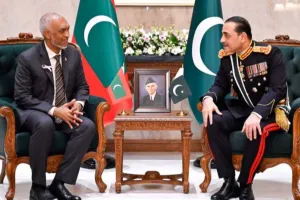
President Mohamed Muizzu has said that the current situation in the Maldives necessitates a "personal jihad" to achieve the higher objectives of Islamic Sharia.
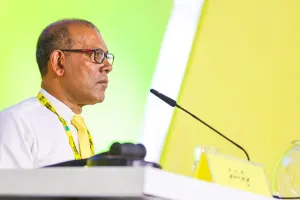
Speaking at a ceremony held at Hulhumalé Central Park to mark the anniversary of the Maldives' conversion to Islam, Muizzu emphasized that this personal struggle is essential for the collective safety of the nation. He stressed the need to formulate a clear vision and implement practical measures to achieve these goals.
"When we look toward the horizon of the future, we see the objectives we must achieve—the objectives of Islamic Sharia. We envision the personal struggles and the great sacrifices we must make. It is a vision that all parties must unite to create for the safety of the entire nation," the President said.
"We must implement practical steps. We must remain vigilant and give special attention to the alarming threats posed to the faith of our young hearts and minds by the influences of a globalized world."
Reflecting on the 900-year history of Islam in the Maldives, Muizzu described the nation's past as a blessing. However, he noted that a look at the current landscape reveals "scars and wounds" in various areas.
"Today, we celebrate the honorable milestone of 900 years as a 100 percent Muslim nation. While the mirror of the past reflects our good fortune, the current reality shows that wounds and scars have formed in certain places," he said.
Underscoring the importance of maintaining the Maldives' status as a fully Muslim nation, the President advised every citizen to work toward ensuring prosperity in both this life and the hereafter.
Although Muizzu had previously stated that a bill regarding the implementation of the death penalty in accordance with Islamic Sharia would be submitted during the last parliamentary term, the bill has yet to be introduced to the Majlis.
Attorney General (AG) Ahmed Usham said last May that the bill on the death penalty would be submitted during the second session this year, noting that much of the drafting is complete. He added that there are numerous religious and technical aspects that must be thoroughly reviewed before the bill is sent to Parliament.
Asserting that not implementing the death penalty is "not an option," Usham stated his belief that every judgment passed by the courts must be enforced. However, he maintained that capital punishment should be carried out under a specific law rather than the existing regulations.