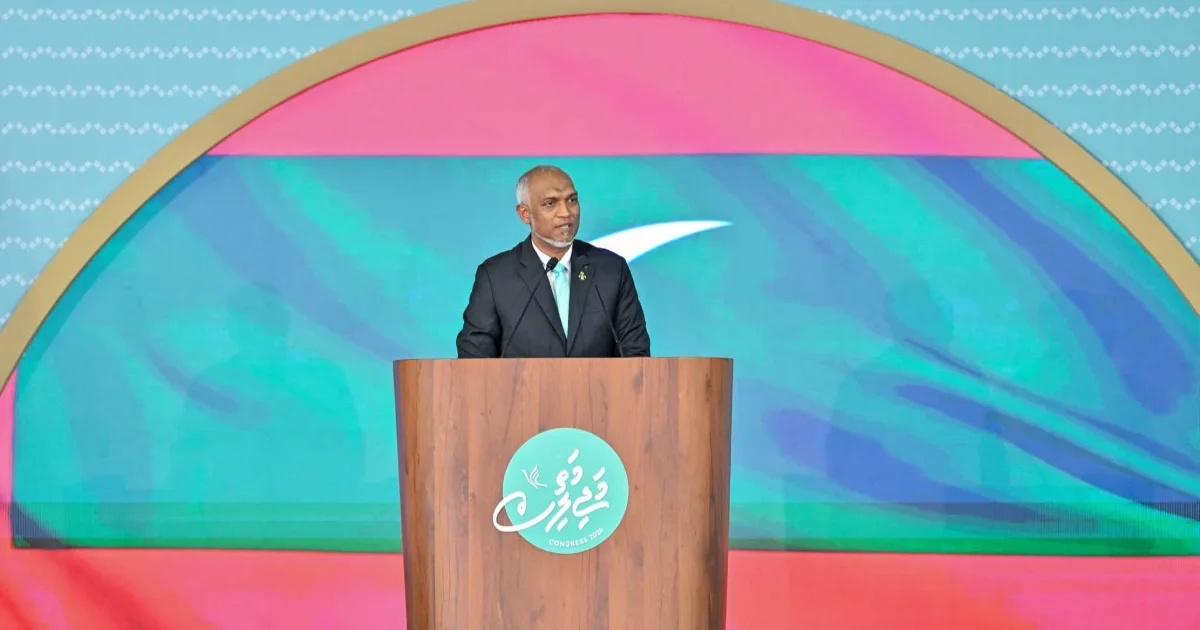
President Mohamed Muizzu has attempted to distort the facts regarding the Thilamale Bridge project, claiming that his administration was responsible for commencing the physical work on the bridge, which was initiated by the previous MDP government with Indian assistance to connect Malé, Villimalé, Gulhifalhu, and Thilafushi.
Speaking on "The Pulse" program, Muizzu stated that his administration had to start the Thilamale Bridge project virtually from scratch. He claimed that not a single bridge pillar had been installed during the MDP administration.
"Between Malé and Villimale, for example, one could say almost nothing had been done. There was very little work. No pillars had been installed, and in that sense, no significant progress had been made," Muizzu said.
"I would say the physical work was a project started almost from zero. However, many days—more than two years—had passed since the project was officially launched before that."
However, official records, government statements, and documented media reports confirm that physical work on the bridge was well underway by the time the current administration took office.
The MDP government signed the agreement for the Thilamale Bridge project with India’s Afcons Infrastructure on September 16, 2021. While the initial completion date was set for May 17, 2024, the timeline was later revised to September 30, 2026.
Following the signing, underwater geotechnical surveys and borehole drilling were conducted throughout 2022. Additionally, a site was established in Gulhifalhu for the fabrication of bridge segments.
Work on the superstructure and precast segments progressed rapidly at the Gulhifalhu site. The installation of marine pillars for the Thilamale Bridge commenced on August 18, 2023. Prior to this, work had already begun in the Villimalé area and on the Malé land-side. Furthermore, the piling and capping of four land-based pillars began in February 2023 during the MDP administration.
During the current administration's first press conference in November 2023, Mohamed Firzul, then Under Secretary at the President's Office, stated that 23 percent of the Thilamale Bridge project had already been completed.
Despite Muizzu’s claim that his administration started from zero, shortly after assuming office, he visited the site with cabinet ministers and media outlets to inspect the ongoing progress.
Due to weather conditions and various other factors that delayed the project, the previous government had extended the completion deadline to September 30, 2026. At the time of that extension, the Minister of Construction and Infrastructure, Dr. Abdulla Muththalib, noted that 29 percent of the total project had been finished.
Although the project, contracted to Afcons, originally aimed for completion by May 2024, the timeline has seen several adjustments due to various challenges.
The bridge section reaching Villimalé was slated for completion by March 31, 2026, with the connection from Gulhifalhu to Thilafushi expected by September 30, 2026. However, in a press conference last April, Muizzu mentioned that these dates had been pushed further into next year, though he did not specify the new deadlines.
Unlike the Sinamalé Bridge (Hulhumalé Bridge), the construction methodology for the Thilamale Bridge is different. While the pillars and superstructure of the Sinamalé Bridge were built directly at the bridge site, much of the Thilamale Bridge work involves pre-fabrication.
While the daily commuters around Malé might not have seen the same level of visible activity as the previous bridge, work on the prefab superstructures was progressing intensely at Gulhifalhu. Media photos confirm that a significant portion of this work was completed before the current administration took power.
On "The Pulse," Muizzu further stated that bridge work is now proceeding at a fast pace and that he wishes to complete the project as soon as possible. However, he did not provide a definitive completion date.
The Thilamale Bridge, developed at a cost of approximately USD 500 million, is largely funded through a line of credit from the Export-Import (EXIM) Bank of India. While USD 400 million is sourced from this credit line, the Indian government has provided an additional USD 100 million as a grant.
The 6.7-kilometer bridge project is estimated to cost over 7 billion Maldivian Rufiyaa in total.