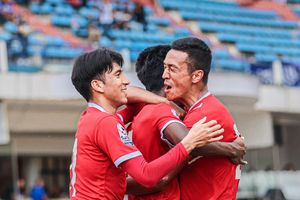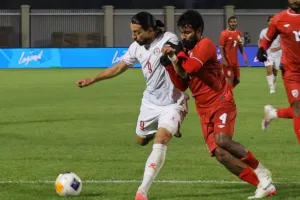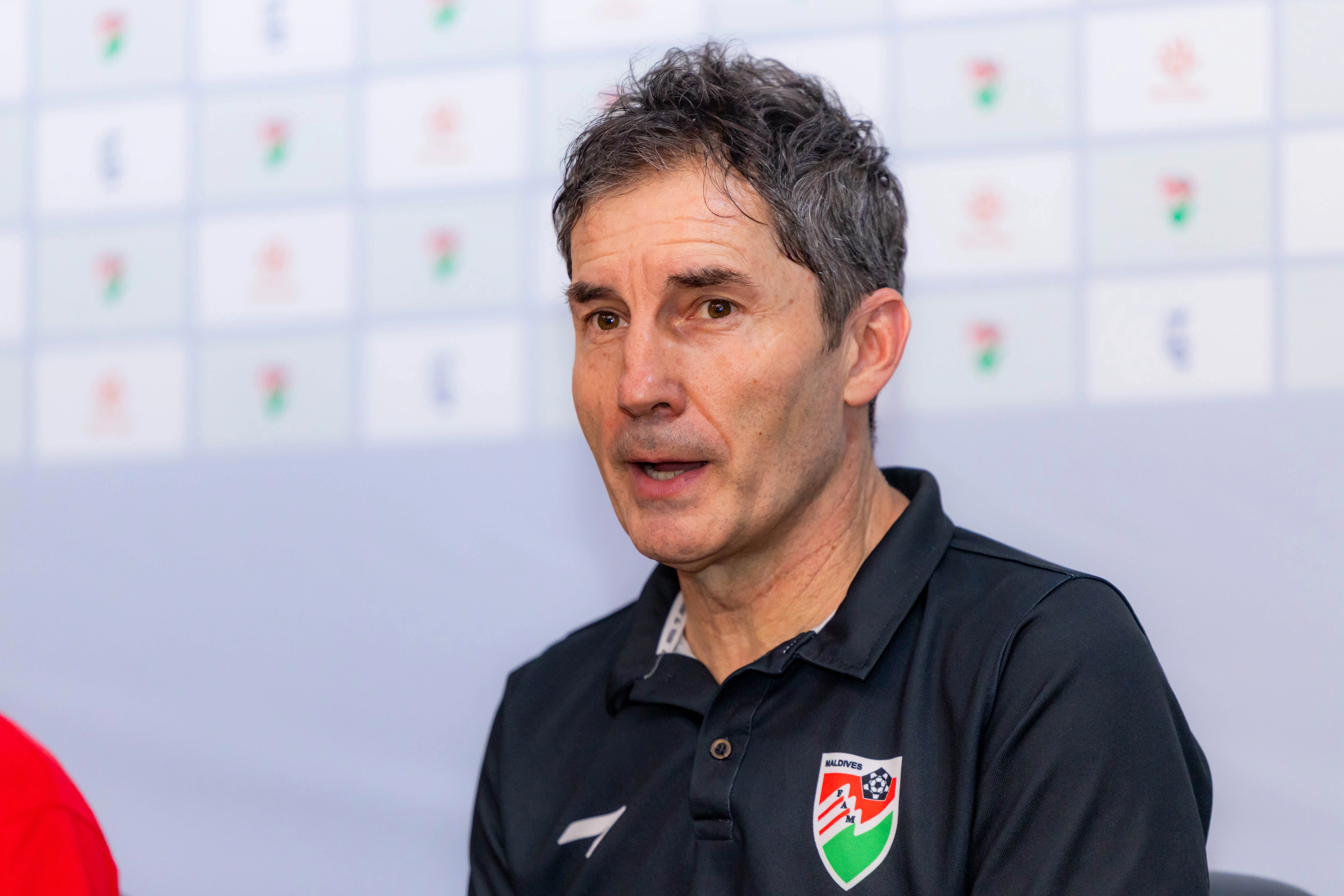
Maldives head coach István Urbányi acknowledged the significant gap between the Maldives and China after his team suffered a 3–0 defeat against China.
Speaking at the post-match press conference, Urbányi praised China’s quality, organisation and intensity, saying the encounter provided the Maldives with an opportunity to measure themselves against a stronger opponent.
The Maldives struggled to create attacking opportunities throughout the match and recorded no shots on target or off target, highlighting the difficulty they faced in breaking down China’s defensive structure.
China’s head coach, Shao Jiayi, expressed satisfaction with his team’s defensive performance and the way the players maintained their organisation throughout the game.
Urbányi said China demonstrated the level expected of a strong Asian team and pushed the Maldives players to their limits.
“China demonstrated the level of performance expected from a strong team,” Urbányi said, while acknowledging that the Maldives still had significant areas to improve.
He explained that China were well organised during the first half, while the Maldives attempted to maintain their own structure and compete in physical battles. However, the intensity of the Chinese side exposed differences between the teams.
The Maldives coach said the match offered important lessons, particularly in controlling the game without possession and dealing with the pressure applied by a stronger opponent.
Urbányi openly acknowledged that the Maldives were not yet capable of consistently handling China’s intensity and that the two teams were currently operating at different levels. He also noted that changes to the Maldives lineup affected the team’s organisation and caused some disruption to their structure.
Despite the defeat, Urbányi praised China and expressed his hope that the team would perform well in the FIFA World Cup qualifiers. He also highlighted the potential of China’s young players and wished them success in their upcoming matches.
Tournament Provides Development Opportunity
Asked how the invitational tournament could contribute to his work with the Maldives following his appointment earlier in the year, Urbányi explained that the decision to participate was made despite limited preparation time.
He said the team initially did not focus solely on whether to accept the invitation or on the possible results. Instead, the Maldives held three to four discussions with players and relevant stakeholders before deciding to take part.
He also highlighted China’s physical advantages, including differences in height and weight. However, he said he did not regret accepting the invitation, stressing that playing against stronger teams was one of the most effective ways for Maldivian players to improve.
“The best way to improve our players is through matches against strong teams. This is a very good way for us to develop.”
He added that facing higher-level opponents would help the Maldives identify weaknesses and understand the demands of international football.
Urbányi Highlights China’s Young Players
When asked which Chinese players had impressed him, Urbányi said he did not feel he was in a position to assess individual players. Instead, he praised the preparation and overall quality of the Chinese squad.
He reiterated that China and the Maldives were currently at different levels, adding that China had reached an Asian standard of football.
Urbányi said the Maldives hoped to return to the level of football the country had demonstrated around the year 2000. However, he acknowledged that the experiences of recent years had shown that the team still had a significant gap to close.
The coach explained that the Maldives were actively introducing young players, including footballers around the age of 19. The match against China, he said, exposed differences in intensity, physicality and overall performance.
The Maldives’ lack of attacking output further reflected the challenge of facing a well-organised Chinese defence, with the team unable to register a shot during the encounter.
Urbányi concluded by expressing his gratitude for the opportunity to participate in the tournament, describing the experience as valuable for the Maldives’ continued development.
For China, Shao Jiayi said the team’s defensive organisation and discipline were among the positive aspects of the victory, while the match also provided an opportunity to give younger players valuable international experience.