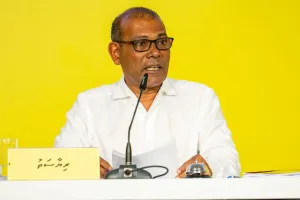
The Maldivian Democratic Party (MDP) has established the "Bodu Badhalu" (Big Change) office within its national secretariat and appointed Hassan Latheef as its Director General today.
"Bodu Badhalu" refers to a series of systemic reforms proposed by former President Mohamed Nasheed and former MDP Chairperson Fayyaz Ismail prior to Nasheed’s election as the party's current Chairperson. The proposals are based on the premise that the Maldives' governance structure requires fundamental changes.
Nasheed introduced these reforms during his campaign for the MDP chairmanship to garner member support, asserting at the time that such changes could only be realized through the MDP. He won the internal election with 69 percent of the vote.
During the first National Council meeting held after his election, Nasheed proposed the establishment of a dedicated office for the "Bodu Badhalu" initiative. The motion was passed unanimously by all council members in attendance.
The primary reform advocated by Nasheed and Fayyaz involves restructuring how the Head of Government and Head of State are elected. They have characterized this proposal as neither a traditional presidential nor a parliamentary system, but rather a model tailored specifically for the Maldives.
"We can give it any name we want; the core idea is for the head of government to focus on administration without being overly entangled with the broader functions of the state," Nasheed previously stated.
At a meeting held on April 19, Fayyaz noted that experience has shown it is difficult to claim any existing system is perfectly suited for the Maldives.
"We believe that based on our experiences in the Maldives, no single existing system is currently the most suitable for us," he said at the time.
Fayyaz explained that under their proposed changes, the head of government would be directly elected by the people. Meanwhile, the head of state would be elected through a vote cast by Members of Parliament and local councilors.
The proposal by Fayyaz and Nasheed also includes requiring public consent for the dismissal of Supreme Court justices and members of independent commissions. Additionally, the reforms seek to ensure better atoll representation in Parliament and introduce mechanisms for the recall of Members of Parliament.