Adhadhu CEO Fiyaz and Editor Hassan plead not guilty to Qazf in closed trial

Jun 8, 2026, 5:26 PM
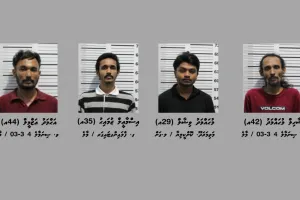
Fiyaz and Hassan outside court today.

Fiyaz and Hassan outside court today.

Adhadhu Editor Hassan Mohamed and Chief Operating Officer (CEO) Hussain Fiyaz Moosa have pleaded not guilty to the Qazf (an Islamic criminal offence of falsely accusing someone of adultery or fornication) charges. 

The trial is being conducted behind closed doors at the Criminal Court. During today’s hearing, the state presented the formal charges, which both Hassan and Fiyaz denied.

The Qazf charges are connected to the "Aisha" documentary released on March 28. It featured a former President's Office employee making sexual misconduct and corruption allegations against President Mohamed Muizzu. 

Police raided Adhadhu's office on April 28, a month after the documentary's release, when a journalist questioned Muizzu about the allegations. Fourteen days later, Hassan and Fiyaz were slapped with criminal charges that could see them jailed and lashed. 

They have also been barred from travelling overseas, with their passports held until July 27. The President's Office employee featured in the documentary has also been barred from travelling, but has not been charged.

Furthermore, Adhadhu journalist Mohamed Shahzan was sentenced to 15 days in prison after questioning Muizzu during a press conference. Another Adhadhu journalist, Leevan Ali Nasir, was sentenced to 10 days in prison for reporting on a court order that prohibited public discussion of the allegations against Muizzu.

Comments

Read More

Latest News

Lawsuit over decision to ban Adhadhu from briefings

Adhadhu has filed a lawsuit against the President's Office for banning its journalists from press briefings, calling it a violation of constitutional rights. The ban followed a reporter's question that allegedly breached a court order. The news outlet is seeking a court declaration to restore press freedom and access to information.

Govt reverses ban on plastic straws until 2031

The Maldives government has reversed its ban on plastic straws, delaying the prohibition on imports and distribution until 2031. The policy shift also extends deadlines for banning plastic water bottles and eases restrictions on small beverage containers, significantly slowing the nation's phase-out of single-use plastics.

"Judiciary lacked independence during Yameen's administration"

President Mohamed Muizzu criticized the lack of judicial independence during former President Abdulla Yameen’s administration, citing the 2018 Supreme Court raid and the arrest of justices. Muizzu claimed he witnessed the poor treatment of detainees firsthand and asserted that his own government does not interfere with the judiciary.

Six expats arrested for trying to smuggle out foreign currency

Six foreign nationals were arrested at Velana International Airport for attempting to smuggle approximately MVR 3.8 million in various currencies hidden inside cereal packets. This operation is part of a broader government crackdown on the illegal foreign exchange black market to stabilize the country's economy.

Exclusive: Maldives sought extension on $50M India debt

The Maldives government requested a further extension to repay a final $50 million debt installment to India, but the request was denied. Despite the refusal, the Maldives settled the payment last week using its Sovereign Development Fund. This follows previous rollovers and a $50 million grant provided by India earlier this year.

Two arrested after video of indecent act on Hiyaa tower balcony

Police have arrested a 36-year-old man and a 25-year-old woman after a video of them engaging in an indecent act on a Hiyaa Tower balcony went viral. The suspects are being detained for five days while authorities continue their investigation into the incident.

Legal expert warns constitution grants President absolute control

Legal expert Ali Hussain warns that the Constitution grants the President absolute control over state funds, land, and institutions. He claims the current system treats the nation as the leader's personal property, leaving justice inaccessible to others. Hussain argues that urgent amendments are needed to curtail these excessive powers.

Newsletter

Get the latest news delivered straight to your inbox