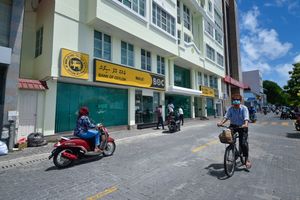
Public concern is mounting over a recent decision by the Bank of Maldives (BML) to restrict foreign currency transactions on cards used at overseas ATMs and POS machines by individuals remaining in the Maldives, because the move, aimed at curbing the misuse of card limits, allows the bank to access private information without consent.
The bank revealed yesterday that a digital integration has been established between BML and Maldives Immigration, ensuring that foreign transaction limits on cards are only activated once a customer departs the country. This measure is directly based on data provided by Immigration.
While BML already tracks dollar purchases made through the bank for overseas travel, this new integration grants the bank access to the travel data of individuals who may not even be customers of the institution.
"Why not just share information on everyone entering guesthouses and hospitals too? Providing private data to the bank in this manner is a major oversight," a user named mfurqan posted on X.
BML implemented this measure months after identifying issues where individuals were taking multiple cards abroad to exploit limits. The move comes at a time when the dollar shortage has intensified due to the ongoing conflict in Iran.
"This is a direct invasion of privacy. Information regarding a customer's travels should not be shared without any form of consent. If it pertains to foreign transaction limits, customer authorization must be obtained," another anonymous user wrote.
Members of the public have argued that the actions of a few individuals using multiple cards for overseas shopping should not result in a collective "punishment" for all citizens.
"Instead of covertly monitoring people through Immigration, the bank could have enabled a feature on its application allowing customers to activate foreign transactions themselves once they are abroad," another person suggested.
The Maldives currently lacks a comprehensive data protection or privacy law. Legal expert Ali Hussain noted that sharing such information with the bank in the absence of a legal framework is problematic.
"Information can only be shared if such a law exists. It is a significant error for Immigration to provide travel data to the bank without a supporting legal statute," Ali Hussain said.
The freedom of movement is a right guaranteed under the Constitution. Article 41 stipulates that every citizen has the right to leave and return to the Maldives. Some argue that this right is now being infringed upon.
"This is an infringement on the freedom of movement. Banks do not have the right to surveil people."
"I have not given consent for my travel information to be shared with a public limited company. This is a severe invasion of privacy. These issues must be challenged in court," another user posted on X.
Article 24 of the Constitution establishes that every citizen has the right to privacy. It states that a person's private and family life, their home, and their private communications are inviolable.
Neither the Bank of Maldives nor Maldives Immigration has yet issued a statement regarding these concerns.