Finance Minister Moosa Zameer has announced that the government is surveying two lagoons in the Male' area to establish fuel storage facilities for the "National Oil Reserve," an initiative aimed at shielding the Maldives from global energy market volatility.
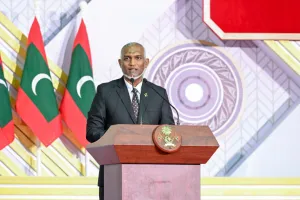
President Mohamed Muizzu announced the project late last month, outlining a three-phase plan to establish fuel storage across three regions, ultimately securing a one-year strategic oil reserve.
The first phase of the National Oil Reserve project will be centered in the Male' region. The locations for the remaining phases have not yet been disclosed.
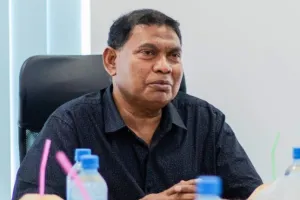
Speaking at a press briefing of the cabinet committee formed to address the impacts of the Middle East conflict, Zameer shared progress on the initiative, noting that it is a collaborative effort between the Finance Ministry, Economic Ministry, and the State Trading Organization (STO).
"STO is currently surveying lagoon areas near two islands. The necessary technical surveys are scheduled to begin next week," Zameer stated during a press conference at the President’s Office yesterday.
He noted that design work and feasibility studies required for financing are underway. He expects to present the final plan, including financing options and the selected site within the next two weeks.
When announcing the plan, Muizzu estimated the total project cost at USD 450 million, with each of the three phases requiring an investment of approximately USD 150 million.
While acknowledging that securing such significant investment immediately may be challenging due to global instability, Zameer stressed the importance of being prepared.
"It is clear that our existing storage is inadequate. Looking at the market shocks and economic shifts over the past decade, it is essential for the Maldives to expand its oil reserves," Zameer said.
He also addressed criticism regarding the feasibility of maintaining a year-long fuel supply. Some critics have argued that the logistics and costs of such extensive storage are impractical.
Zameer stated that the government welcomes this feedback and assured that these concerns would be addressed in the feasibility study and final plan. However, he maintained that a year-long reserve is both achievable and economically viable.
"For instance, through agreements with major oil distributors, we could host large stocks. This could allow us to purchase fuel as needed or arrange favorable cash-flow terms," Zameer explained.
The move to establish the reserve in a lagoon comes as STO continues its efforts to relocate its existing fuel farm from Funadhoo, a process that has faced delays for over two years.
The government ordered the relocation of the Funadhoo tanks to transform the island into a Special Economic Zone and an international financial center.
Initial plans to move the fuel farm to Maagirifalhu were scrapped in favor of Thilafushi in November 2024 to avoid additional land reclamation. At the time, STO Managing Director Shimad Ibrahim stated that higher-capacity tanks would be established at Thilafushi within three months; however, that project remains ongoing.