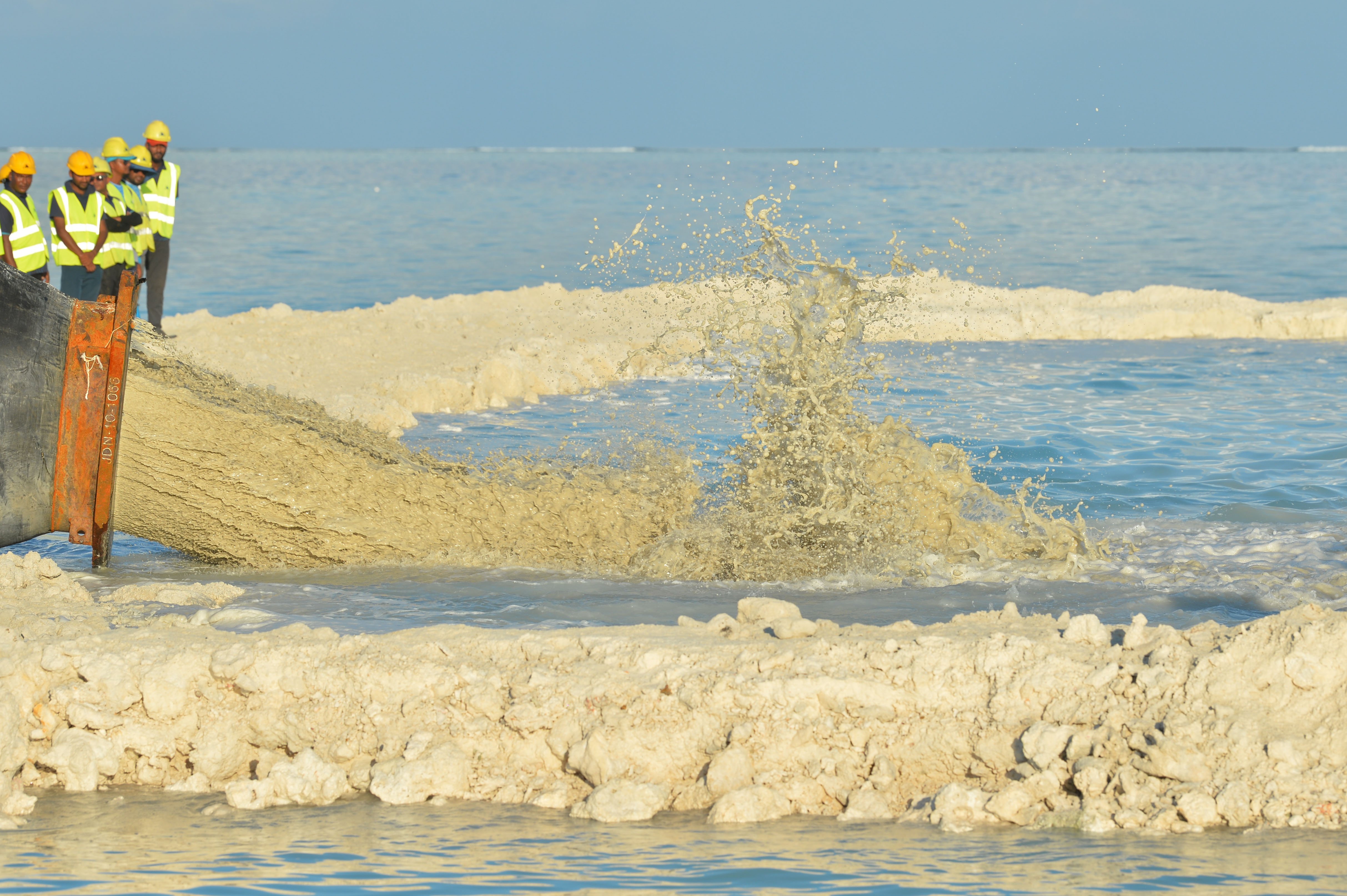
The government has made legal changes to allow sand borrowing and dredging for land reclamation from areas protected or declared "environmentally sensitive" under the environment law.
The government gave the authorization by amending regulations on dredging, deepening and land reclamation in lagoons and islands. According to the amendments gazetted by the Environment Ministry on Saturday, land reclamation, sand borrowing and dredging would be permitted with conditions from protected areas and "sensitive" areas for the purpose of projects approved by the cabinet or a cabinet committee.
The dredging, deepening and land reclamation regulations enacted 11 years ago on April 2, 2013 initially prohibited sand borrowing from four areas, which were:
- 100 meter area from edge of lagoon to island's shore
- 500 meter inner area of any lagoon from the outer wall
- If there is an island in the lagoon, 50 meter area inside the lagoon from the island's shoreline
- Areas protected under law number 4/93 (Environment Protection and Preservation Act of Maldives) or declared as "environmentally sensitive areas."
In addition to sand borrowing from protected and "sensitive" areas, dredging, sand borrowing and land reclamation were also prohibited within 200 meters of such areas.
However, the regulations were amended a year later to state that sand borrowing, land reclamation and dredging could be carried out in such areas with a permit from the Environment Protection Agency (EPA) for the purpose of development projects determined by the cabinet. The conditions for seeking permits included:
- (a) conducting detailed research on marine life and endangered species in the area
- (b) making arrangements for the protection, management and maintenance of an area or areas not smaller than the area including its natural features, or an area or areas designated by relevant agencies to the extent determined by the agency, in accordance with regulations, standards and guidelines determined by relevant agencies
- (c) determining the impact on the groundwater aquifer, conducting research on the changes, taking corrective measures if changes are expected, and monitoring from enforcement agencies
- (d) conducting research on possible flooding the island could face due to the changes and establishing an adequate drainage system on the island
Despite these conditions, the regulations stated that dredging, sand borrowing and land reclamation could be carried out in such areas.
titledesc
The new changes to the provision state that such work could be carried out with the EPA's permission after fulfilling the previous conditions in order to implement a project determined by the cabinet or a cabinet committee.
Therefore, due to the phrasing of the provision in the current change, it states that such work could be carried out. The ordering of provisions was revised and the conditions that need to be met were added as numbers under Article 13(d).
The changes appear to have been made to correct the phrasing and to ensure that the regulations comply with the normal ordering of provisions. However, the official reason for amending the regulation is unclear as the Environment Ministry has not been responding to calls.