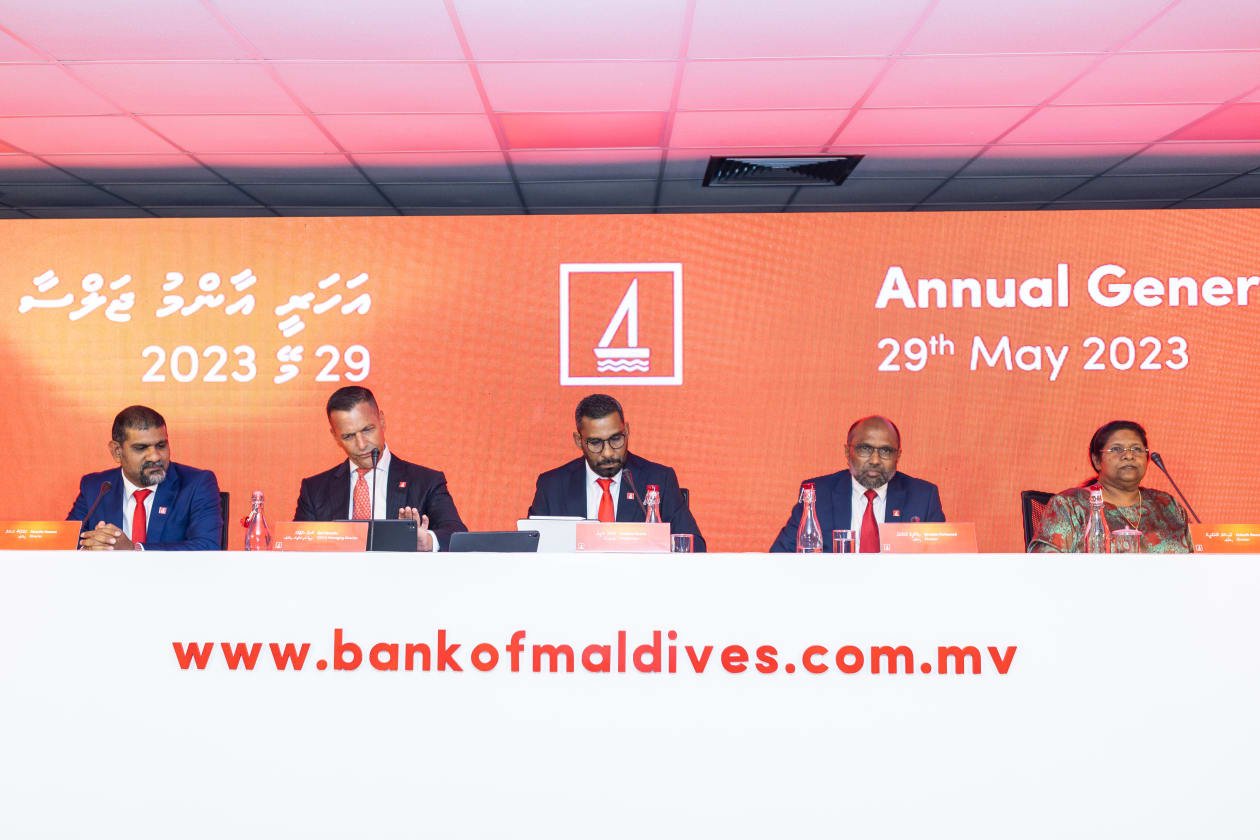
The removal of the chairman and board members of the Bank of Maldives (BML), a partially government-owned public bank, through the Privatization and Corporatization Board (PCB) contravened the bank’s operating procedures, Adhadhu has learned.
The government decided to sack the bank’s chairman and four directors from the board over the bank’s refusal to raise the dollar withdrawal limit for Maldivian students overseas. After the abrupt removal of the directors last week, two directors were reappointed. However, none of this was allowed by the bank’s operating procedures.
BML’s operating procedures very clearly specify the composition of the board, the term of office for directors, retirement of directors before the end of their term and rules for dismissal over incompetency.
BML directors are nominated by the bank’s shareholders and appointed to the board. As the largest shareholder, the government appoints seven directors. Of the remaining four, three are elected from among public shareholders. The other is an independent director nominated by the government.
Directors nominated by the government are approved in a poll inclusive of the government’s shares during an annual general meeting. Directors nominated by public shareholders are approved at the same meeting in a poll taken exclusively among public shareholders.
According to section 56 of the bank’s operating procedures, a person appointed as a director must fulfil the responsibilities of the role until the next annual general meeting, unless he or she is removed in accordance with the rules. This shows that the removal of any director must be in line with the operating procedures.
Matters related to the retirement, incompetence and removal of directors are stated in section 57 of the operating procedures. The section specifies 10 circumstances whereby a vacancy could arise in the post of a director. It does not include any way for the PCB to remove directors despite the government’s wishes.
The process for removing directors at the government’s wishes is laid out in subsection (b), which is through a resolution passed by a 51 percent majority of shareholders in attendance at a special meeting. As the bank’s majority shareholder, the government could easily do this without the votes of public shareholders.
As such, there are currently seven directors appointed by the government to the bank’s board in accordance with the operating procedures. It is notable that despite PCB’s announcement to remove BML’s directors, information on board members can be seen on the bank’s website and CMDA portal without any change to the board membership.
The process for the government to change the bank’s board is to propose the eight directors appointed by the government to the bank and to proceed in accordance with the rules, which is to nominate and approve a new board at an extraordinary general meeting.