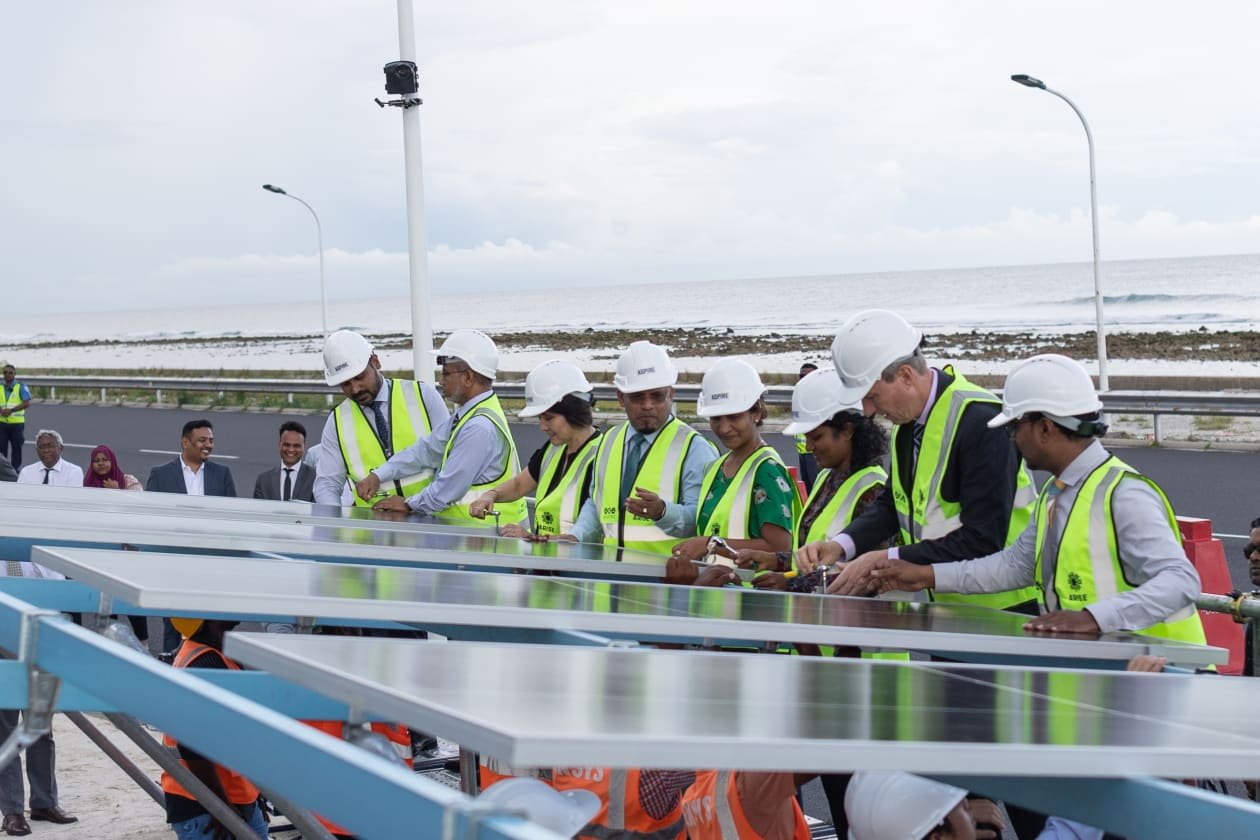
The relocation of solar panels from the Sinamale’ bridge highway between Male’ and Hulhumale’ as pledged by President-Elect Dr. Mohamed Muizzu would cost MVR 170 million, the Environment Ministry has estimated.
The Environment Ministry's project with World Bank assistance was undertaken by Thailand's Ensys Co.
The total cost of the project was USD 11 million or MVR 169 million.
With the project nearly completed and work ongoing on the final stages of connecting the panels to the grid, relocation would be a financial burden on the state, the ministry said.
"It is estimated that the state would have to spend about MVR 170 if the solar panels are to be removed from there and changed to another island. In addition, due to the state of the electricity system in the islands to which it is to be relocated, a further large expenditure will be needed to upgrade the network and establish battery storage," the ministry said in a press statement on Tuesday.
The President-Elect said the panels have obstructed the pleasant view of the bridge area.
Renewable energy is important but the project was not undertaken properly, Muizzu said. As the President-Elect, he said he intends to relocate the panels to another inhabited island.
The space underneath the solar panels installed in the seaward side of the link road provides cover and could be used for various social purposes under rules determined by the government, the Environment Ministry said.
Plans have also been made to make the solar structures green and turn the area into an attractive landmark, the statement added.
The decision to install the solar panels on the bridge highway was made by former President Abdulla Yameen's administration, during which President-Elect Muizzu was the Housing Minister, the Environment Ministry noted.
The ministry warned that relocation would cause loss of investor confidence and prompt international donors to reconsider planned assistance.
The project's concept design was made by Yameen's administration between 2017 and 2018, during which discussions with stakeholders also took place and regulatory approvals were secured.
The project was carried out with private sector financing under a guarantee facility provided by the World Bank.
It was one of the largest private investments in renewable energy in the Maldives to date, the Environment Ministry noted.
Electricity generated by the project is to be sold to the State Electicity Company (STELCO) at a rate of USD 0.10 per unit, which is MVR 1.68 per unit.
Electricity generated by the 1.5 megawatt solar PV system installed on 1,000 housing units in Hulhumale' under phase one of the 'Accelerating Sustainable Private Investment in Renewable Energy (ASPIRE)' project is being sold to STELCO at USD 0.21 per unit.
Once the project is complete, the solar panels will produce 7.3 million units annually and the state will save between MVR 15 to MVR 20 million a year from the cost of fuel imports.
The capacity to generate a further 67.8 megawatts of electricity would be added upon completion of various renewable energy projects to be carried out under phases.
Renewable energy capacity would increase to a total of 121 megawatts when the projects are completed, saving nearly MVR 1 billion from annual expenditure on importing oil.