Marine heat waves last longer in deeper water: Study

Sep 19, 2023, 5:55 AM
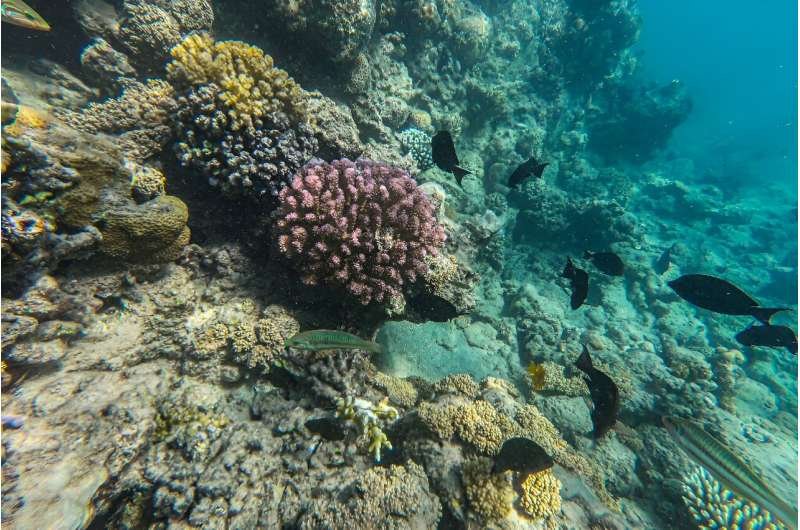
Marine heat waves can decimate species that cannot migrate to escape intolerably warm waters. notably corals.

Marine heat waves can decimate species that cannot migrate to escape intolerably warm waters. notably corals.

Marine heat waves may last longer and be more intense in deeper water, potentially threatening sensitive species as climate change makes the extreme events more frequent, researchers said on Monday.

Oceans have absorbed 90 percent of the excess heat produced by the carbon pollution from human activity since the dawn of the industrial age.

Marine heat waves—episodes of abnormally high water temperatures—have become more frequent and intense.

These can have a particularly severe impact on species that cannot migrate to escape intolerably warm waters, like corals in the Great Barrier Reef and kelp forests off southern Australia and the northeastern Pacific.

In a new study published in the journal Nature Climate Change, researchers looked at impacts of temperature spikes in deeper waters, which lead author Eliza Fragkopoulou said was "the first attempt to look into marine heat waves below the surface".

"Marine heat waves and their effects have been studied mostly at the ocean surface and we did not know much about their characteristics in the deep ocean," she told AFP.

Using on-site observations and modeling, researchers examined global marine heat waves from 1993 to 2019, including data up to 2,000 meters (6,562 feet) below the surface.

They found the intensity was highest at 50 to 200 meters below the surface, occasionally up to 19 percent stronger than the surface heat wave.

The duration also increased with depth, with warming persisting up to two years after temperatures returned to normal on the surface, the study said.

The scientists looked at a proxy measure of thermal stress known as cumulative intensity and mapped that against distribution of biodiversity at the edge of their maximum heat limits to see areas where marine creatures are potentially more vulnerable to changes.

These high stress conditions overlapped in up to 22 percent of the global oceans, they found.

Regional variability of marine heat waves makes measuring biodiversity exposure complex, and their duration varied by location due to different oceanic conditions.

In general, Fragkopoulou, of the Centre of Marine Sciences at Portugal's University of Algarve, said the impact on biodiversity was likely greatest from the surface to a depth of 250 meters.

The largest portions of the oceans categorized as highly exposed were found in the North Atlantic and Indian oceans, at depths between 1,000 and 2,000 meters.

Better monitoring 'urgent'

A separate study published last month in the journal Nature suggested that some marine creatures can withstand the heat better than others, with a finding that ocean fish can endure marine heat waves with no major impact on their numbers.

Fragkopoulou told AFP that more research was needed on heat waves in the deeper oceans to unpick the potential impacts on tourism and fisheries.

"Considering that marine heat wave impacts on deep-sea biodiversity are still largely unknown, there is an urgent need for more and better monitoring of the global ocean to understand their effects," she told AFP.

This story was produced by AFP.
Comments

Read More

Latest News

Mental health centre opened in Kulhudhuffushi

Kulhudhuffushi City has opened "Manas Hub," a new mental health center launched by the City Council and the Australian High Commissioner. The facility aims to reduce social stigma and provide accessible support, treatment, and early intervention. This milestone marks a major step in strengthening community-based mental health services.

Audit reveals millions in losses over project given to POLCO

An audit revealed millions in losses after the Home Ministry awarded a prison project to POLCO without competitive bidding. POLCO subcontracted the work for a fraction of the price and charged MVR 2.9 million for demolition work that never occurred. The Auditor General has recommended an investigation by the Anti-Corruption Commission.

Yameen urges Eagle Hills to scrap Rasmalé project

Former President Abdulla Yameen has urged Eagle Hills to scrap the Rasmalé project, labeling it an exploitation of a "morally bankrupt" regime. He cited public resentment and controversial lease terms that suggest a permanent loss of land. The project faces heavy criticism for its financial structure and perceived lack of public support.

PG had secured release of suspect detained with film stars

Shahil Mohamed, recently arrested with several film stars for drug offenses, was previously released from pretrial detention in a two-kilogram heroin trafficking case. The Prosecutor General’s Office had requested his release due to his medical condition and length of detention. He has now tested positive for synthetic drugs.

Eagle Hills to develop 5,000 housing units in Urban Isle

UAE’s Eagle Hills will develop 5,000 housing units in Hulhumalé’s "Urban Isle" as a prerequisite for the Rasmalé Waterfront project. The $400–$500 million development features three-bedroom apartments funded by future property sales. This initiative replaces a stalled $8 billion financial center project previously planned for the same site.

Two discharged, two in critical condition after road accident

Two people are in critical condition on ventilators and two others have been discharged following a motorcycle crash in Hulhumalé. The accident occurred when a motorcycle carrying three people fled police by driving against traffic. One victim suffered a brain hemorrhage, and the unlicensed driver reportedly has an extensive criminal record.

Renovation begins at Hulhumale' synthetic track

Renovations have begun on the Hulhumale' synthetic track to upgrade it to international World Athletics standards. The project involves installing a high-quality polyurethane surface to ensure athlete records are officially recognized. Work is expected to be completed by January next year.

Newsletter

Get the latest news delivered straight to your inbox