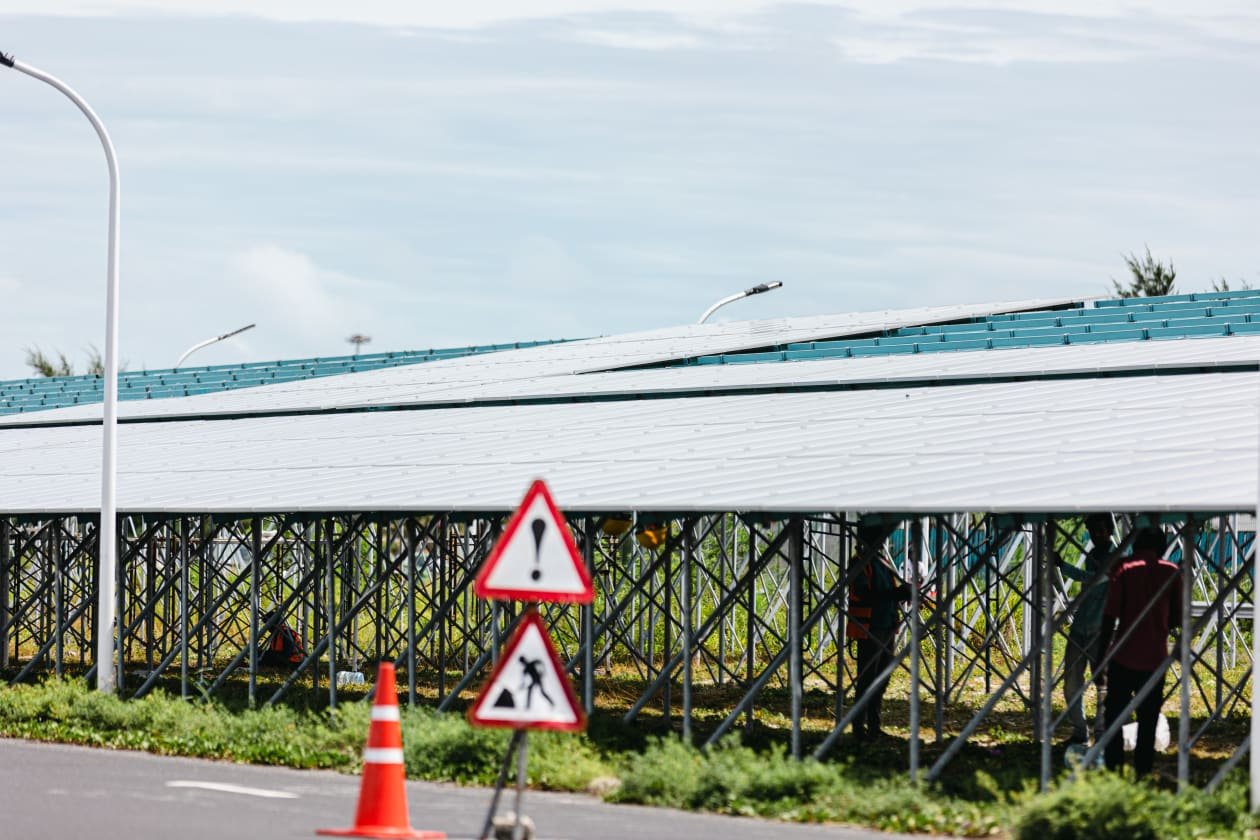
The government has decided to carry out an investigation after unattached solar panels kept for installation at the Male’-Hulhumale’ highway were blown off into the sea by strong winds.
Four solar panels that were to be installed on Tuesday evening blew away and fell into the sea. In a tweet about the incident, Male’ Mayor Mohamed Muizzu expressed concern about the potential for a dangerous accident and urged caution.
Ifad Waheed, communications specialist of the solar panel project, said none of the panels that were blown off had been attached to the structure. All of the panels have been retrieved from the lagoon, he said.
“There’s no damage to the structure from a preliminary inspection. And a design fault has not been noted. From the inspection so far, we have not noted any incident or threat that could pose a danger to those travelling on the highway,” Ifad said.
A further internal investigation will be conducted into how the ministry’s contractor carried out the work and precautionary measures will be ensured before work resumes, he said.
"All the attached panels will be checked over this to ensure that there aren't any problems with any panel. And supervising the work will be increased and it will be inspected repeatedly," he said.
Installing solar panels on the Male'-Hulhumale' highway under the 'Accelerating Sustainable Private Investment in Renewable Energy (ASPIRE)' project is now 70 percent complete. Work is ongoing on setting up the steel structure on the seaward side and installing solar panels.
The environment ministry project with World Bank assistance is carried out by Thailand's Ensys Co.
Electricity generated by the project is to be sold to the State Electricity Company (STELCO) at a rate of USD 0.10 per unit, which is MVR 1.68 per unit. Electricity generated by the 1.5 megawatt solar PV system installed on 1000 housing units in Hulhumale' under phase one of ASPIRE is being sold to STELCO at USD 0.21 per unit.
Once the project is complete, the solar panels will produce 7.3 million units annually and the state will save between MVR 15 to MVR 20 million a year from the cost of fuel imports.