Advertisement




Urbányi Begins New Maldives Era with Focus on Long-Term Rebuild Ahead of Timor-Leste Test
31 މާރިޗު 2026 - 09:23 0
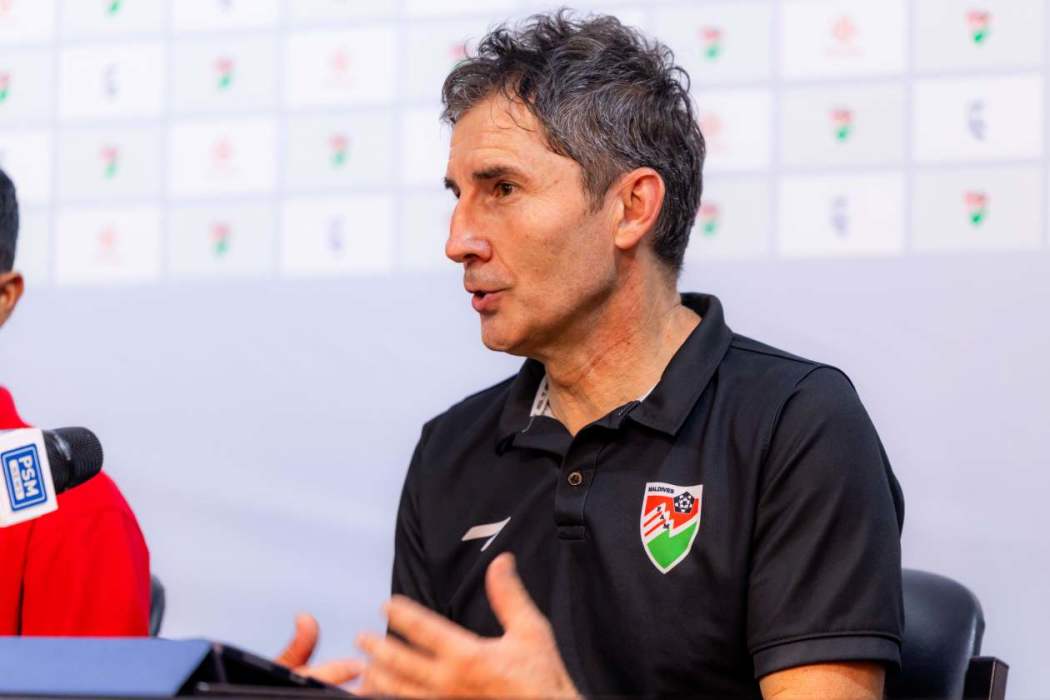
Urbányi shared his thoughts with reporters during the press conference --- PHOTO: Images.mv
Urbányi Begins New Maldives Era with Focus on Long-Term Rebuild Ahead of Timor-Leste Test
31 މާރިޗު 2026 - 09:23 0
Male' Maldives: After more than a decade away, István Urbányi has returned to lead the Maldives national football team, beginning his third spell with Maldivian football at a crucial moment for the national side.
The 58-year-old Hungarian officially resumed duties in January 2026 as both head coach and technical director, returning to a football environment he knows well after earlier spells between 2009 and 2013, when he worked with both the senior national team and the under-23 programme.
His comeback comes with immediate competitive pressure, as Maldives prepare to face Timor-Leste national football team in their final Group A fixture of the Asian Cup qualifying campaign.
For Maldives, the match carries significance beyond pride. The team currently sits bottom of the group after losing its first five matches, and victory is required to avoid finishing last and move above Timor-Leste in the standings. The fixture also carries added motivation after Maldives suffered a 1–0 defeat away to Timor-Leste in June last year.
While the immediate target is victory, Urbányi has made clear that his broader objective extends far beyond one result. Since returning, his focus has centred on rebuilding competitive standards, strengthening football foundations, and identifying the core group capable of carrying Maldives forward over the next several years.
He has stressed that while football in the region has evolved, the real challenge for Maldives remains creating the right environment for players to develop consistently. In his assessment, the gap between countries is less about talent and more about exposure, competitive rhythm, and football structure, areas he believes require sustained long-term work.
A major part of that approach has been balancing experience with youth. Urbányi has recalled several senior players from earlier eras, not simply for their on-field contribution, but because of the leadership and understanding they can transfer to younger players entering the national setup.
The current squad includes a number of experienced figures from previous national team generations, alongside players Urbányi believes can help translate his football ideas quickly inside a short preparation window. At the same time, he has emphasized that the long-term aim remains to build around players aged between 24 and 26, an age bracket he sees as the natural core of a competitive national team.
Veteran names remain important in that transition, as former two captains, Ali Ashfaq (Dhagandey) and Imran Mohamed. Ashfaq, 40, returned to National squad after three years while Imran is in the coaching team.
Urbányi views established senior players not only as performers but as cultural references inside the squad, helping younger players understand professionalism, discipline, and responsibility at international level.
Leadership inside the squad has also been approached carefully. While experienced senior players continue to hold influence, the coach has made it clear that leadership and captaincy are not identical roles, with the current generation expected to take increasing responsibility on the field.
Tactically, Urbányi wants a side that is more aggressive, organized, and proactive than recent Maldives performances have shown. He has identified collective pressing, discipline without the ball, and quicker decision-making as immediate priorities.
He believes modern football increasingly rewards teams that can think and react quickly under pressure, and that limited competitive intensity in recent years has affected player rhythm and decision speed. For that reason, much of the early work in camp has focused on rebuilding habits rather than introducing complex systems.
The SAFF U-20 Championship also forms part of that wider rebuilding process. Although Maldives failed to reach the semifinals, Urbányi has pointed to visible improvement across the tournament and confirmed that several youth players remain part of the senior national team project, though not immediately due to physical and emotional recovery after the tournament.
He views youth integration as essential, but insists players must enter senior football at the right moment and under the right conditions.
For now, attention turns to Timor-Leste, where Urbányi hopes to see early signs of the identity he wants to establish: a team that shows commitment, tactical clarity, and the courage to play with purpose.
He has repeatedly framed this return not as a short-term rescue mission, but as the beginning of another cycle that requires patience, realism, and collective belief.
For Maldivian football, today’s match may offer only one result on paper, but for Urbányi, it also serves as an early measure of how quickly a new foundation can begin to take shape.
Comment