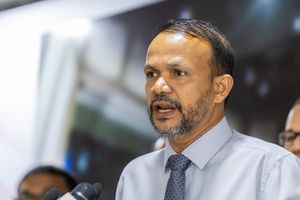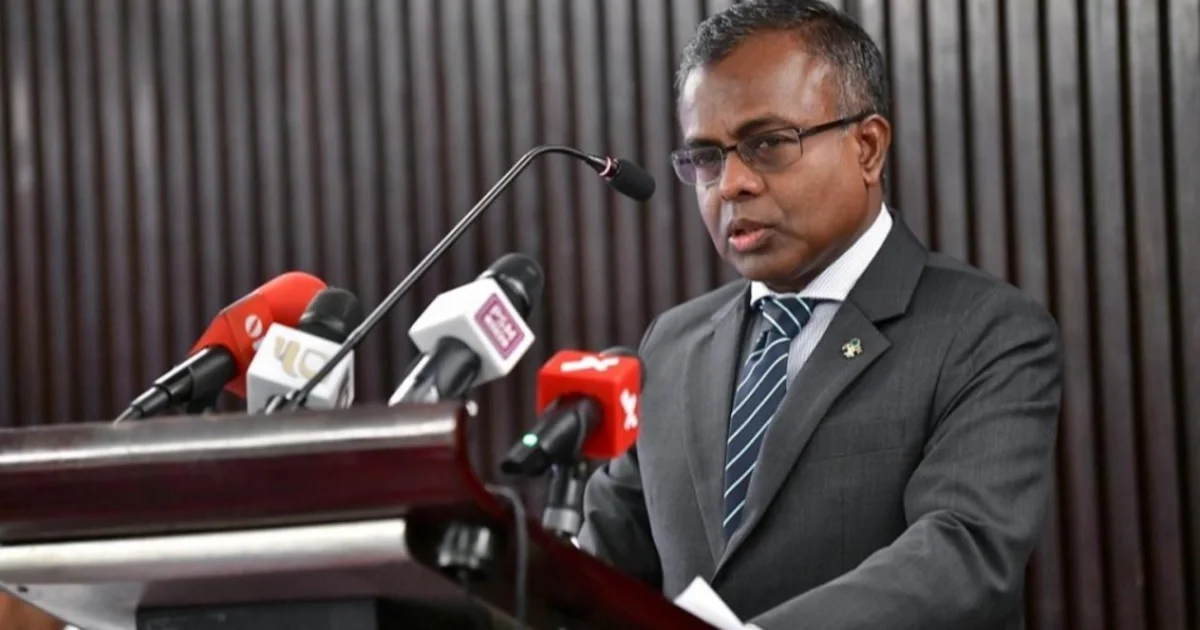
Former Chief Justice Dr Ahmed Abdulla Didi said today that President Mohamed Muizzu is not an Islamic leader, describing his administration as secular.
Speaking on Raajje TV’s "Fashaa Iru" program, Didi remarked that Muizzu is detached from the hardships faced by the public and argued that the President’s conduct does not align with the principles of Islamic leadership.
"One cannot witness the plight of the Maldivian people or the state of this nation by simply commuting between home and the office in a Mercedes-Benz. Therefore, he is not presiding over an Islamic government. President Muizzu cannot be called an Islamic leader; he is exhibiting the characteristics of a secular ruler," Didi said.
Didi further noted that Muizzu’s focus on televised optics and his penchant for luxury attire are inconsistent with the behavior of Islamic leaders, suggesting a need to reflect on Islamic history.
"In a country facing such budgetary constraints and revenue shortages, our President should not be wearing the most expensive suits or luxury watches. One must look at Islamic history. Currently, national affairs are being conducted for the sake of television appearances," Didi added.
"It is not enough to hold meetings with residents just for show. To serve a genuine purpose, the President should follow the example of Caliph Umar; after the dawn prayer, he should walk the streets of Male' to observe the condition of the roads and the reality of the citizens' lives."
Highlighting that criticising a leader's directives is permissible under Islamic Sharia, Didi stated that the government should not resort to court orders to silence journalists under the guise of "gag orders" whenever they speak out.
"The reality is that criticism and dissent are broadly permitted in Islamic Sharia; this is the true essence of 'enjoining good and forbidding evil.' It is not about reacting in anger. When a journalist says something, the response should not be to issue a court-like directive claiming they have violated a gag order to stop them," he said.
Furthermore, Didi alleged that the government’s decision to grant a portion of Rasmalé to Eagle Hills was made by bypassing the separation of powers and failing to establish the necessary legislative framework. He emphasized that while the executive claims it will formulate laws, the legislative power remains solely with the Parliament.
However, he noted that the Parliament currently appears to be a body elected to carry out the government's bidding, which he suggested reflects the troubling direction in which the country is headed.