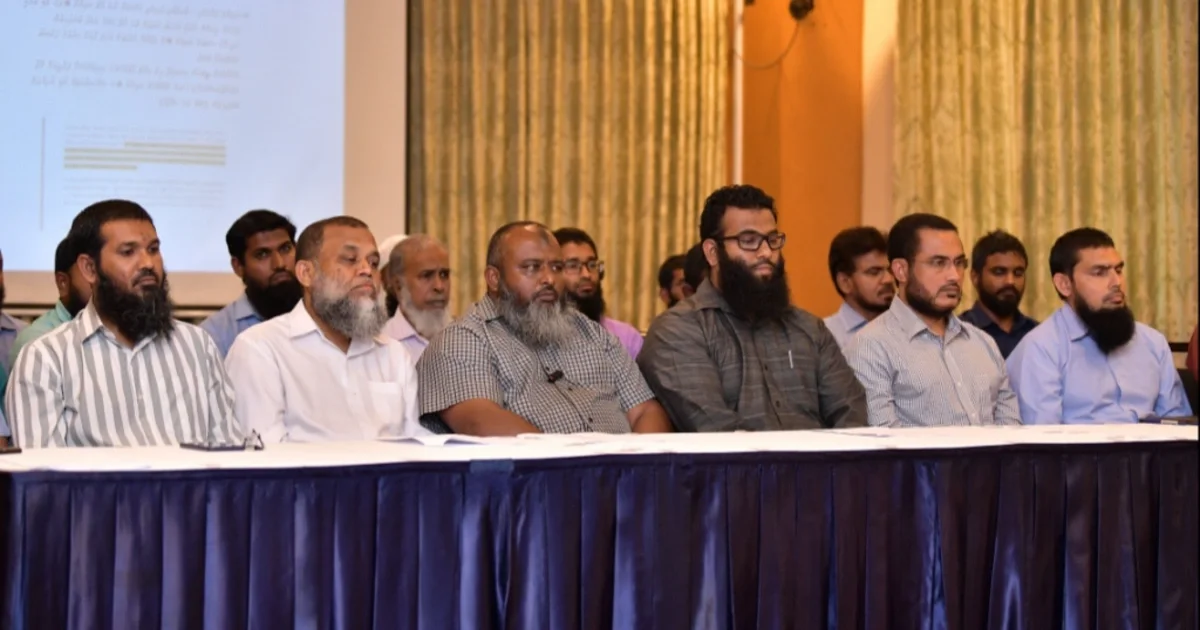
An investigative study conducted by the "Ilmuveringe Gulhun" (Scholars' Union) has asserted that it is a religious obligation for the government to halt the Rasmalé project in its current form.
A draft of the study, which examined the government's decision to hand over Rasmalé to the United Arab Emirates-based Eagle Hills, has been circulated to the organization's members.
The study, a copy of which was obtained by Adhadhu, notes that while engaging in trade and fostering relations with non-Muslims is permissible, such dealings must adhere to Islamic principles. Highlighting that the Rasmalé project currently fails to meet these requirements, the study concludes that stopping the project is a religious duty of the government.
"The government still retains the legal authority to suspend this project. Furthermore, the government is legally obligated to halt it. Any further progress on this project must only occur through renegotiation," the study stated.
The report warns that the settlement of a large non-Muslim population near Malé would pose religious risks.
"The greatest religious threat is not the construction of a church or the holding of secular festivals. The biggest religious danger is the establishment of a population of 30,000 foreigners near the capital, Malé, living under the same conditions as those in resorts," the study noted.
While the government maintains that Rasmalé is being leased to Eagle Hills for 99 years, the company has stated that if a property in Rasmalé is sold or gifted before the 99-year term expires, a new 99-year lease period would commence.
The Scholars' Union study also addressed this point. Citing the Khaybar Agreement, the study argued that it is impermissible to relinquish Muslim land indefinitely or under an agreement that has no definitive end.
The Khaybar Agreement was established in the seventh year of the Hijra following the conflict between Muslims and Jews. Under that agreement, Jews were permitted to reside in Khaybar; however, the contract was structured so that Muslims could terminate it without conditions whenever they wished.
"Under the Khaybar Agreement, the land remained in the hands of the Muslims and under Muslim sovereignty," the study emphasised.
The study has been sent to more than 160 scholars who are members of the association. The paper will be finalised and released to the public after incorporating feedback from these scholars.
A confidential agreement to hand over Rasmalé to Eagle Hills was signed on September 21. Rasmalé, which was reclaimed using state funds, is being handed over without an acquisition cost or land rent.
The government claims the lease is for 99 years. As this is not currently permitted under existing laws, the government is working to draft new legislation to facilitate the project. Efforts are also underway to sign a permanent agreement by November 11.