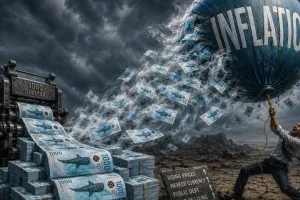
This year, 2026, began with the largest budget in the Maldives' history, together with the heaviest debt repayment schedule the country has faced.
Compared with the first six months of previous years, revenue rose significantly in the first half of this year. However, alongside that, rising expenditure, record debt repayments, and the growing volume of unpaid bills (arrears) owed to various parties, together with the scale of financing needed to run the budget, show that despite the rise in revenue, the fiscal outlook remains highly challenging.
By the middle of the year, a large share of the amount budgeted for repaying the principal of debt had already been paid. However, with domestic borrowing from the local financial market continuing to rise, questions arise as to whether the Government can manage the second half of the year without taking on significantly more debt, without further increasing unpaid financial obligations, or without making major changes to the budget passed by the People's Majlis.
From a Widening Deficit to Financing Pressure
A fiscal deficit arises when Government expenditure during the year exceeds the revenue and grants received, creating a gap that must be financed. However, the deficit does not represent the full amount of cash the Government needs to raise. Financing is also required to cover debt principal repayments, loans disbursed by the Government, investments, and transfers to financial funds such as the Sovereign Development Fund (SDF).
Based on audit reports and published figures, the budget deficit over the past three years stood at:
· 2023: MVR 15.1 billion [World Bank estimate: MVR 10.7–10.8 billion]
· 2024: MVR 13.1 billion [World Bank estimate: MVR 10.8 billion]
· 2025: year-end fiscal reports show a deficit of approximately MVR 3.5 billion [World Bank estimate: MVR 5.1 billion]
Looking at these figures, the sharp narrowing of the deficit in 2025 should not be read as the result of deliberate fiscal consolidation. Capital expenditure fell sharply that year because of liquidity constraints in executing the budget. Even so, budgeted spending commitments did not fall to the same extent and, as the World Bank has reported and the previous year's figures confirm, delayed payments caused a further increase in unpaid bills (arrears) owed to various parties.
While last year's budget stood at MVR 49.2 billion, Ministry of Finance figures show that actual expenditure was MVR 43.1 billion. During that year, while recurrent expenditure was spent close to the budgeted level, only MVR 6.8 billion of the MVR 12.6 billion allocated for capital expenditure (projects) was actually spent.
As a result, although the year's deficit narrowed, Government figures show that of the MVR 20.76 billion budgeted as financing to cover MVR 5.2 billion in debt principal repayments, along with additional investments, loans disbursed, and transfers to the SDF, only MVR 12.34 billion was actually raised during the year, leaving MVR 8.42 billion unraised. So although the deficit appeared smaller, it is clear that spending fell short of the budgeted level because the required cash (financing) was not fully secured.
Financing Required Beyond Revenue and Grants, and Financing Raised (2023–2025)
Figures in MVR billion
| Year | Financing Required | Financing Raised | Difference |
| 2023 | 21.31 | 15.86 | − 5.45 |
| 2024 | 19.36 | 15.40 | − 3.96 |
| 2025 | 20.76 | 12.34 | − 8.42 |
Note: Financing-required figures are based on State Budget estimates. Financing-raised figures for 2023–2024 are based on Auditor General reports. The 2025 figure is derived from published Government data and remains unaudited and independently unverified.
The Government's difficulty in raising the cash needed to run the budget contributes to a growing accumulation of amounts owed to various parties.
In this regard, audited figures show that unpaid bills owed to various parties stood at:
· End of 2022: MVR 1.23 billion
· End of 2023: MVR 3.12 billion
· End of 2024: over MVR 6 billion
Taking into account the World Bank's statement that arrears rose further in 2025, and estimating the extent of the shortfall in financing secured for that year's budget, unpaid bills owed to various parties by the end of the year are expected to exceed MVR 8 billion.
Halfway Through 2026: Where the Fiscal Picture Stands
By the end of June 2026, the State had received 55 percent MVR 22.4 billion of the revenue and grants estimated for the full year, while Government expenditure over the same period reached 48 percent of the annual budget, or MVR 23.4 billion. During this period, only 35 percent of infrastructure development (PSIP) projects had been implemented. MVR 8.99 billion was spent on debt repayment during this period, 70 percent of the total amount budgeted for debt repayment for the year. In the same period last year, debt repayment stood at MVR 3.28 billion. Although revenue received continued to grow through the middle of the year, a large share of what the State received during this period was spent on repaying debt.
Budget Execution as of End of June 2026
Figures in MVR billion
| Indicator | 4 July 2024 | 2 July 2025 | 2 July 2026 |
| Revenue and Grants | 18.29 | 20.29 | 22.40 |
| Expenditure | 23.11 | 19.22 | 23.38 |
| Fiscal Balance (Deficit/Surplus) | − 4.82 | + 1.07 | − 0.98 |
| Debt Repayment | 1.26 | 3.28 | 8.99 |
Note: Figures are taken from Ministry of Finance reports. The 2024 column uses figures as of 4 July 2024. The 2025 and 2026 columns use figures as of 2 July of the respective years.
Debt Repayment and Rising Domestic Borrowing
The 2026 debt repayment schedule was budgeted on the expectation that part of the financing would come through an external bond or sukuk. However, while the figures do not show that an external bond or sukuk was issued during the first half of the year, Government securities in the domestic financial market rose in step with the timing of the April repayment of external debt.
Government securities are Treasury Bills (T-bills), Treasury Bonds, and other such debt instruments that the Government issues to raise money from banks, pension funds, Government-owned companies and investors, with a commitment to repay the principal and interest upon maturity.
Between March 2026 and the first week of May of that year, the stock of Government securities rose by MVR 5.4 billion. This period coincided with the settlement of the USD 500 million sukuk and the repayment of the USD 400 million currency swap facility. Although it cannot be confirmed that these securities were used directly to fund those repayments, this together with official reserves, the Sovereign Development Fund, and the renewed INR 30 billion currency swap facility indicates that domestic borrowing formed an important part of the financing strategy for these debt repayments.
The Second Half of 2026: Weathering the Storm
The first half of 2026 showed that strong revenue growth alone cannot eliminate fiscal pressure. Based on current trends, revenue is on track to exceed the budgeted MVR 40.37 billion, potentially reaching between MVR 42 billion and MVR 44 billion. However, even though most of the year's debt repayments have already been completed, the Government enters the second half of the year with domestic debt rising, unpaid obligations accumulating, and continued pressure from subsidy and healthcare expenditure.
The greatest challenge for the second half of the year is financing. While revenue exceeding the budgeted amount will reduce part of the borrowing requirement, the Government will still need to raise a substantial amount of additional financing to complete the approved budget and meet both current and outstanding obligations.
Beyond the revenue and grants estimated for 2026, the total financing required to cover the MVR 8.84 billion fiscal deficit, MVR 12.91 billion in debt principal repayments, and other financial transactions amounts to MVR 26.26 billion. Given that financing raised over the past three years has averaged around MVR 15 billion per year, it cannot be assumed that most of this additional financing requirement will be met without printing additional money.
If the additional financing targeted in the budget is not secured, delays in payments to suppliers, contractors and service providers to the Government will increase further. In addition, since money will also be needed to settle unpaid bills carried over from previous years, part of any new borrowing will be used not to finance current expenditure but to settle past obligations. It is therefore plausible that by the end of 2026, the Government's unpaid obligations (arrears) to various parties could exceed MVR 10 billion. If the Government delays payments owed to businesses and individuals, the resulting cash shortage will spread to suppliers, employees, banks and taxpayers, slowing the circulation of money in the private sector and weakening economic activity.
By July of this year only around one-third of PSIP had been implemented, so while there may appear to be room left in the project-spending budget, subsidy expenditure had risen sharply by mid-year and was approaching the full annual budgeted amount. As a result, settling Aasandha, interest costs and other significant outstanding obligations will depend on securing additional financing. At the same time, T-bills and Government securities issued in the first half of the year will need to be refinanced upon maturity, and if the renewed INR 30 billion currency swap facility is not extended or amended, that too will factor into refinancing considerations.
Taking these factors into account, by the end of 2026 total budget expenditure excluding debt repayment could reasonably reach between MVR 51 billion and MVR 54 billion, with the fiscal deficit plausibly rising to around the MVR 12 billion range. This is not merely an independent estimate: the World Bank's own base-case projection likewise estimates that the annual deficit will widen to around 13 percent of GDP.
Two indicators will show, by year-end, whether this projection is materialising. The first is subsidies: with the subsidy budget already close to exhaustion by mid-year, a supplementary budget submitted to the People's Majlis under Article 96(b) of the Constitution would be the clearest public admission that the approved budget was not held to. The second is unpaid obligations: if amounts owed to suppliers and contractors rise to around or above MVR 10 billion, it will mean that part of this year's borrowing is not financing 2026 at all it is financing bills left unpaid from previous years.
Either way, the lesson from 2026 is not that revenue collection failed, revenue did increase. The lesson is that even with record revenue, a record budget and record debt repayments, the cash-financing gap the Government must fill keeps widening. The problem is the accumulated weight of past borrowing decisions, which now requires debt to be serviced from domestic resources at a rate far outpacing the growth of the country's own output. Raising debt in the domestic market in order to convert it into foreign currency to service external debt places continual upward pressure on the exchange rate. That cannot be called fiscal consolidation. It is the gradual narrowing of Maldivians' own capacity to determine the value of their own currency. And unless this trend is changed, each year's fiscal burden will simply be passed on to the next.