A government that cannot finance its own housing projects is preparing to sell long-term residency in those same projects to the world’s wealthy in exchange for residency. Every Maldivian should pause and ask: what property of ours are we offering, to whom, and on what terms? And, in the name of our sovereignty, can it ever be recovered?
Todays Fiscal Reality
With the Maldives’ fragile economy increasingly exposed to financial risks and adverse external conditions, the country faces serious risk of debt distress. The ADB projects that economic growth will slow this year and that per-capita productivity growth will fall below 1%, while external reports, with total public debt standing above USD 9.5 billion and expenditure continuing to outpace revenue, make clear that debt will rise further in the period ahead.
The state’s usable reserves now hold barely enough foreign currency to cover a single month of imports, and the funds set aside in the Sovereign Development Fund (SDF) for debt repayment have fallen drastically [3]. With a large share of the state’s foreign currency income already consumed by debt service, the need to increase the country’s foreign currency inflows is beyond dispute.
Chasing Political Ambition, Hoping to Escape the Curse of Debt
With the country’s financial future balanced on the edge of indebtedness and the government desperate for foreign currency and eager to attract foreign investors, large land reclamation projects have nevertheless been launched in four directions around Malé in the name of housing. Begun without a technically established, safe, and coherent plan, the financial future of these projects carries no certainty.
And with the works at Hulhumalé Phase 3, Giraavarufalhu, and Gulhifalhu standing as they are, and no published master plan, even the ‘hope’ of land yet to be reclaimed from Ras Malé’s unfilled lagoon has now been offered for sale. Under the ‘Pearl Residency’ programme introduced for the world’s wealthy, the government’s own marketing campaigns make it clear that this is a special investment product that bundles premium real estate with long-term residency visas.
Selling Land Ahead of the National Interest: Shaping the Law to Maximize Foreign Investment
What we are experiencing today is the stalling of strategically vital urban development projects for the Maldivian people, while, within just eighteen months, legal changes were made and the administrative framework was reshaped to open those very areas to foreign capital.
Under the Foreign Investment Act (Law 11/2024), which came into force in 2024, foreign investors are free to repatriate their investments and profits from the Maldives to any extent they wish. In granting investors permanent protection from the decisions of future governments, all rights derived from international treaties are placed above domestic law, while no comparable protection whatsoever exists in that Act for the rights of Maldivian citizens. There is no condition obliging foreign-run real estate projects to provide housing for Maldivians, no employment quota, no arrangement for sharing profits with the state and no limit on the number of licences that may be issued.
After this law, the Urban Planning and Management Act (Law 16/2024) and the 13th Amendment to the Decentralization Act (Law 7/2010) vested in the President the power to determine national land-use policy and then, under the Urban Development Act (Law 28/2024), which concentrates all development powers in a single centre, near-absolute authority over Maldivian land was delivered to the President of the Republic. While these changes do not grant foreigners direct freehold ownership of Maldivian land, the ‘long-term leasehold’ (rental ownership) and ‘strata property’ (individually ownable unit) systems effectively hand the real economic and domestic control of those areas to foreign parties.
The final link added to this legal chain was the law passed as an amendment to the Special Economic Zones Act (Law 24/2014). It further widened the definition of an SEZ, removed the rules governing import and export duties from the general jurisdiction of Maldives Customs, added to the categories of SEZ a new concept called the ‘sustainable township’ (a large area developed under a single management as a real estate or integrated tourism development, in which residential facilities and public services are established) and set the property transfer tax rate at just 4%.
The President’s Words and the Ministers’ Vision
In his 2025 Presidential Address, President Dr Muizzu introduced the ‘Pearl Residency Programme’ as a useful new initiative, and at the Malaysia Business Forum held that year he announced real estate as a priority sector for foreign investment.
In April 2026, in an article published in the Maldives Independent under the title ‘Why real estate matters to the Maldives’, Housing Minister Dr Abdulla Muttalib wrote that the sector would attract substantial foreign and domestic investment and stated that beyond affordable housing it must also target investors and buyers of high-end ‘premium projects'.
He noted that real estate would open the door to mortgages, real estate funds, and new financial products, broadening the financial sector. Presenting these as instruments allowing foreign investment to extract the financial value of Maldivian land, he wrote directly that President Muizzu’s restructuring of the Ministry’s mandate was no ordinary administrative matter, but a ‘deliberate decision’.
Yet not a single principle, plan, economic or financial theory, or framework for protecting the national interest underlying the vision set out in that article has been submitted to the People’s Majlis, nor is any visible to the public.
The Road Other Nations Walked and Their Struggle to Turn Back
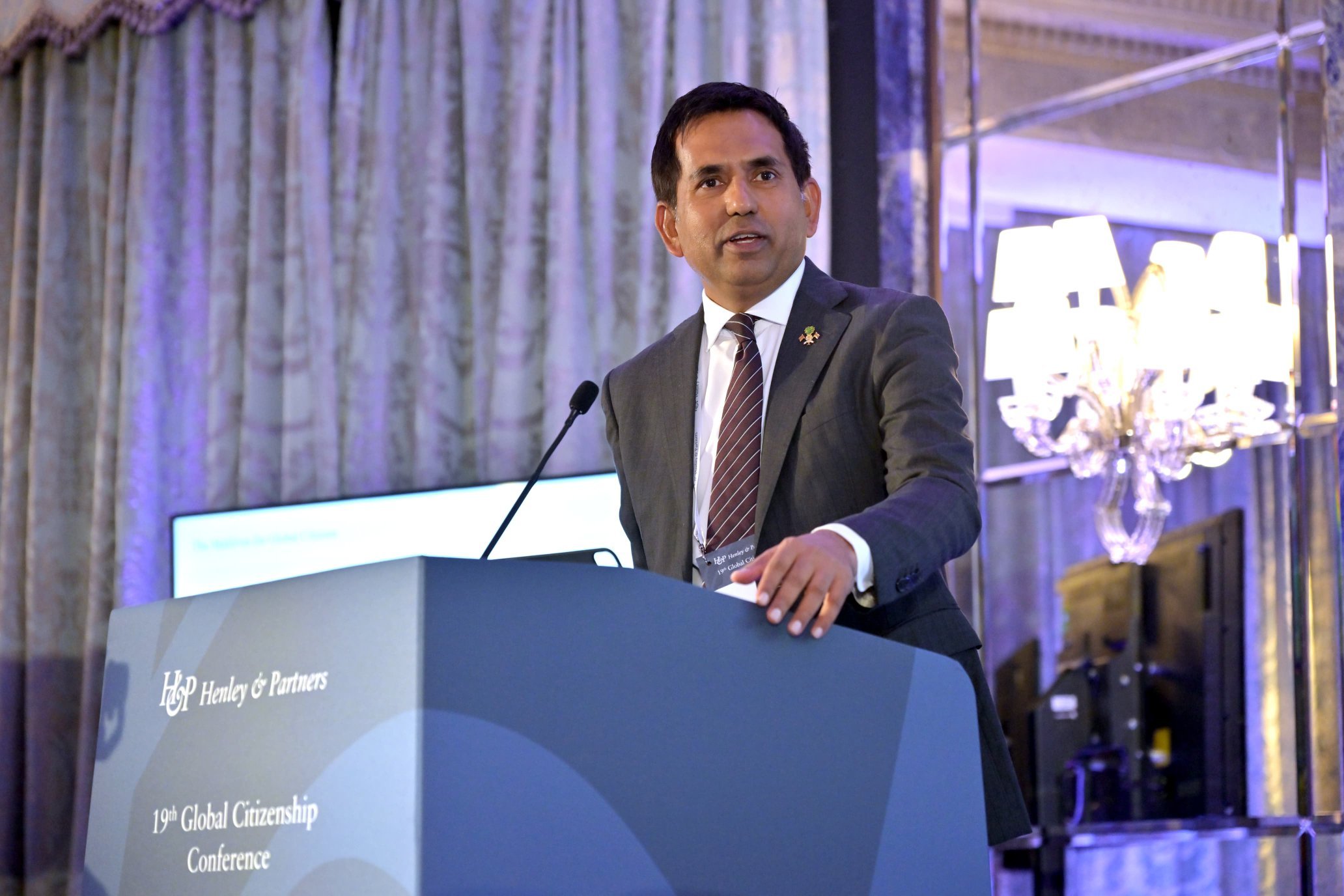
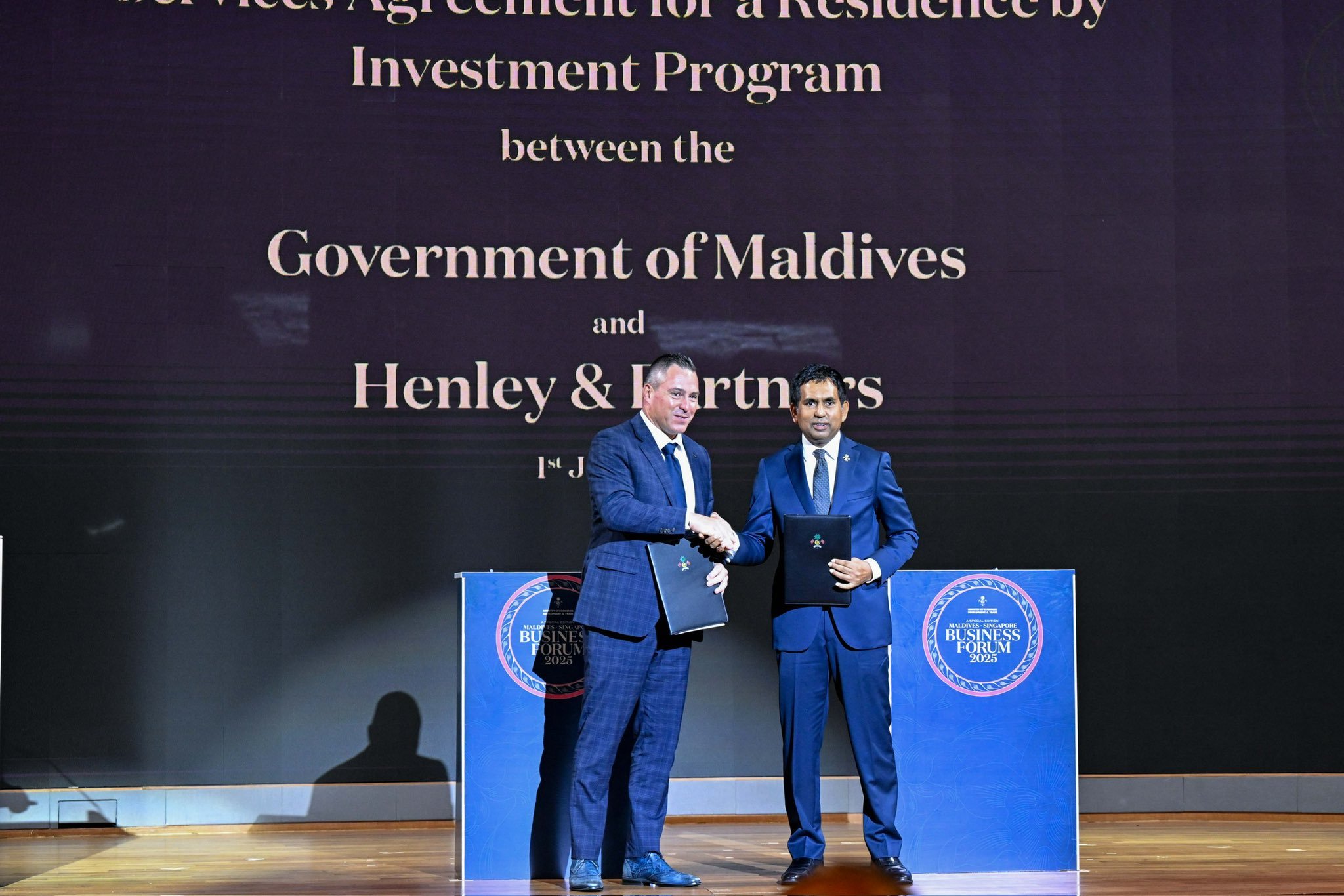
At the Singapore Business Forum in July 2025, the Minister of Economic Development disclosed that long-term residency for foreigners investing in the Maldives would be granted under the ‘Maldives Pearl Residency’ programme, and the Government of Maldives signed a partnership agreement with Henley & Partners to develop and implement the country’s first residency-by-investment programme and to design the visa framework for land-purchasing investors.
Regulatory authorities in the United States and Canada have raised concerns that citizenship-by-investment programmes of the kind Henley operates can be exploited by criminals as vehicles for illicit trade and money laundering. Henley is a company with a dark history of waiting for the moment when financially distressed countries and small island states are at their weakest to introduce such programmes. It is enough to look at what this business delivered to other countries to foresee, with some clarity, the trajectory of the Maldives’ ‘Pearl Residency’.
Under its agreement with the Government of St Kitts and Nevis, Henley & Partners played a central role in establishing the Sugar Industry Diversification Foundation, which was financed through the country’s citizenship-by-investment programme. According to an OCCRP investigation, two of the fund’s most prominent failed investments had links to an associate of Henley’s chairman. OCCRP further alleged that the chairman offered the opposition strategic assistance and access to investors during an election campaign, apparently seeking to preserve the programme’s favourable arrangements if the opposition candidate won. Henley and its chairman denied wrongdoing. Although a parliamentary committee recommended further investigation, no criminal investigation directly targeting the company followed.
Malta’s Individual Investor Programme, for which Henley & Partners served as concessionaire, also faced legal action by the European Commission in 2020. The Commission argued that granting EU citizenship in return for predetermined payments or investments, without requiring a genuine connection to the country, undermined the principle of sincere cooperation and the integrity of EU citizenship. Cyprus provides an even stronger warning. Its investor-citizenship scheme, introduced in 2007, was substantially expanded after the 2013 financial crisis to attract foreign capital, much of it through property investment. Weak oversight and rapid approvals subsequently exposed the programme to serious allegations of corruption, abuse and inadequate due diligence.
In October 2020, Al Jazeera published undercover footage showing senior Cypriot political figures, including the Speaker of Parliament, appearing willing to assist a fictitious investor with a criminal conviction in obtaining citizenship. The Government abolished the programme with effect from November 2020. A subsequent official inquiry found that approximately 51% of the citizenship examined had been granted unlawfully, not necessarily without any background check, as previously stated. Cyprus has since continued to review cases and revoke citizenships granted to applicants who were ineligible or failed to satisfy the programme’s requirements.
Latvia’s programme, launched in 2010, bears the same company’s fingerprints. Latvia’s failure was not a matter of rising housing prices; it was the question of who was buying the land. In the programme’s early years, it was Russian nationals who were purchasing property and gaining control, and the domestic and international problems this created forced the recognition that selling residency tied to land is not merely an economic transaction; it is a grave threat to national security, akin to ceding parts of the nation’s territory to the citizens of a hostile power. Finally, on 11 June 2026, Latvia’s parliament voted to abolish the route of granting visas through real estate sales under the programme.
Portugal, Spain, and Greece launched their golden visas after financial crisis without Henley’s involvement. But the company became one of the largest parties that ranked those programmes and advertised them to the world’s wealthy. All three programmes nevertheless met the same fate. Portugal abolished the real-estate visa route in October 2023; Spain declared that housing is a right of the people rather than a commodity for commercial profit and shut down its entire programme in April 2025; and Greece was forced to raise its minimum investment threshold severalfold to limit the damage inflicted on basic housing.
Henley & Partners and the Israeli Market
While Henley & Partners maintains a dedicated investment platform in the Hebrew language, the joint statement issued by the Government of Maldives and Henley on the ‘Pearl Residency’ programme launched after the Government’s own decision to bar Israeli passport holders from entering the Maldives was distributed through PR Newswire’s Israel regional platform. This is evident from the statement’s inclusion of Israel’s regional code and the country-specific contact channels embedded in it.
While these facts do not, at this point, directly prove that Israeli citizens will receive Maldivian residency, in the Greek programme that Henley marketed, Israeli citizens became the fastest-growing group of investors. And on Henley’s Israel edition and Hebrew-language platform, the ‘Maldives Pearl Residency’ has been marketed directly to that market. Even though Israeli passport holders are barred from entering the Maldives under the Immigration Act, and even though they fail the eligibility criteria of the Foreign Investment Act itself, in the shadow of the Maldives’ Companies Act there remains room for such matters to be arranged from behind the curtain of the law. Given this company’s long record of bringing into its business parties barred even in the advanced countries of Europe, the fear that such a path could open through the Maldives’ weak administrative arrangements is acute.
Protecting Future Generations from the Mistakes of Today
Although the Maldives’ financial position is fragile, the country’s difficulties are not beyond the reach of prudent, transparent and honest decision-making. Yet recent legislative changes and public statements by government leaders indicate a clear intention to link long-term residency with investment in Maldivian real estate. This direction requires the highest level of parliamentary scrutiny and public accountability particularly when laws are being amended to facilitate it.
At a time of severe foreign-currency pressure, transferring long-term economic rights and effective control over scarce land to foreign investors in return for short-term financial relief carries consequences that may be difficult, or even impossible, to reverse. The Maldives has only about 298 square kilometres of natural land. Our land is not merely a commercial asset: it is inseparable from national sovereignty, housing security, social stability and the independence of future generations.
Foreign investment can contribute to economic development, but it must operate within a transparent legal and financial framework that protects the enduring interests of Maldivians. Until such safeguards are established, including parliamentary oversight, public disclosure, strict limits on land rights and protection of affordable housing, the State must not exchange long-term control over Maldivian land for a temporary inflow of foreign currency. A financial crisis may eventually be overcome; land committed on unfavourable terms may never be recovered.