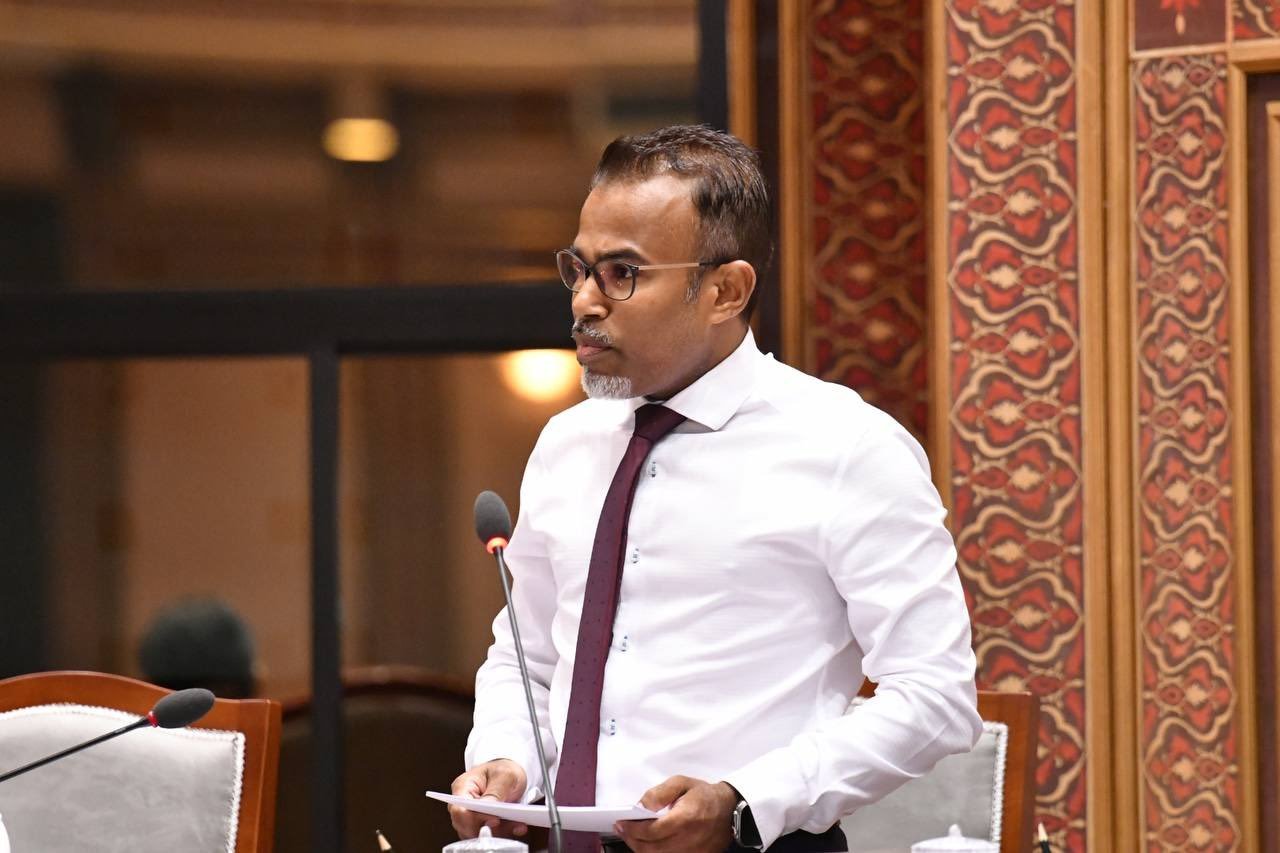
A no-confidence motion against a cabinet minister cannot be filed without a legal reason at the discretion of the parliament speaker and MPs, attorney general Ibrahim Riffath said on Monday.
Defending himself in response to a no-confidence motion filed over the boundary dispute where the country's southern exclusive economic zone (EEZ) was determined, Riffath said a legal reason must be shown to submit a no-confidence motion. The opinion of the speaker and MPs is not a reason, he said.
"Article 101(a) of the constitution states that a no-confidence motion cannot be submitted without stating the reason. What the parliament speaker's and 13 MPs' heart sees about how I advocated is not a reason referred to in the constitution," the attorney general said.
Instead of allowing Riffath the opportunity to speak in his defence, MPs took an unusual number of points of order. The speaker interrupted Riffath each time and allowed the points of order.
Speaking during one of his opportunities, Riffath said he was trying to continue in line accordance with the procedure. He was not summoned under the procedure for questioning ministers, he said.
"Honourable speaker, I am trying to present my defence as granted by the constitution over the no-confidence motion filed against me under article 101 of the constitution. This is not, in any case, the procedure for questioning ministers under article 98 of the constitution," he said.
Speaker Mohamed Nasheed immediately responded and told the attorney general to proceed as instructed.
"Honourable attorney general, I am the one who maintains the procedure here. It is the speaker of parliament who would know how to carry out the parliament's procedure. Therefore, I urge the attorney general to proceed in accordance with the procedure maintained by this parliament's chair," Nasheed said.
Riffath continued speaking in his defence without objecting to what Nasheed said.
"Honourable speaker, I am trying to do this in accordance with parliament's rules," the attorney general said, resuming his defence.
In the short time that he was allowed to speak, Riffath said he served the highest interest of the state in the maritime boundary demarcation and accused previous administrations of negligence.
"No previous government dared to make a decision on behalf of Maldivians. I note that what was done, unintentionally or not, was to have been extremely negligent," Riffath said.
Riffath also addressed the opposition's allegations about a hidden agenda and secret deals behind the territorial dispute.
"I assure the Maldivian people that the government has no intention or interest in hiding anything in this case," the attorney general said, accusing the opposition of misleading the public for political gain.
"I am saying repeatedly that it was the Maldives that won the [International Tribunal of the Law of the Sea] case. They are [misleading] for political purposes in a matter as clear as daylight."