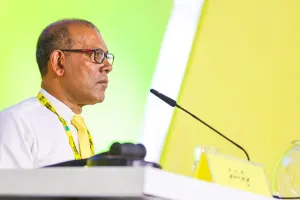
Maldivian society is not yet ready to transition to an electronic voting (e-voting) system, and public awareness efforts are required before such a move can be made, Elections Commission (EC) President Mohamed Shakeel has said.
In an interview with PSM News, Shakeel noted that the main obstacle to implementing e-voting is the lack of public awareness regarding such systems.
"Given the current state of our society, we are not yet ready to transition to e-voting," said Shakeel, who assumed the presidency of the EC after previously serving as the Secretary General of the ruling party.
He observed that public discourse surrounding such systems remains inconsistent, noting that there are particular concerns and allegations regarding the potential for electoral fraud.
"We cannot move toward an e-voting system until the public is properly educated and provided with factual information on how these systems actually operate," he added.
Shakeel further noted that there are no inherent legal barriers to implementing e-voting, as it could be facilitated through legislative amendments.
"However, since this is a matter of public interest, it would not be the right decision to move to e-voting until the public is sensitized and demonstrates readiness for the change," Shakeel said.
The opposition Maldivian Democratic Party (MDP) has recently alleged that the "Maldives 2.0 Digital Transformation Bill"—which proposes granting extensive legal powers to "Maldives Digital Service" under the Ministry of Homeland Security to manage state data and personal information—is intended to pave the way for an e-voting system in the Maldives.