Battles were raging in Gaza early on Saturday, as Israel expanded its ground operations and cut communications to the Palestinian territory.
The United Nations warned of a looming “unprecedented avalanche of human suffering” inside the Gaza Strip, following weeks of relentless bombing by Israel, while the General Assembly pushed for an “immediate humanitarian truce”.
“We are confronting an Israeli ground incursion in Beit Hanoun (in the northern Gaza Strip) and east Bureij (in the centre) and violent engagements are taking place on the ground,” Hamas’s armed wing the Ezzedine al-Qassam Brigades said in a statement.
Israeli military spokesman Major Nir Dinar told AFP: “Our troops are operating inside Gaza as they did yesterday.”
With tens of thousands of troops massed along the Gaza border ahead of an expected full-blown invasion, Israeli forces also made limited ground incursions on Wednesday and Thursday nights.
“Following the series of strikes of the last days, the ground forces are extending the ground operations tonight,” military spokesman Daniel Hagari told reporters Friday.
Israel’s military also said it had increased its strikes “in a very significant way”, while the Ezzedine al-Qassam Brigades said on Telegram it responded with “salvos of rockets”.
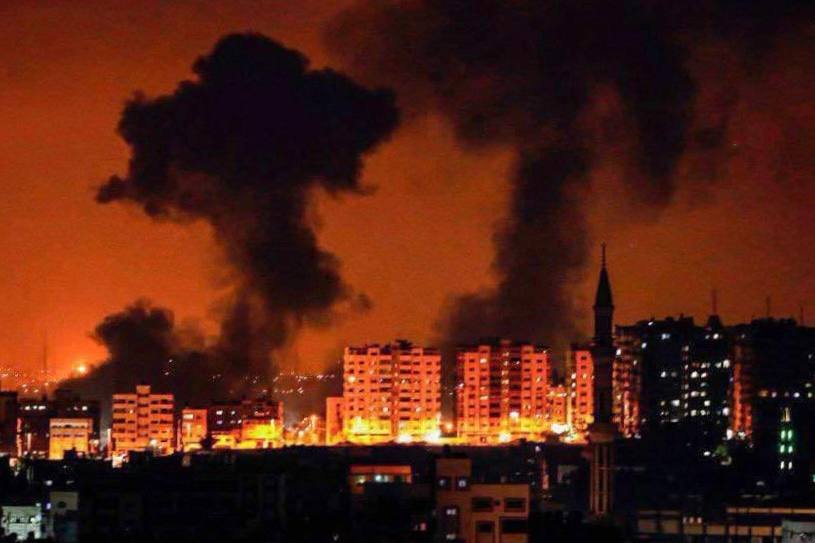
AFP live footage late Friday showed air strike after air strike light up the night sky of northern Gaza as thick black smoke clouded the horizon.
In a bombed-out street in the Tal al-Hawa neighborhood, 50-year-old Om Walid Basal asked why her apartment block had been bombed by Israel.
“This was our house, we lived here just with our children, it was full of children,” she said.
“Why are they bombing us? Why are they destroying our homes?”
Israel launched its bombardment of Gaza after Palestinian fighters stormed across the fence on October 7, killing 1,400 people, mostly civilians, and kidnapping over 220 others, according to Israeli officials.
The Gaza health ministry said Friday that Israeli strikes on Gaza had now killed 7,326 people, more than 3,000 of them children.
Hamas earlier said it was “ready” for an invasion.
“If (Prime Minister Benjamin) Netanyahu decides to enter Gaza tonight, the resistance is ready,” Ezzat al-Rishaq, a senior member of the Hamas political bureau, said on Telegram.
“The remains of his soldiers will be swallowed up by the land of Gaza.”
Hamas said all internet connections and communications across Gaza had been cut, and accused Israel of taking the measure “to perpetrate massacres with bloody retaliatory strikes from the air, land and sea”.
Human Rights Watch also warned that the near-total telecommunications blackout in Gaza risks providing cover for “mass atrocities”.
The Palestinian Red Crescent meanwhile said ambulance services had been disrupted.
“We have completely lost contact with the operations room in the Gaza Strip and all our teams operating there,” it said on X, formerly Twitter.
Lynne Hastings, the UN humanitarian coordinator for the occupied Palestinian territory, also said on X that Gaza “has lost contact with the outside world”, cautioning that “hospitals & humanitarian operations can’t continue without communications”.
UN truce call
The reports of ground fighting came after the UN General Assembly called on Friday for an “immediate humanitarian truce” in Gaza.
The nonbinding resolution received overwhelming support and was welcomed by Hamas.
But it was harshly criticized by Israel and the United States for failing to mention Hamas, with Israeli ambassador Gilad Erdan calling it an “infamy”.
Washington earlier said it supports a “humanitarian pause” so aid can get into Gaza.
Israel’s bombardment has displaced more than 1.4 million people inside the crowded territory, even as supplies of food, water and power to Gaza have been almost completely cut off.
And Israel has blocked all deliveries of fuel, saying it would be exploited by Hamas to manufacture weapons and explosives.
UN Secretary-General Antonio Guterres warned that misery was “growing by the minute”.
“I repeat my call for a humanitarian ceasefire, the unconditional release of all hostages, and the delivery of life-saving supplies,” Guterres said in a statement.
“Without a fundamental change, the people of Gaza will face an unprecedented avalanche of human suffering.”
Jordan’s foreign minister warned on X that an Israeli ground invasion of Gaza would spell a “catastrophe of epic proportions” for the territory for years to come.
The UN agency for Palestinian refugees, UNRWA, has cautioned that “many more will die” in Gaza from catastrophic shortages.
“People in Gaza are dying, they are not only dying from bombs and strikes, soon many more will die from the consequences of (the) siege,” said Philippe Lazzarini, chief of the UN agency for Palestinian refugees (UNRWA).
A first tranche of critically needed aid was allowed in last weekend, but only 74 trucks have crossed since then. The UN says an average of 500 trucks entered Gaza every day before the conflict.
“These few trucks are nothing more than crumbs that will not make a difference,” Lazzarini said.
A first team of six medics from the International Committee of the Red Cross entered Gaza Friday via its Rafah crossing with Egypt, along with six aid trucks, the ICRC said.
Between the bombardments and the fuel shortages, 12 of Gaza’s 35 hospitals have been forced to close, and UNRWA said it has had to “significantly reduce its operations”.
Israel’s military accused Hamas of using hospitals in Gaza as operations centres for directing attacks, an allegation Hamas swiftly denied.
Violence has also risen sharply in the occupied West Bank since the October 7 attacks, with more than 100 Palestinians killed and over 1,900 wounded.
This story was produced by AFP.