Education minister Dr. Aishath Ali said on Tuesday that all secondary students in the Maldives were required to study five subjects starting in 2020 and the pass rate has appeared low because the results of some students were previously omitted in preparing statistics.
The education ministry faced criticism from the public following reports that the pass rate among students who sat for five subjects in the O'Level examinations last year was below 50 percent. Successfully completing the O'Levels is counted as passing five compulsory subjects.
Prior to 2019, the education ministry counted students in the Dhasvaaru program with three passes and students in the BTEC program with four passes in calculating the pass rate. Both programs offered work training and vocational training to academically challenged students.
Dhasvaaru students were allowed to choose two subjects from O'Level and SSE subjects. BTEC students were required to choose one subject. They could drop the rest of the subjects.
"So what we saw was not a true representation. Students were off-rolled to calculate those who passed in five subjects. That is, students who were seen as unlikely to pass were set aside and students who would pass were included in the calculation to prepare statistics," Aishath said in response to a question from an MP.
As a result, the number of students who passed five subjects previously appeared high. But the current administration made changes in 2020.
"Only children in very severe cases were allowed the opportunity to drop [subjects] after I review it. So almost all children do five subjects," she said.
As only half of the students who sat exams passed Math and English before 2020, special programs were started to solve the problem, the education minister said. The programs have now started producing results, she noted.
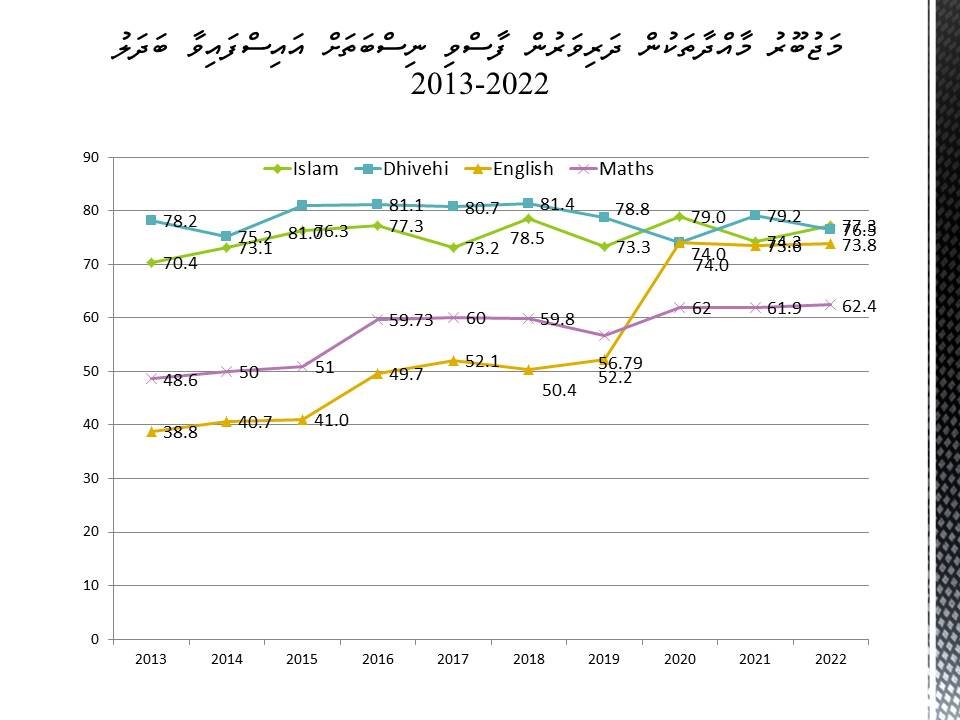
Pass rate in math, Dhivehi, English and Islam subjects.
As academic capability is mainly based on literacy and numeracy, the true results of a student could not be appraised without the core subjects, the education ministry previously said. As such, with effect in 2020, Islam, Dhivehi, English, Math and one more subject taught at school were made compulsory.
The change was made as part of an inclusive policy because literacy and numeracy are essential for learning, the education ministry said. The true results of students have been reflected in statistics since then, the ministry said.
The ministry noted that the number of students in the national top 10 has increased significantly in the past two years with 13 percent of students who completed secondary education in the 2021-2022 academic year finishing among the top 10.
More than 60 percent of students passed the elective subjects, according to statistics shared by the ministry.
In the business stream, more than 75 percent of students passed for the first time last year. While 80 percent of students passed in the arts and science streams, the results showed an improvement in the science subjects compared to previous years, the education ministry said.